

how fine dining in jail is helping prisoners and satisfying customers
- Written by: The Conversation
Prison food and fine dining aren’t usually mentioned together. But various initiatives around the world are changing that, with restaurants located within jails offering both culinary satisfaction and opportunities for positive social change.
Prison catering and dining programs aim to tackle re-offending and recidivism by offering inmates training and practical experience before they finish their sentences and re-enter society.
The success of various restaurants based in minimum- or medium-security prisons, including The Clink[1] restaurants in the UK, the InGalera[2] restaurant in Italy and INTERNO[3] in Colombia, suggests a definite trend toward this form of responsible, socially conscious hospitality.
Britain’s Clink Charity operates four restaurants in working prisons in Brixton[4], Cardiff[5], High Down[6] and Styal[7]. All are registered catering colleges. Despite the security measures and no alcohol on the menu, we found these restaurants offer a dining experience comparable to any modern, stylish, fine dining establishment.
Brixton prison’s Clink restaurant consistently ranks[8] in Tripadvisor’s top ten restaurants in London. The charity itself has received more than 60 awards since its first restaurant opened in 2009.
A hit with diners
The differences between conventional fine dining establishments and prison restaurants are obvious. But changing public perceptions of prisoners through prison dining programs is key to their wider rehabilitation.
The restaurants are usually staffed by prisoners with six to 18 months left on their sentences. They have completed restorative courses and are lower risk or chosen for their good behaviour.
Analysis of 3,951 Tripadvisor customer reviews of the four Clink restaurants shows diners reported great meals and professional and memorable experiences. They also appreciated the charity’s inspiring ethos. Comments include:
It is not every day that you get to dine in a category C prison, but I can strongly recommend it. A great concept where training and rehabilitation are the key drivers here — they deliver excellent quality food in a relatively relaxed environment. Well worth supporting.
Rehabilitation — new chances — go for it. Feelgood experience while enjoying superbly cooked and presented food. Great value. And it’s not just about supporting a good cause, you will appreciate the quality as well.
Although these restaurants lie within the walls of a prison, customers noted the warm welcome and the relaxed and friendly atmosphere during their visits, despite the initial security checks (including having to leave their phones and laptops outside).
Importantly, the prisoners staffing the restaurants came to be viewed less as inmates and more as trainee hospitality employees capable of delivering outstanding service.
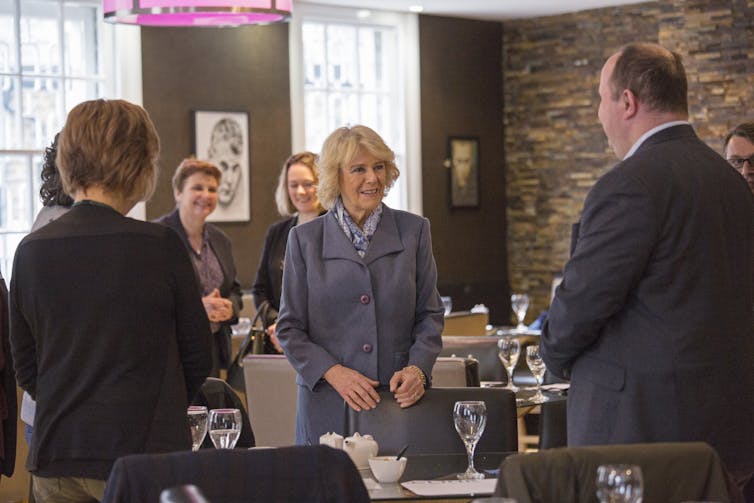 The Duchess of Cornwall visits Brixton Prison’s Clink restaurant and kitchen in 2016.
GettyImages
The Duchess of Cornwall visits Brixton Prison’s Clink restaurant and kitchen in 2016.
GettyImages
Reducing reoffending
Gaining formal qualifications and training in prison restaurants, as well as having mentoring and support on their release, provides offenders with valuable skills, confidence, dignity and a work ethic that helps them on the outside.
Prison restaurant initiatives also help reduce recidivism. The Clink training programs — based on five stages from recruitment, training, in-prison support to employment and post-prison mentoring — have reduced the chance of a Clink graduate reoffending by 65.6%.
As Clink CEO Christopher Moore has explained:
The key to the success of The Clink Charity is that we are one of the only organisations to deliver a five-step integrated model, both sides of the wall.
A solution for New Zealand
Adopting the successful hospitality training model demonstrated by The Clink Charity should be considered for New Zealand. Our imprisonment rate is high[9] by developed world standards, with a re-offending rate over 50%.
The low numeracy and literacy skills among New Zealand’s prisoner population, as well as general substance abuse and mental health issues, suggest an urgent need for innovative solutions to reoffending and reincarceration rates. It is widely accepted that education reduces recidivism rates.
Adding prison dining programs would build on existing opportunities for inmates. In 2018, 2,017 New Zealand prisoners gained 3,003 qualifications. Hospitality qualifications are offered in 13 New Zealand prisons[10], but there are few genuine equivalents to the Clink model beyond Rimutaka Prison[11]’s participation in the Wellington on a Plate festival, and the Auckland Region Women’s Correction Facility cafe[12].
Creating change will be difficult, but prison dining programs have demonstrated success in increasing prisoners’ skills, social support and meaningful employment in the hospitality industry after release.
Furthermore, such programs provide restaurant goers with an opportunity to contribute to meaningful change and help break down stereotypes that hold former prisoners back from making a successful transition from cell to society.
References
- ^ The Clink (theclinkcharity.org)
- ^ InGalera (www.ingalera.it)
- ^ INTERNO (restauranteinterno.com)
- ^ Brixton (theclinkcharity.org)
- ^ Cardiff (theclinkcharity.org)
- ^ High Down (theclinkcharity.org)
- ^ Styal (theclinkcharity.org)
- ^ consistently ranks (www.tripadvisor.co.nz)
- ^ imprisonment rate is high (www.corrections.govt.nz)
- ^ 13 New Zealand prisons (www.corrections.govt.nz)
- ^ Rimutaka Prison (www.visawoap.com)
- ^ cafe (www.corrections.govt.nz)