

Can governments mandate a COVID vaccination? Balancing public health with human rights – and what the law says
- Written by: The Conversation
Earlier in 2020, Prime Minister Scott Morrison said he expected the COVID-19 vaccine to be mandatory. He later backtracked, noting[1] the government “can’t hold someone down and make them take it”.
But should it be able to mandate vaccination in the interests of public health?
Some argue[2] mandatory vaccination can be justified on ethical grounds and recommend penalties for non-compliance – or even payment for compliance. It is clear the Australian government will do whatever it can to encourage widespread vaccination. It anticipates the vaccine will be rolled out in Australia from March 2021[3].
This is also sparking debate about liability should anything go wrong[4].
Meanwhile, Qantas CEO Alan Joyce signalled vaccination is likely to be compulsory[5] for international travel with the airline. Flight Centre and others have joined the call for “vaccine passports[6]” as the means to re-establish international travel in a COVID-safe way.
Since the beginning[7] of the COVID-19 pandemic, public health initiatives have continued[8] to raise questions regarding the appropriate balance between community interests and individual rights.
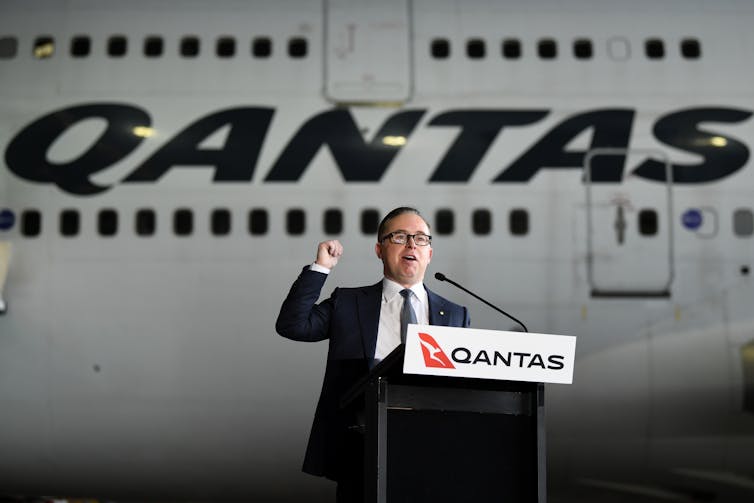 Alan Joyce has indicated a COVID-19 vaccination will be required of passengers wanting to board international flights.
Joel Carrett/AAP
Alan Joyce has indicated a COVID-19 vaccination will be required of passengers wanting to board international flights.
Joel Carrett/AAP
Can governments mandate vaccination?
The position of governments at national or state and territory level is nuanced.
Public authorities have the ability to implement policies that make vaccination mandatory for discrete purposes[9]. For example, the Commonwealth “No Jab No Pay” policy makes eligibility for certain social security payments dependent upon vaccination. State-based “No Jab No Play[10]” policies limit access to childcare services.
These policies allow for a limited number of approved exemptions[11] at the national level, with some variation at state level.
Government may legitimately pursue such policies for public health reasons, and may do so in rolling out a COVID-19 vaccine. Governments cannot force vaccination on individuals who chose to refuse it, as acknowledged in the Australian COVID-19 Vaccination Policy[12]. However, they can effectively punish people for refusal – as with “No Jab No Pay” – with incentives for vaccination then working as forms of compulsion.
Read more: We may have to accept a 'good enough' COVID-19 vaccine, at least in 2021[13]
It is also important to distinguish between individual healthcare and public health. In Australia, informed consent, whether express or implied, is an essential pre-requisite of individual healthcare treatment[14]. Administering medical treatment in the absence of informed consent exposes healthcare professionals to both civil and criminal liability. The requirement of informed consent protects an individual’s right to bodily integrity.
The exception is in situations of emergency, when doctors can provide treatment in the absence of consent. There is no general definition of emergency but the treatment must be necessary and not merely convenient. These interventions are limited to situations in which the patient lacks capacity to provide consent[15].
Responsibility for public health primarily lies with the states and territories. In the context of declared public health emergencies, authorities have some coercive powers, including the ability to impose vaccinations. For example, section 157(1)(j) of WA’s Public Health Act[16] 2016 allows the chief health officer (or a delegate) to “direct any person to undergo medical observation, medical examination or medical treatment or to be vaccinated” during a state of emergency[17].
However, this power relates to individual cases and cannot form the basis of a blanket policy.
Requirements of reasonableness are also built in to ensure such a provision is not used arbitrarily[18].
The situation is different when it comes to international travellers, as stated in the Australian COVID-19 Vaccination Policy[19]. This policy contemplates the introduction of “border entry or re-entry requirements that are conditional on proof of vaccination”.
What about employers and businesses?
An additional layer of vaccine compulsion is likely to operate in certain industries. Employers may compel COVID-19 vaccinations where employees are working with vulnerable people. For example, health and aged-care workers may be obliged to be vaccinated as a condition of employment. Such requirements would need to be both lawful and reasonable[20], and would withstand legal challenge.
The idea of a “vaccine passport[21]” as a requirement for international travel is less legally controversial than it might sound. Airlines and other travel organisations already have detailed conditions of carriage[22]. These permit the refusal of passengers in specific circumstances.
Of course, some passengers may refuse to fly if they do not wish to vaccinate themselves against COVID-19. From the perspective of the airlines, this is a business risk that appears insignificant in comparison to the massive damage[23] the pandemic has done to the international travel market.
 The idea of a ‘vaccine passport’ for international travellers is not as controversial as it might sound.
Shutterstock
The idea of a ‘vaccine passport’ for international travellers is not as controversial as it might sound.
Shutterstock
What about our human rights?
Travel bans, social distancing, quarantine, restrictions on gatherings, contact tracing and many other COVID-related measures adopted around the world have breached or constrained human rights. These rights include freedom of movement and association, the right to education, the right to work and the right to privacy.
These steps were taken to protect the most fundamental of our human rights: the right to life[24]. They also protect our right to health[25].
In particular, pandemic restrictions have protected vulnerable members of society. These groups will also be prioritised[26] when the vaccine is rolled out.
International human rights law allows for some restrictions on rights in certain circumstances, such as a state of emergency, and for public health reasons. These restrictions are subject to strict tests of necessity and proportionality[27].
Similarly, the Victorian Charter of Rights and Responsibilities[28] allows for some limitations to rights.
Rights are generally not absolute. The COVID-19 pandemic has provided many instances where constraints on individual rights and freedoms have been presented as justified in order to meet the public health goal.
None of this means we should ignore the significant human rights implications of these measures. Early in the pandemic’s global transmission, the World Health Organisation director-general said[29]:
All countries must strike a fine balance between protecting health, minimising economic and social disruption, and respecting human rights.
Unfortunately, a lack of human rights infrastructure in Australia complicates efforts to achieve balance between rights claims. Australia remains an outlier among Western democracies given its lack of a federal bill or charter of rights. Limitation and balancing provisions are set out in the subnational human rights laws of Victoria, the ACT and Queensland.
At a national level, all new federal bills and legislative instruments must have a statement of compatibility with international human rights law under the Human Rights (Parliamentary Scrutiny) Act 2011[30]. The act applies at a federal level only and covers only “disallowable” instruments that can be repealed. As a result, some measures introduced due to COVID-19 have not been subject to scrutiny[31].
Read more: COVID-19, risk and rights: the 'wicked' balancing act for governments[32]
Australia is undoubtedly fortunate in terms of its exposure to the pandemic. However, we are under-resourced in legal terms to debate where balances can be struck between individual freedoms and the collective interest in public health.
As the pandemic and its effects on individuals and communities continue to evolve, policymakers must ensure human rights scrutiny of restrictive measures. Such engagement can build support for interventions based on scientific evidence.
References
- ^ noting (www.abc.net.au)
- ^ argue (jme.bmj.com)
- ^ March 2021 (www.abc.net.au)
- ^ should anything go wrong (theconversation.com)
- ^ compulsory (www.abc.net.au)
- ^ vaccine passports (www.theage.com.au)
- ^ beginning (theconversation.com)
- ^ continued (journals.sagepub.com)
- ^ policies that make vaccination mandatory for discrete purposes (www.ncirs.org.au)
- ^ No Jab No Play (www2.health.vic.gov.au)
- ^ limited number of approved exemptions (guides.dss.gov.au)
- ^ Australian COVID-19 Vaccination Policy (www.health.gov.au)
- ^ We may have to accept a 'good enough' COVID-19 vaccine, at least in 2021 (theconversation.com)
- ^ pre-requisite of individual healthcare treatment (www.healthlawcentral.com)
- ^ lacks capacity to provide consent (www.alrc.gov.au)
- ^ Public Health Act (www.legislation.wa.gov.au)
- ^ state of emergency (www.legislation.wa.gov.au)
- ^ provision is not used arbitrarily (www.abc.net.au)
- ^ Australian COVID-19 Vaccination Policy (www.health.gov.au)
- ^ lawful and reasonable (www.dsalaw.com.au)
- ^ vaccine passport (www.axios.com)
- ^ conditions of carriage (www.qantas.com)
- ^ massive damage (www.oliverwyman.com)
- ^ right to life (humanrights.gov.au)
- ^ right to health (www.ag.gov.au)
- ^ prioritised (www.health.gov.au)
- ^ necessity and proportionality (undocs.org)
- ^ Victorian Charter of Rights and Responsibilities (www.legislation.vic.gov.au)
- ^ said (www.who.int)
- ^ Human Rights (Parliamentary Scrutiny) Act 2011 (www.legislation.gov.au)
- ^ have not been subject to scrutiny (verfassungsblog.de)
- ^ COVID-19, risk and rights: the 'wicked' balancing act for governments (theconversation.com)