

Government set for quick passage of bill to facilitate CFMMEU breakup, with Labor support
- Written by: The Conversation
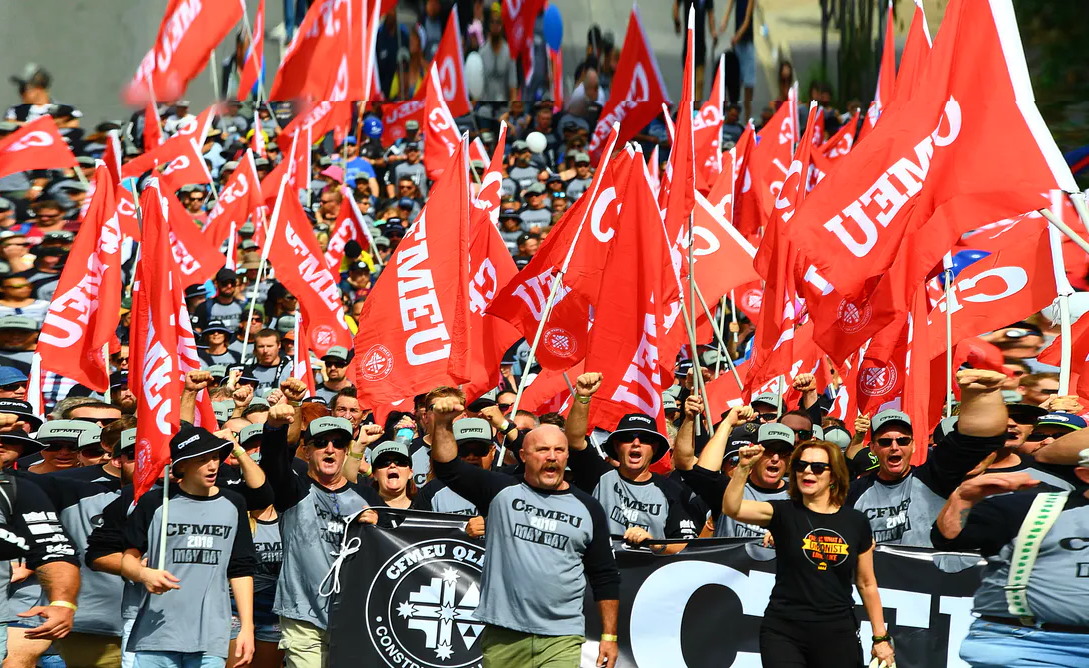
The government is set to rush through parliament this week its legislation enabling parts of the militant Construction, Forestry, Maritime, Mining And Energy Union to break away.
Labor on Monday night was ready to support the legislation – aimed at construction heavyweight John Setka and his allies, who have created havoc internally as well as industrially and brought the mega union into disrepute.
The legislation would allow the mining and energy division, led by Tony Maher, to leave the union, and follows negotiations between Maher and Industrial Relations Minister Christian Porter.
Maher recently resigned as national president of the CFMMEU, and Michael O'Connor, the head of the manufacturing division, quit as national secretary, amid bitter infighting.
The bill is due to be introduced on Wednesday. Labor’s position was discussed in shadow cabinet on Monday night and will go to caucus on Tuesday.
Opposition leader Anthony Albanese some time ago forced Setka out of the ALP.
The legislation, which allows demergers to take place in a union after the present cut off time of five years, would enable a proposal to split away to be put to vote of members of the mining division. The manufacturing division might also leave.
Passage of the legislation would culminate years of the Coalition trying to curb the construction union.
Maher said in a message to his division’s members on Monday that if the legislation passed this week, “our officials and lawyers will have a close look at the detail and Central Council will consider whether the question of applying to withdraw from the amalgamated Union should be put to our quadrennial Convention in March 2021.
"If Convention supports making an application to withdraw from amalgamation, then all members will have their say in a national vote.”
Maher said “the purpose of being part of an amalgamated union should be to give workers a bigger voice and more power. It should provide solidarity and strength in numbers to achieve better outcomes for members.
"However, over the past couple of years solidarity has been replaced by self-interest and strength in numbers has been replaced by hostile number-crunching.
"The Construction Division has made it clear that they will use their numbers to steamroll smaller divisions, force decisions in their favour and run the CFMMEU as a construction union,” Maher said.
CRIMINAL PENALTY FOR WAGE THEFT
Meanwhile, for the first time, employers committing “egregious” wage theft would face the threat of federal criminal charges, under the Morrison government’s proposed industrial relations omnibus legislation to be introduced on Wednesday.
This is separate legislation from the demerger bill, and won’t be dealt with until next year.
The maximum penalty would be $1.11million or four years imprisonment, or both, for individuals and $5.55 million for a company.
But it is clear the application of the criminal penalty would be very rare. The government says the offence would apply where a “national system employer dishonestly engages in a deliberate systematic pattern of underpaying one or more of their employees”.
The offence wouldn’t apply to one-off underpayments, inadvertent mistakes or miscalculations.
ACTU secretary Sally McManus said while the ACTU welcomed any laws that would address wage theft, the bar the government proposed was too high.
“It is unlikely any employer will ever be caught and it will wipe out stronger and better laws in Queensland, Victoria and the ACT,” McManus said.
For less serious cases, the legislation would increase the present civil penalties.
For most wage underpayments, the maximum penalty would rise by 50%. This will take it from $13,320 to $19,980 for an individual. and from $66,600 to $99,900 for a body corporate including small businesses.
For larger businesses, maximum penalties would be based on the higher of either twice the benefit obtained or $99,900.
Penalties for “serious” wage underpayments by bigger businesses would be based on the higher of either three times the benefit obtained or $666,600.
Porter said that “overwhelmingly there was a view amongst the business groups that there shouldn’t be a criminal offence of wage theft at all”. But he stressed the criminal offence was different from “inadvertent underpayment”.
Asked on Sky whether he could give examples of instances that would meet the criminal threshold, Porter could not.
But he did point to the 7-Eleven scandal as “the most egregious and blameworthy example of the underpayment scenario”.
The Fair Work Ombudsman reported in October: “Between September 2015 and February 2020, 7-Eleven Stores Pty Ltd have back-paid $173,610,752 in wages, interest and superannuation to 4,043 current and former franchisee employees.”
The FWC said it had “brought 11 litigations against 7-Eleven franchisees resulting in courts awarding more than $1.8 million in penalties against them, including for operating unlawful cash-back schemes, paying unlawful flat rates to workers, and falsifying records”.
The Australian Industry Group said it opposed criminal penalties for wage underpayments but if the legislation was to include them they must be fair and balanced, applying only to “deliberate, dishonest and serious conduct”.