



3 practical ways New Zealand could help with the Israel-Palestine conflict from afar
- Written by: Alexander Gillespie, Professor of Law, University of Waikato
Last week’s ceasefire in Gaza is holding[1], but if history is any guide this will not be the last time the Israel-Palestine conflict flares up. In the past 12 years, Israel and Hamas have clashed seriously four times.
May’s 11 days of violence[2] took the lives of at least 243 people in Gaza, including more than 100 women and children, and 12 in Israel, including two children. Both sides have claimed victory[3], and both accuse the other of crimes and intolerable actions.
Witnessed from afar, this seemingly endless cycle of violence can seem hopeless. Nonetheless, we need to ask how New Zealand can best respond.
So far, the foreign minister has made the right calls, denouncing the violence[4] and its underlying causes, namely the evictions[5] in East Jerusalem. The prime minister added her voice to calls for a ceasefire[6], at the same time recognising the disproportionate nature of the conflict.
The problem is, none of these words will make any difference. Neither of the main belligerents listen to us. So, if New Zealand genuinely wants to contribute, there are three practical steps it should take.
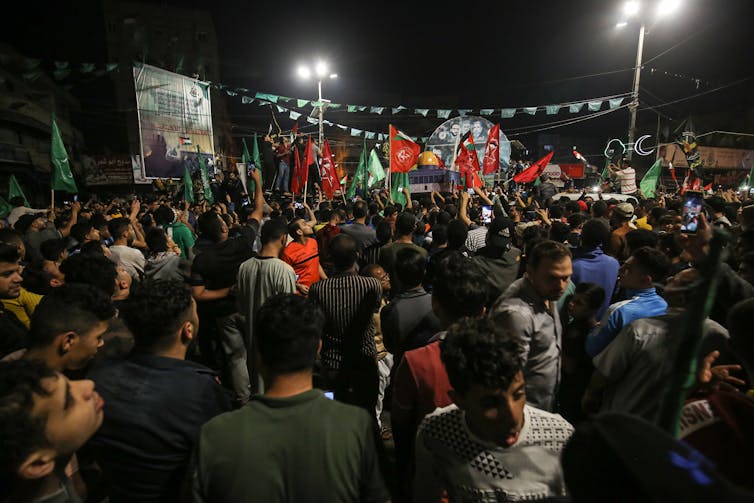 Celebration in Gaza following a ceasefire brokered by Egypt between Israel and Hamas on May 21, 2021.
www.shutterstock.com
Celebration in Gaza following a ceasefire brokered by Egypt between Israel and Hamas on May 21, 2021.
www.shutterstock.com
Call for a proper inquiry
At the global level, New Zealand should call for an independent inquiry, in accordance with existing obligations under international law, to set the record straight on exactly what happened during the most recent violence and whether any rules were broken.
This is not a new idea. Following the violent outbreaks in 2009[7] and 2014[8] there were thorough investigations of war crimes or crimes against humanity.
Read more: Israel-Palestine conflict: why Gulf leaders are staying quiet – for now[9]
One possible advance, however, would be to push for such an inquiry under the auspices of the International Criminal Court (ICC[10]) to ensure an impartial and independent examination of what has just occurred.
Given Israel has vowed not to cooperate[11] with a proposed[12] ICC investigation, this won’t be easy. But it would still be positive for New Zealand to publicly advocate for a multilateral, rules-based response.
Be consistent on human rights
New Zealand also needs to treat assertions of serious human rights violations consistently.
This means parliament should debate alleged behaviour by Israel and the Palestinian authorities in Gaza and the West Bank in the same way it debated and passed a resolution[13] about China’s treatment of its Uyghur population.
On the one hand, parliament needs to consider the widest and most serious allegation[14] that Israel is practicing a form of apartheid in the territories it controls. It must also address long-standing concerns about the continued illegal annexation of territory[15] in the West Bank, as well as the blockade of Gaza by Israel and Egypt and its extreme economic[16] and humanitarian[17] costs.
Read more: Israeli politics and the Palestine question: everything you need to know[18]
On the other hand, parliament also has to examine the record[19] of the Palestinian authorities in the West Bank and Hamas in Gaza.
Allegations include the stifling of freedom of expression and assembly, attacking journalists and detaining opponents, unnecessary or excessive force, detention without charge, torture and ill-treatment of detainees, and discrimination and violence against women.
Be clear about a Palestinian state
Finally, New Zealand should clarify its position regarding the recognition of Palestine. With 139 countries[20] currently maintaining diplomatic relations with the State of Palestine, New Zealand is in a global minority that doesn’t officially recognise Palestine’s statehood (in company with the US, Australia and others).
This is despite its original 1947 commitment at the United Nations, when New Zealand, agreed[21] that “independent Arab and Jewish states” be created from the partition of Palestine (with Jerusalem to be given a special international status).
This should have been the foundation of a two-state system[22]. Although this is not how history worked out, many countries, including New Zealand, remain committed to the ideal.
Read more: Israel-Palestine conflict: the role of Hamas and Fatah rivalry in latest violence[23]
After wars in 1948-49, 1967 and 1973 tore the region apart, the Oslo Accords in the 1990s created a Palestinian Authority with limited self-governance in parts of the West Bank and the Gaza Strip.
This pathway for peace foundered when Yasser Arafat died in 2004. Palestinian leadership broke into two, with Hamas in Gaza and Fatah in the West Bank having very different agendas[24], despite various reconciliation attempts.
Seek a pathway to peace
A major sticking point remains that Hamas (or its military wing) is commonly recognised as a terrorist organisation by many western countries[25], including New Zealand[26]. Although its 2017 covenant[27] modified the 1988 version[28] (which called for the “obliteration” of Israel), Hamas’s designation remains, and the 2017 covenant still considers Israel to be ‘entirely illegal’.
Clearly, New Zealand can’t agree to statehood for any proposed country, or part of one, that is closely associated with terrorism.
Accordingly, the government should assess whether that designation is still appropriate. It then needs to explain whether an overall peace settlement is the prerequisite for accepting Palestinian statehood.
Conversely, if parliament decides a comprehensive peace settlement is unlikely in the foreseeable future, it must outline what conditions must be satisfied before New Zealand is willing to accept a fundamental premise: that, in as much as Israel has a right to exist, so too does Palestine.
References
- ^ holding (www.reuters.com)
- ^ 11 days of violence (www.bbc.com)
- ^ claimed victory (www.reuters.com)
- ^ the violence (www.rnz.co.nz)
- ^ the evictions (www.tvnz.co.nz)
- ^ a ceasefire (www.tvnz.co.nz)
- ^ 2009 (newsarchive.ohchr.org)
- ^ 2014 (www.ohchr.org)
- ^ Israel-Palestine conflict: why Gulf leaders are staying quiet – for now (theconversation.com)
- ^ ICC (www.icc-cpi.int)
- ^ not to cooperate (www.bbc.com)
- ^ proposed (www.icc-cpi.int)
- ^ debated and passed a resolution (www.newshub.co.nz)
- ^ serious allegation (www.hrw.org)
- ^ illegal annexation of territory (www.ohchr.org)
- ^ economic (unctad.org)
- ^ humanitarian (news.un.org)
- ^ Israeli politics and the Palestine question: everything you need to know (theconversation.com)
- ^ examine the record (www.amnesty.org)
- ^ 139 countries (palestineun.org)
- ^ agreed (undocs.org)
- ^ two-state system (www.rnz.co.nz)
- ^ Israel-Palestine conflict: the role of Hamas and Fatah rivalry in latest violence (theconversation.com)
- ^ different agendas (theconversation.com)
- ^ western countries (www.state.gov)
- ^ New Zealand (www.police.govt.nz)
- ^ 2017 covenant (www.middleeasteye.net)
- ^ 1988 version (avalon.law.yale.edu)










