Samoa’s first female leader has made history — now she faces a challenging future at home and abroad
- Written by: Patricia A. O'Brien, Visiting Fellow, School of History, Australian National University, and Adjunct Professor, Asian Studies Program, Georgetown University
After nearly four months of being taken to the brink of dictatorship, Samoa’s constitutional crisis ended on July 26 when the prime minister for the past 23 years, Tuilaepa Sa’ilele Malielegaoi, conceded defeat[1].
With the April 9 election loss, the 40-year dominance of Samoan politics by Tuilaepa’s Human Rights Protection Party (HRPP) ended too.
Samoa’s new leader, Fiame Naomi Mata’afa, might be the country’s first female prime minister, but she is a veteran politician. As she attempts to bring her nation out of its greatest test in the 59 years since independence, she will need all the deep experience she brings to the role.
A political dynasty
Fiame was born in 1957 into one of Samoa’s leading chiefly and political families. Her parents were both trailblazers, too. Her father, Mataʻafa Faumuina Mulinuʻu II, served as Samoa’s first prime minister over two terms (1959-1970 and 1973-1975).
When he died in office in 1975, Fiame’s mother, La'ulu Fetauimalemau Mata'afa, represented his constituency of Lotofagu. She was just the second woman to be elected to Samoa’s parliament.
Read more: Samoa's stunning election result: on the verge of a new ruling party for the first time in 40 years[2]
After serving in parliament, La’ulu was appointed Samoa’s consul general to New Zealand in 1989 and then served as Samoa’s high commissioner to New Zealand from 1993 to 1997.
Fiame also has strong ties to New Zealand[3]. From age 11, she attended Marsden College in Wellington before studying political science at Victoria University, graduating in 1979.
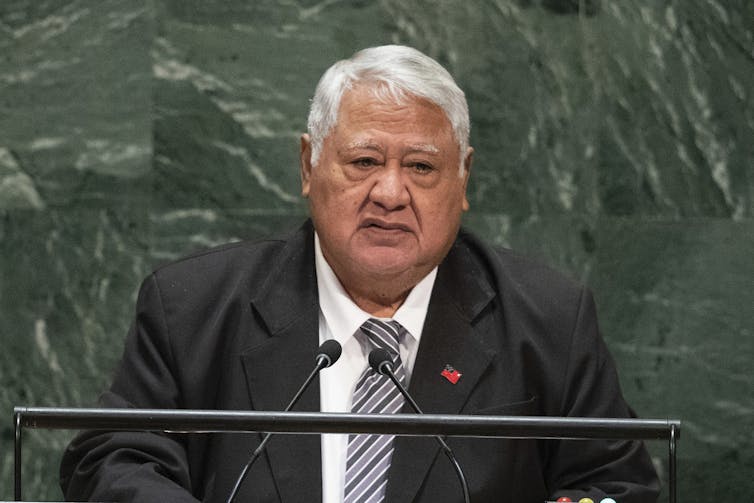 Out of office but still in parliament: Tuilaepa will lead a defiant opposition.
AAP
Out of office but still in parliament: Tuilaepa will lead a defiant opposition.
AAP
A veteran and trailblazer
Fiame’s own political career began in 1985 when she won her parents’ former parliamentary seat of Lotofagu. Since then, Fiame’s career has ridden the wave of the HRPP’s popularity.
Under former prime minister Tofilau, she became the country’s first female cabinet minister[4], holding the education portfolio for 15 years. Fiame has also overseen the Ministry of Women, Community and Social Development, and the Ministry of Justice and Courts Administration, as well as other government appointments.
In 2016, she again broke new ground when she was appointed Tuilaepa’s deputy prime minister. She held this position until her resignation in September 2020 in protest at Tuilaepa’s controversial “three bills[5]” (which gave the Lands and Titles Court additional powers over the bestowal of lands and titles within families and villages and undermined judicial independence and the rule of law).
Read more: Samoan democracy hangs in the balance as a constitutional arm wrestle plays out — with the world watching[6]
The bills and their rushed passage into law ignited widespread protests and the formation of the Fa’atuatua i le Atua Samoa ua Tasi (FAST Party), which Fiame joined as leader in March 2021. Ultimately they led to Tuilaepa’s political demise.
The bitter election campaign and its protracted aftermath, when Tuilaepa went to extraordinary lengths to retain power, has tested Fiame’s mettle as a national leader.
Throughout, she has embodied the same faith that justice would prevail that she asked of Samoa’s people as they witnessed the alarming twists and turns of Tuilaepa’s power play.
The challenge of power
Her impressive track record and admirably steady temperament will continue to be called upon as she faces multiple challenges as leader.
Firstly, Fiame will have to contend with something Tuilaepa never had to during his long term — a viable opposition, whose leader just happens to be Tuilaepa. True to form, he has already questioned the legitimacy[7] of Fiame’s FAST government.
How much power Tuilaepa can wield in parliament is yet be to determined. Seven by-elections[8] have been triggered so far due to petitions stemming from the general election. FAST currently holds 26 seats and the HRPP 17, with one independent.
Read more: Has the door finally opened for Samoa's first female prime minister, after weeks of constitutional crisis?[9]
There will also be a by-election for the 52nd parliamentary seat created since the April 9 election — the seat designated for a woman candidate[10] to meet a constitutionally mandated 10% quota of female parliamentarians. It was by creating this seat[11] and “weaponising[12]” gender politics[13] that Tuilaepa hoped to keep Fiame out of power.
Fiame must also contend with Tuilaepa’s residual powers beyond parliament. His son, Leasiosio Oscar Malielegaoi, was appointed CEO[14] of the Ministry of Finance in 2018, as well as various other positions[15], by his father.
The bureaucracy is staffed by other Tuilaepa loyalists. Reinvigorating national power structures will be a delicate operation for Fiame. But she is aided in her nation-building by the grassroots, village-level[16] support for her government that has seen a succession of leaders calling on Tuilaepa to concede over the past weeks.
This support will be critical, not only for the pending by-elections but also to ward off the threat of COVID-19, now tragically playing out in neighbouring Fiji.
Samoa’s place in the world
While no deaths have been attributed to COVID-19 in Samoa, vaccinations are vital to keep it that way. Currently, only 18.6% of the population[17] are fully vaccinated and vaccine hesitancy persists.
Ameliorating the devastating impact of the pandemic on Samoa’s tourist economy is another major challenge. And Fiame will also need to negotiate China’s considerable economic influence, encouraged by Tuilaepa[18] but which Fiame has signalled[19] she will not emulate.
Read more: With five countries set to quit, is it curtains for the Pacific Islands Forum?[20]
Regionally, Fiame has an opportunity to be a constructive presence at a time when the pandemic has exacerbated frayed relations[21] between Pacific democracies and China, and within the Pacific Islands Forum[22], which has recently seen a third of its member nations quit.
None of which detracts from the historical significance of Fiame’s election. She joins an exclusive group of women political leaders and can encourage other women in the region aspiring to political office.
As US Vice President Kamala Harris said of her own election[23], “I may be the first woman to hold this office. But I won’t be the last.” For Fiame, perhaps, that is the ultimate challenge.
References
- ^ conceded defeat (www.samoaobserver.ws)
- ^ Samoa's stunning election result: on the verge of a new ruling party for the first time in 40 years (theconversation.com)
- ^ strong ties to New Zealand (www.rnz.co.nz)
- ^ first female cabinet minister (www.samoaobserver.ws)
- ^ three bills (www.lowyinstitute.org)
- ^ Samoan democracy hangs in the balance as a constitutional arm wrestle plays out — with the world watching (theconversation.com)
- ^ questioned the legitimacy (www.samoaobserver.ws)
- ^ by-elections (www.samoaobserver.ws)
- ^ Has the door finally opened for Samoa's first female prime minister, after weeks of constitutional crisis? (theconversation.com)
- ^ woman candidate (www.rnz.co.nz)
- ^ creating this seat (www.rnz.co.nz)
- ^ weaponising (talamua.com)
- ^ gender politics (www.samoaobserver.ws)
- ^ appointed CEO (www.rnz.co.nz)
- ^ various other positions (www.samoaobserver.ws)
- ^ village-level (www.samoaobserver.ws)
- ^ 18.6% of the population (www.samoagovt.ws)
- ^ encouraged by Tuilaepa (www.rnz.co.nz)
- ^ Fiame has signalled (www.abc.net.au)
- ^ With five countries set to quit, is it curtains for the Pacific Islands Forum? (theconversation.com)
- ^ frayed relations (www.smh.com.au)
- ^ Pacific Islands Forum (www.theguardian.com)
- ^ said of her own election (www.vox.com)