Rail Signalling Power Supply: Keeping Signals On in Storms
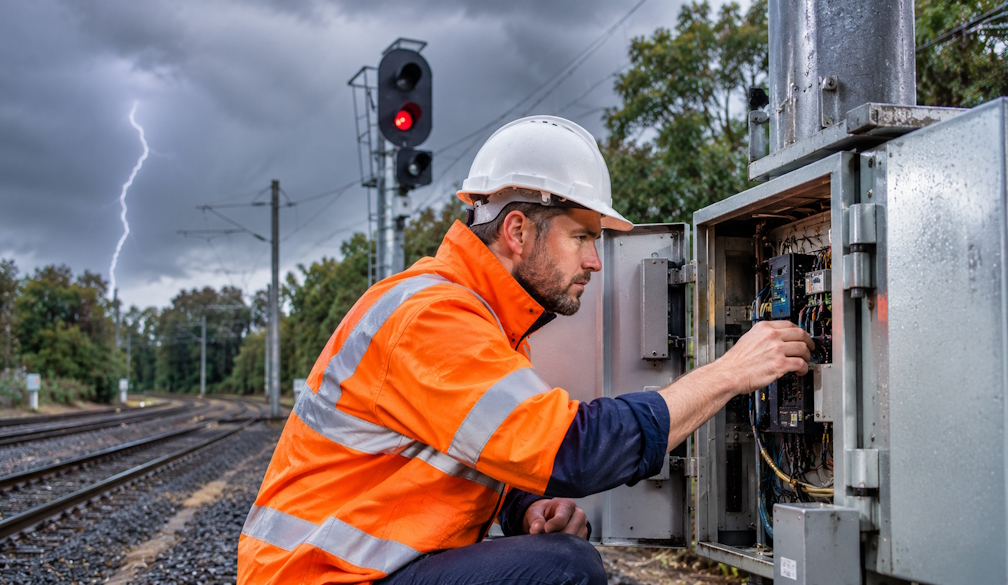
Keeping Rail Signals Running Through Storms and Grid Outages
Say a storm cuts the mains to a trackside location overnight. Nothing dramatic follows: no fire, no fallen mast. The signal simply holds at stop, a level crossing keeps its boom gates down, and a corridor that ran to the minute at midnight starts to back up. Passengers see a delay. The maintenance team sees a question about whether a small bank of batteries in a cabinet did its job. Keeping rail signals running through storms and grid outages depends on that question being answered long before the weather turns.
Why Rail Signals Fail Safe
Railway signalling is built to fail to its safest state. When something goes wrong, the system’s answer is for trains to stop or slow down rather than guess. That design protects passengers and motorists, and it explains why a fault that would barely register in another industry can stall an entire rail corridor.
South Australia’s Department for Infrastructure and Transport described one such morning in January 2018. A signalling fault sent level crossings on the Outer Harbor line into fail-safe mode, with boom gates held down and trains crossing at slow speed. The cause appeared to be damage to surge arrestors during a lightning storm on the Sunday night, and the department said the system operated as designed.
That was not a battery failure, and it is worth being precise about that. What it shows is how a storm fault looks from the track: a safe state, slow running and crews sent out to find the cause. Every fail-safe response is the right behaviour, and every one costs time, which is why backup power should be judged by how rarely it lets a site reach that point.
Rail Signalling Power Supply Basics
Many trackside locations run from mains power with a charger and a battery bank behind it. The batteries sit idle for most of their lives and are then asked to carry the whole site on the one night the mains fails. Planning a rail signalling power supply therefore starts with a plain question: how many hours must this location run with no mains at all? The national standard for this ground is AS 7703, Railway signalling, Power supply systems, which RISSB published in December 2020 and which treats the signalling power supply as a critical aspect of safe operation.
Hours Without Mains
The answer comes from the project’s own specification and differs between networks and asset types, so the governing document for any site is the rail infrastructure manager’s requirement, not a rule of thumb. Whatever the figure is, it should sit next to the installed battery capacity in the records for every location. A number nobody can find is a number nobody checks.
Solar and Remote Sites
Remote sites without mains add a second problem. Sizing has to cover the longest run of cloudy days at that location, and it has to use the capacity the batteries will have in year eight rather than on day one. A site that only just meets its target when new will miss it later, which is exactly when a storm tests it.
Signalling Battery Backup Weak Points
Batteries rarely fail loudly. A bank that reads healthy at rest can still collapse the moment it carries a real load, so a quick voltage check on a maintenance visit tells you less than it seems to. Three weak points are worth checking first.
The first is age. Banks replaced only after they fail tend to fail during the storm, because a storm is the first real load they have carried in years. Replacing on a schedule moves that failure to a day of your choosing.
The second is the charger. After a long outage it has to carry the normal site load and recharge a flat bank at the same time, and a unit that cannot do both leaves the site half-charged for the next storm. The third is temperature. Heat shortens battery life and cold cuts the capacity on offer, so the temperature inside the location case, not just the ambient figure, belongs in the sizing.
A second storm a day later finds whatever state the first one left behind. A site that recovers fully and quickly is a very different asset from one that limps back to partial charge.
Storm-Season Rail Power Checklist
Before the first storm of the season, a maintenance team can work through a short list at each signalling location:
- Record the install date of every battery bank and plan replacement by age, not by failure.
- Load-test each bank against the real site load, because resting voltage alone can mislead.
- Write down the required hours without mains and compare them with the installed capacity.
- Confirm the charger can carry the site load while recharging a discharged bank.
- Check the temperature inside the location case, not just the weather forecast.
- At solar sites, recalculate autonomy using end-of-life capacity and the longest local run of cloudy days.
None of this is exotic. A location that has been checked against its own specification before the season starts is one where the mains can drop out and the corridor carries on.