OPPO has 7 papers selected and wins 8 challenges at CVPR 2022
- Seven papers submitted by OPPO were selected for presentation at the 2022 Computer Vision and Pattern Recognition Conference, breaking a new record for the company.
SHENZHEN, CHINA - Media OutReach - 23 June 2022 - The annual Computer Vision and Pattern Recognition Conference (CVPR) came to an end in New Orleans today, with globally leading technology company OPPO successfully having seven of its submitted papers selected for the conference, putting it among the most successful technology companies at the event. OPPO also placed in eight of the widely watched competition events at the conference, taking home three first place, one second place, and four third place prizes.
As deep learning technology has developed over the years, artificial intelligence has shifted from perceptual intelligence to cognitive intelligence. In addition to being able to 'see' or 'hear' like humans, modern AI technology is now able to demonstrate a similar level of cognitive ability to humans too. Multimodal fusion, 3D visual intelligence technology, and automated machine learning are becoming key research topics in the field of AI, and areas in which OPPO has achieved several theoretical and technological breakthroughs of its own.
"In 2012, deep neural networks designed for image recognition tasks re-energized the research and application of artificial intelligence. Since then, AI technology has seen a decade of rapid development." said Guo Yandong, Chief Scientist in Intelligent Perception at OPPO."OPPO continues to promote artificial intelligence to accomplish complex perceptual and cognitive behaviors. For example, AI can learn from unlabeled massive data and realize downstream migration and reconstruct 3D information from several limited perspectives. We also empower AI with higher cognitive abilities to understand and create beauty and develop embodied AI with autonomous behavior. I'm delighted to see that seven of our papers have been selected for this year's conference. Building on this success, we will continue to explore both fundamental AI and cutting-edge AI technology, as well as the commercial applications that will enable us to bring the benefits of AI to more people."
The Seven papers accepted by CVPR 2022 showcase OPPO's progress in creating humanizing AI
Seven papers submitted by OPPO for this year's CVPR were selected for presentation at the conference. Their areas of research include multimodal information interaction, 3D human body reconstruction, personalized image aesthetics assessment, knowledge distillation, and others.
Cross-modal technology is seen as the key to 'humanizing' artificial intelligence. Different modal data have different characteristics. Text information often features a high level of generality, whereas visual image information contains a large amount of specific contextual details. It is a great challenge to establish effective interaction for multimodal data. OPPO researchers proposed a new CRIS framework based on the CLIP model to enable AI to get a more fine-grained understanding of the text and image modal data. The model can achieve an accurate match of a piece of relevant visual information in an image after feeding the complex text descriptions.
The biggest difference between human and artificial intelligence today lies in multimodality. Human beings are able to easily understand information in both words and images and draw associations between the two types of information. AI on the other hand is currently unable to move past the identification stage and finds it difficult to accurately match information between different modes. The novel method proposed by OPPO improves multimodal intelligence, which could potentially lead to artificial intelligence being able to truly understand and interpret the world through multiple forms of information such as language, hearing, vision, and others, making the robot and digital assistants of sci-fi movies become a reality.
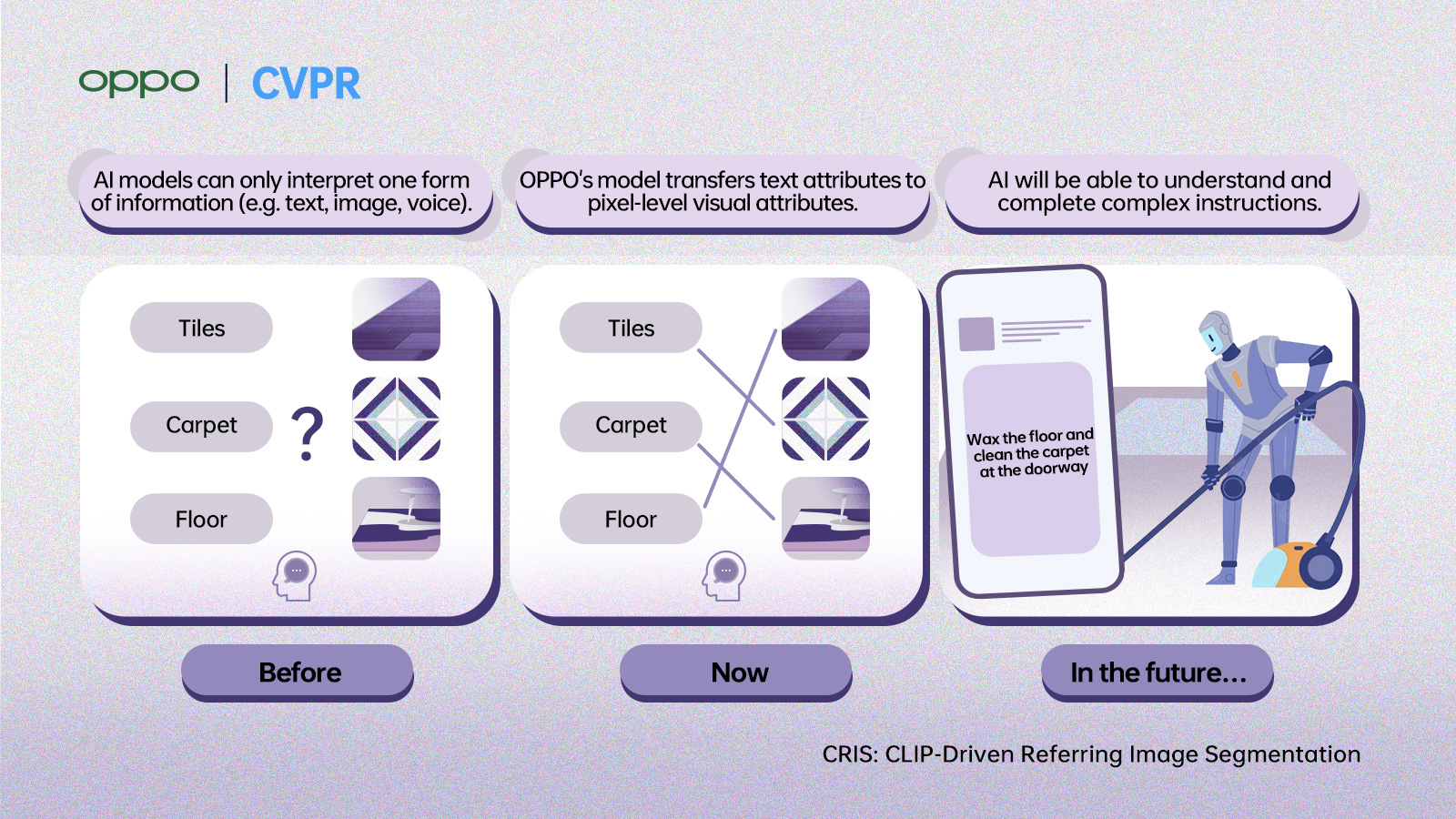
CRIS: CLIP-Driven Referring Image Segmentation
3D human body reconstruction is another area in which the OPPO Research Institute has made significant progress. At CVPR, OPPO demonstrated a process for automatically generating digital avatars of humans with clothing that behaves more naturally. The solution was achieved by improving the NeRF dynamic character model method. By analyzing RGB video of humans captured with a camera, the OPPO model can accurately generate 3D, 1:1 dynamic models that include small details like logos or fabric textures. Creating accurate 3D models of clothes has remained one of the biggest challenges in the field of AI due to the difficulty in observing the deformation of clothes depending on the posture of those wearing them. This makes it difficult for AI to recognize and distinguish the deformation in certain parts of clothing, for example, a hemline. The new model effectively reduces the requirements needed to perform 3D human body reconstruction, providing technical foundations that can be applied to areas such as virtual dressing rooms for online shopping, AI fitness instruction, and the creation of lifelike avatars in VR/AR worlds.
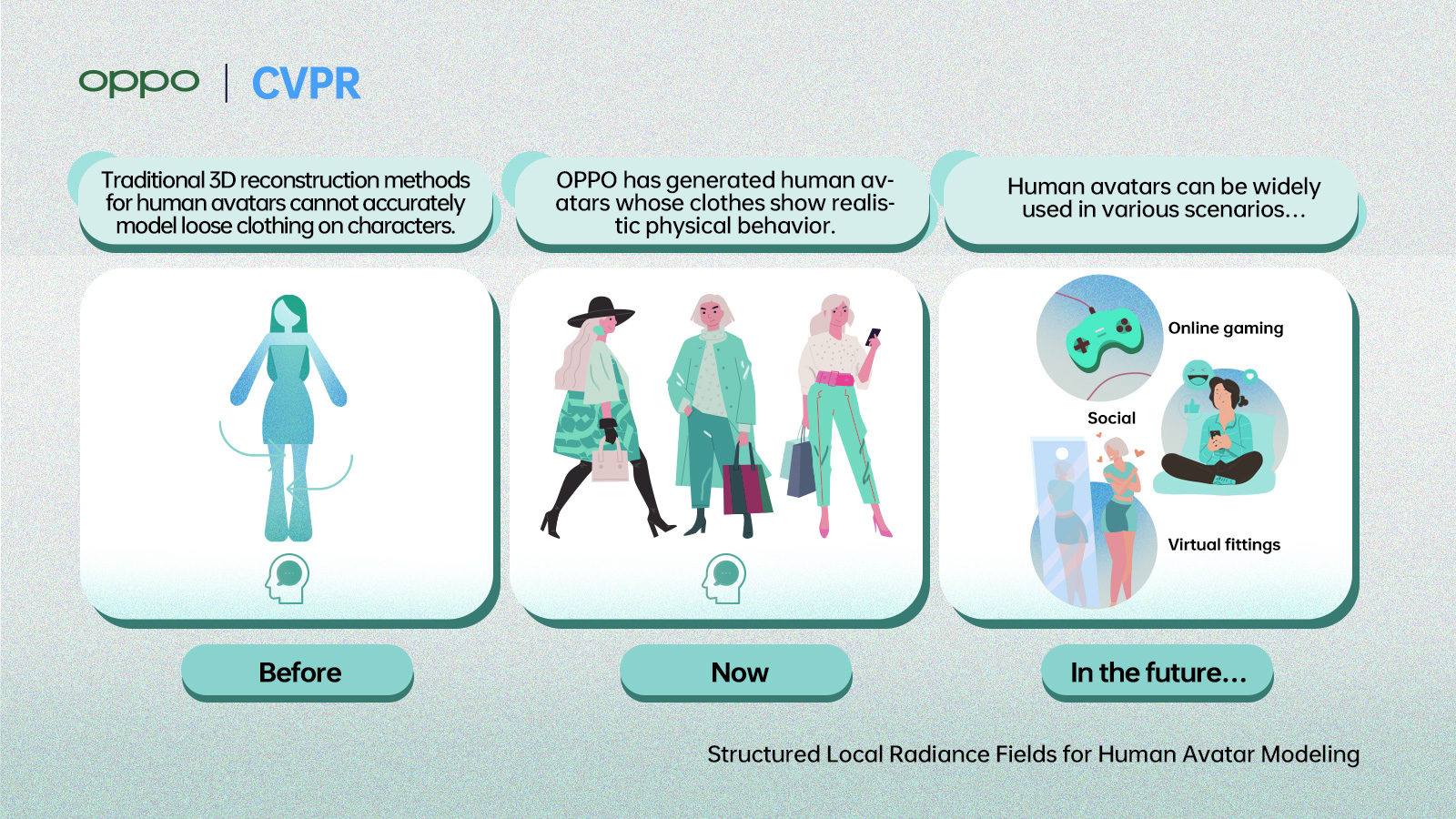
Structured Local Radiance Fields for Human Avatar Modeling
AI image recognition has now reached a stage where it can accurately identify a wide range of objects within an image. However, the next challenge in this area is developing AI that is capable of interpreting an image for its aesthetic value. The ability of AI to evaluate images in terms of their perceived aesthetic quality is often strongly related to the big data used in training the AI model. As a result, 'opinions' provided by AI are often not to everyone's taste, and in many cases, models have been shown to demonstrate clear biases. This has led to the development of more refined data and models that take into account the diverse preferences of different people.
In collaboration with Leida Li, a professor from Xidian University, the OPPO Research Institute brought the solution to this problem, which is the innovative Personalized Image Aesthetics Assessment (PIAA) model. The model is the first to optimize AI aesthetics assessment by combining users' subjective preferences with more generalized aesthetic values. The algorithm can perform personalized image evaluations based on preferences learned by studying user profiles. In the future, the model will be used to create personalized experiences for users, not just limited to the curation of photo albums, but also provide recommendations on how to shoot the best photo and which content a user might prefer.
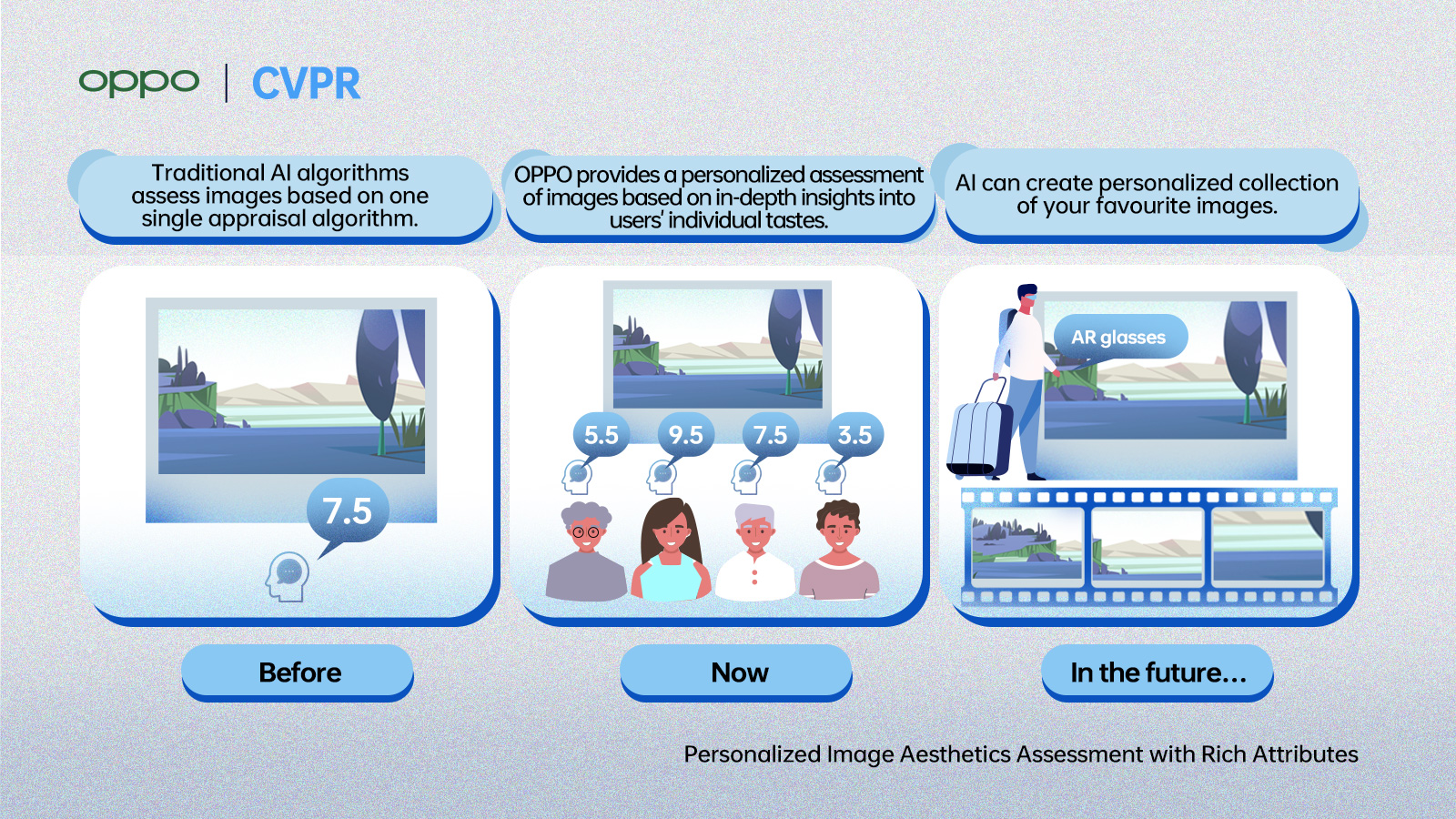
Personalized Image Aesthetics Assessment with Rich Attributes
OPPO has also chosen to make the PIAA model evaluation data set the open source for developers, with a number of research institutions and universities already expressing an interest in using the data to further their own efforts in personalized AI aesthetic assessment.
Further to this, OPPO also proposed a multi-view 3D semantic plane reconstruction solution capable of accurately analyzing surfaces within a 3D environment. The technology can recognize semantic characteristics of different surfaces, such as the ground, desktops, and walls, to a much higher degree of precision than current mainstream single-view reconstruction architecture. Developed in partnership with Tsinghua University, the INS-Conv (INcremental Sparse Convolution) can achieve faster and more accurate online 3D semantic and instance segmentation. This can effectively reduce the computing power needed to perform environment recognition, which will enable such technology to be more easily adopted in applications such as automated driving and VR.
OPPO makes AI 'lightweight' with second place win in the NAS Challenge
Alongside the presentation and review of the latest research in computer vision and pattern recognition technology, CVPR 2022 also saw a number of technical challenges take place, with OPPO placing third and above in eight challenges. These include the neural architecture search (NAS) challenge, SoccerNet, SoccerNet Replay Grounding, ActivityNet temporal localization, the 4th Large-scale Video Object Segmentation Challenge, the ACDC Challenge 2022 on semantic segmentation in adverse visual conditions, and WAD Argoverse2 Motion Forecasting.
From mobile photography to automated driving, deep learning models are being applied in an increasingly large pool of industries. However, deep learning relies heavily on big data and calculation power and consumes a lot of cost, both of which present challenges to its commercial implementation. Neural architecture search (NAS) techniques can automatically discover and implement optimal neural network architectures, reducing the dependence on human experience and other inputs to enable truly automated machine learning. In the NAS competition, OPPO researchers trained a supernetwork of 45,000 sub neural networks to inherit the parameters of the supernetwork by optimizing the Model Parameter Forgetting and the Unfair Gradient Descent Problem, achieving a high level of consistency between subnetworks performance and performance ranking, ranking second place among all entrants.
Using the NAS technique, researchers only need to train a large supernetwork and create a predictor to let the subnetworks learn by inheriting the supernetwork parameters. This provides an efficient and low-cost approach to obtaining a deep learning model that outperforms those manually designed by expert network architects. This technology can be applied to most current artificial intelligence algorithms and can help AI technology typically requiring a large amount of computing power to be implemented on mobile devices by optimizing the neural architecture search to search for architects that perform well under specific conditions. This will ultimately bring previously unthinkable levels of AI technology to mobile devices in the near future.
In addition to its success in the NAS challenge, OPPO also took first place in the SoccerNet Replay Grounding challenge and third place in the SoccerNet Action Spotting challenge, following second place wins in both categories at CVPR last year.
During CPVR 2022, OPPO also participated in seminar presentations and three high-level workshops. At the SLAM seminar, OPPO researcher Deng Fan shared how real-time vSLAM could be run on smartphones and AR/VR devices. OPPO researcher Li Yikang also delivered a speech at the mobile artificial intelligence seminar and presented OPPO's method for performing unsupervised cross-modal hashing between video and text. Named CLIP4Hashing, this method presents an important approach to performing cross-modal search on mobile devices. In AICITY Workshop, Li Wei proposed a multi-view based motion localization system to identify abnormal behavior of drivers while driving.
OPPO is bringing the benefits of AI to more people, sooner
This is the third year that OPPO has participated at CVPR. Over the past three years, AI research has undergone a dramatic shift from the development of specific applications like facial recognition, to more fundamental technologies that have wider reaching implications.
OPPO's rising success at CVPR during these three years owes much to its continued investment in AI technology. OPPO first began investing in AI development in 2015, establishing R&D teams dedicated to language & semantics, computer vision, and other disciplines. At the beginning of 2020, the Institute of Intelligent Perception and Interaction was established under the OPPO Research Institute to further deepen OPPO's exploration of cutting-edge AI technologies. Today, OPPO has more than 2,650 global patent applications in the field of AI, covering computer vision, speech technology, natural language processing, machine learning and more.
Guided by its brand proposition, 'Inspiration Ahead', OPPO is also working with partners across the industry to take AI technology from the laboratory into daily life. In December 2021, OPPO launched its first self-developed dedicated imaging NPU, MariSilicon X. The NPU boasts both powerful computing performance and high energy efficiency to enable complex AI algorithms to be run at unprecedented speeds on mobile devices, delivering superior video quality through advanced night video and other image processing algorithms. OPPO's AI technology has also been used to develop products and features such as the real-time spatial AR generator CybeReal, OPPO Air Glass, Omoji, and more. Through these technologies, OPPO is aiming to create more lifelike digital worlds that combine virtual and reality to create all-new experiences for users.