Nationals move Bill to protect women. Sall Grover interview
- Written by: Times Media
Matt Canavan
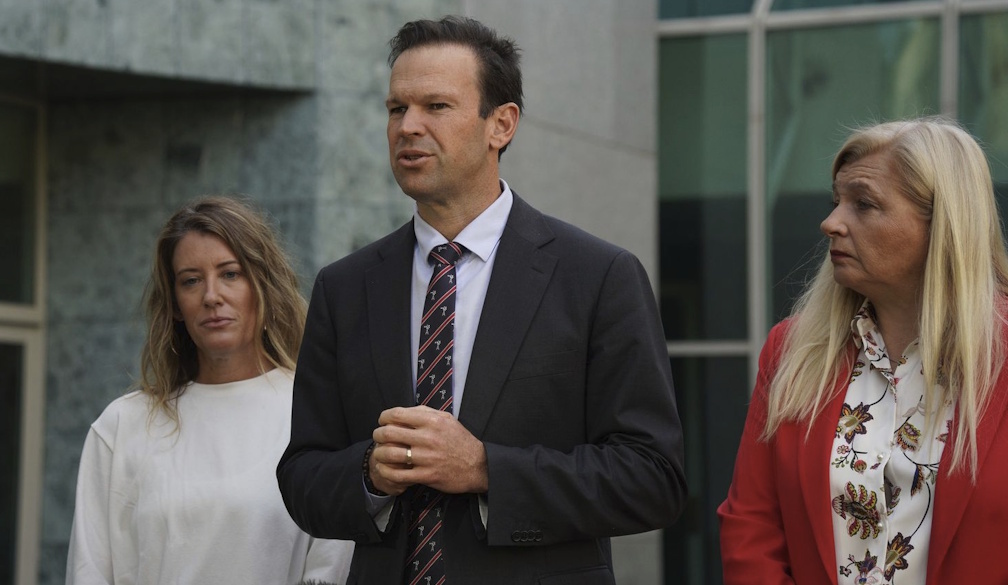
All good. Look, well, it's great to be here with my friend and colleague, Alison Penfold, and also Sall Grover. And Sall has been through a lot in the last few weeks that she shouldn't have had to go through. Our laws should protect women, they should protect men, they should protect anyone in this country that wants to associate with other people for legitimate purposes. Years ago, Sal wanted to create a space, an online space for females, for women. And, unfortunately, as we've found out now through the federal court, our laws don't protect the rights of women like Sall to associate with other women. And when we see a problem in the Nationals Party, we work to fix it. I want to thank Alison for the work she's done over the past year. Ever since she was elected, Alison has been working on this issue. Something came up to her on her campaign, and she made a commitment to do so, and she's been working diligently on making changes to the Sex Discrimination Act to ensure that we protect women like Sall and all women in Australia, to give them the rights that they can have their own spaces, their own activities, their own sporting events, anything that women want to choose to associate in should be protected in this country, and so today Alison has introduced her bill into the house. It was coincidental with the timing in the court case, but we do clearly need to fix this problem, and the Liberal and Nationals parties have committed to support changes to the Sex Discrimination Act, which would reinstate biological sexes definitions in the act, so that, so that men and women, girls and boys can can enjoy their own spaces. We don't want to take rights away from anyone, but it is now clear that the changes that were made to the Sex Discrimination Act almost 15 years ago now have have taken rights away from people like Sall, from the women of Australia, and that needs to be fixed. Alison.
Alison Penfold
Thank you, everyone. It is an honour to be here with Sall Grover. I did, as Matt said, made a commitment some time ago. In fact, it was over three years ago when Kirralie Smith, who is also fighting a battle on this issue and is currently in court today in fact, came and spoke with my Federal Electorate Council and she told us her story and it was from that moment that I made a decision and a commitment to the members of the Nationals in my electorate that if I was elected in my first term, I would move a bill to reinstate the biological definition of man and woman, and that is exactly what my bill does today. My bill sets it straight that sex is biological and binary, and that the bill also ensures that there are protections for women-only spaces. There is an opportunity now in this parliament, given what Sall has been through now for many years, and many other very brave and courageous women, that the parliament could choose to make a decision and vote on this bill in the next few weeks and resolve the issues that Sall is facing. The fact of the matter is in this country at the moment that women have had the choice to say no taken away from them. If this Parliament does not act on this bill, does not fix the conflict that exists that was created by this Parliament in 2013 when it did not provide a balancing test between sex-based rights and gender identity. If it doesn't fix this situation, it's effectively saying to all Australian women, as I said in my speech today, "suck it up, princess, we don't care". Well, I care, the Nationals care, and I know millions of Australian women and men care, they want everyone to have the dignity, the privacy, and the choice to live their lives to the best possible degree. And I'm merely a vehicle to get an outcome that Sall Grover and so many brave women deserve. Sall, I'll hand over to you.
Sall Grover
Thank you so much, and I want to thank Alison and Matt, and every politician who is actually finally speaking up about this issue, so that includes Angus Taylor and Michaelia Cash, Pauline Hanson, everyone who is now finally coming out and saying that something needs to be done, women like myself have been yelling into the abyss for years in this country, saying that our rights have been completely destroyed. For far too long, we were told that it was just a culture war. We were called transphobes, we were called bigots, we were called turfs, right wing, anything to try and silence us and get us to go away, but the reality is, this has never been a culture war. The federal court never treated it as a culture war, nor did the Sex Discrimination Commission, who took it very seriously. And in 2013 when the amendments were changed, they didn't tell people then it's a culture war, no, we're not going to do anything. Laws were changed then, it's an amendment, you can change it again if you can't, you might need a dictionary. We don't want to take rights away from anybody. It's never been about that, but no man has ever had the right to go into a female only space. To change laws to say that men can now go into female only spaces puts women in the position of having no legal recourse to reestablish what the Sex Discrimination Act was set out to achieve. So I would like to know, is it the Labor government's position that the 2013 amendments were brought in to exclude the very demographic women, which the act was created to protect. Women and girls, need protections in law. We need accuracy in law and reality in law. And the girls currently going to school, who are not drinking water because they don't want to use the bathroom, because there are boys in it, they don't have time to wait. They're not going to care what political party does this, who fixes it. They just want it fixed, and that's my position as well. I would really just like this issue fixed as quickly as possible. Thank you very much.
Matt Canavan
Well said, Sall.
Matt Canavan
Good on you for your bravery. Yes.
Journalist
You introduced a similar kind of bill, I think it was last year. Can you talk us through, how does this bill differ?
Matt Canavan
Look, I'm happy to let Alison talk about her bill, but yes, that's right. I, with Senator Antic, tried to do something similar, because we could see this issue emerging. I don't think Sall should have even had to go through this process. It's ridiculous, the costs, the stress, that just an average woman, not that you are average Sall, clearly not, but just an everyday, everyday Australian woman has had to go through being trawlled through the courts. It's an injustice in and of itself, but good on Sall for having the courage, the bravery, the perseverance, the resilience to see this through. So, yes, I made my effort to do that. I think Alison's improved on my effort. I must say, or Alex and I's effort, and I'll ask her to speak about why.
Alison Penfold
Thank you. My bill does one fundamental thing, which is to ensure that sex is binary and biological. The current act sees sex as on a spectrum, and that sex is changeable, and that has enabled the court to take effectively rights away from women to their own spaces. My bill does one other thing, which other bills have not done, is that I don't seek to remove gender identity as a protected attribute. Indeed, while I amend gender identity in my, in my bill, I am not seeking for blanket discrimination against transgender Australians. I'm simply trying to reflect reality and create the space and choice and safety where it's necessary for women, and that should not be controversial. Should not be controversial, that there are differences in physicality between men and women. Indeed, in rugby league and soccer, when kids turn, you know, a certain age, just before puberty, the codes actually separate children, and yet the law now overturns that. That separation is done for physical safety, yet the law does not now respect that. So, again, as I say, I am not, unlike previous bills, seeking to remove gender identity. I'm just seeking to clarify the law, which has a conflict in it, that it cannot determine what prevails between sex and gender identity, and we need that conflict to be resolved, even if the Prime Minister does not agree with that women deserve sex-based rights. He must appreciate that there is a problem with the act, and he needs to come into the parliament and help resolve it one way or another. There's no fence sitting on this issue, and as has been said, you know there are opportunities where, you know, there's my bill doesn't stop someone creating a women's only app that allows women and transgender women. I'm not taking that right away. I'm hoping to create that right and encourage people to do that if that is what they want to do. So, I have tried to find a pathway, particularly to try and build consensus in this parliament, because we've seen previous attempts fail, and this is a very serious situation, Sall and many other women should not be having to crowdfund to take their case to the federal court and the high court, and let so the parliament created the problem. I'm simply asking the parliament to fix it.
Journalist
So, can I just ask, you've said that it's not that you're the bill includes a definition of binary genders or binary sex, does that mean that you'd be wanting trans men to be using women's spaces because of that biological sex definition.
Alison Penfold
Sorry, can you repeat that?
Journalist
So, in your bill, you mentioned that you're advocating for having a binary of sexes under that, would that mean that trans men born male, born female transitioning to male, that they would be using women's spaces?
Alison Penfold
Well, you know, they're the opportunity here is to create spaces. I mean, we're seeing in many public places now where unisex toilets, there is a solution to this problem. The solution, though, isn't taking rights away from women and taking away and men their safety and space. I mean, I've advocated publicly in the context of this bill that men's sheds should be able to stay for men. I mean, I saw during the floods last year older men struggling to cope with the impact of losing everything, and there wasn't a female, there wasn't a male councilor in sight. They need spaces where they can go and talk to men, so I'm simply saying, let's create spaces where we can all live with dignity and respect, not take rights away from women to create for men.
Journalist
So, how does that not even.. how is that not possible now, like what's what's not like I'm just not quite grasping why you can't have men's sheds now, and ...
Alison Penfold
We do have men's, with the federal court, here around me maybe let Sall answer this question, because she's living it right now.
Sall Grover
Well, at the moment the federal court is saying that it's unlawful to have spaces on the basis of sex.
Journalist
Well, they said that it can be a women's space, but to discriminate within women is...
Sall Grover
Yes but men who claim to be women are not women.
Matt Canavan
That's the point.
Journalist
But that erases transgender people.
Sall Grover
This is a linguistic war here that we're having, and it becomes really circular when the reality is, is that women, adult human females, want female only spaces, the all the other spaces you want to create that need that are needed for any demographic, create them. We're not going to stop you, but the law has to also allow for female only spaces. That's it.
Matt Canavan
Can I add to that? Because I just look, I feel pretty passionate about this myself, and obviously not a woman, but you know, I talk to my wife about these issues. She gets very passionate about it, and there is something unique and special and beautiful about a biological female and biological male. All we're saying is that uniqueness should be reflected in our law, that we should have a definition of that, and that doesn't mean, though, as Alison's done and improved on my bill, because my bill just sought to, okay, this is a problem, let's roll it back. She's done better that we still then can also define and protect those that have different gender identities, but there is something unique about a biological female, a biological male, and it's that binary definition of biological sexes, that is now absent from our laws, possibly inadvertently absent. I'm not even sure the Julia Gillard government knew what they were doing that long ago, but the federal courts made their decision now, and that's the state of our law, and we need to fix it.
Journalist
Senator Caravan, just on another issue, can I get your reaction to Bridget McKenzie's travel expenses. Are you satisfied with her explanation for why she charged taxpayers to attend her son's wedding? Particularly given that this isn't her first.
Matt Canavan
Absolutely, because she paid for the personal elements of that trip. Bridget's an extremely hardworking Senator. She was not just in Tasmania, but all over the country, highlighting cuts to infrastructure, which is her job as Shadow Minister for Infrastructure. She does a fantastic job. She's up there in Senate estimates continuing it.
Journalist
Two other quick things: one, what do you make of the speculation about the Teals forming a party today? And second, what's your read on the Redbridge poll that was released over the weekend? I think it showed you would lose your seat, the Liberal leader would lose his seat. How worried are you guys about this threat from One Nation?
Matt Canavan
Okay, both those questions. Look, the Teals are already a party, they're already a party, they meet every week, decide their positions, just like we do in the Nationals party. I say, bring it on, because just get it over with. We all know you're a party, you're funded by similar people. I saw it in action at the Farrer by-elections, so stop the charade, stop trying to hide from the Australian people in reality that the Teals are a party, they work in unison, they're funded in unison, and they have a hidden agenda in unison as well. Now, I think the Australian people are waking up to that agenda, they're waking up to the fact that the people funding the Teals and backing the Teals are the reason why energy prices are through the roof. Why we don't have fuel security in this country right now, and look on this issue, I reckon the Teals won't help one bit, Sall or other women in this country, but I live in hope, I live in hope that any political party could see common sense on this issue. We'll work with anyone in the parliament, the Labor Party, One Nation, the Teals, the new Teals, as a party, whatever it is, we'll work with people to protect women's rights, to protect women's spaces. That is very important. On the other issue, the poll look it doesn't tell me anything I don't know. We are in a massive fight, and I completely understand why we're in that fight. People have been disappointed with ourselves, and all I can say to people out there is I'm fighting every day for them. I haven't budged on lots of issues, and I've got a lot of fight and energy with in me. I'm a Queenslander, so we usually are behind, and we still find a way to win.
Alison Penfold
Not this week Matt, not this week, sorry about that!
Matt Canavan
We'll see Alison.
Journalist
Senator, coming back to this issue. Do you think that it's going to help win back moderate voters to the Coalition?
Matt Canavan
Look, I've been on this issue for years, as was said, so I'm not.. I'm not.. this is.. this is about the women of Australia, and as we said earlier, we'll work with anybody on this, you know, and Sall mentioned One Nation saying they'd support things like this, but I do want to promote and recognise the work that Alison and the Nationals party have done lots of times. Our members of parliament just do hard work, not always in the spotlight, but when you do that, hard work pays off, like times like this, where it just so happens that Alison had a bill ready to go, as when this court case came down, so congratulations to Alison. I'm very proud of the work my Nationals colleagues, my Nationals team does, and but we will work with anyone to fix problems for Australians.
Alison Penfold
Can I add, can I just say this is a this isn't about politics, this is doing what's right. I, as I said, I had been working on this legislation for quite a long time. I'd made a commitment, and it was tabled some seven weeks ago. You know, I wasn't aware of the timing of Giggle versus Tickle, so this is an individual MP, first female MP for Lyne, standing by her commitment to the to the members of her electorate council, the National Party members in Lyne, and standing up for women. Indeed, as I said, one of my constituents today, Kirralie Smith, is in court fighting these very issues. So, for me, as I said I'm a vehicle to get a job done. I will work with anybody in this parliament to do so, and in fact, I asked the Prime Minister in my second reading speech to support this bill. Let's get on with the job, because we could fix this within weeks. Thank you.
Journalist
Have either of you had any conversations with Pauline Hanson or anyone else from One nation about this bill, without trying to get it through the Senate?
Matt Canavan
Look, not Alison's particular bill, sorry, but I'm pretty sure I have spoken to Pauline about this before. Obviously, I had some feelings in the Senate on this in recent years.
Alison Penfold
No, I haven't had any particular discussions, but I recognised all of the Senators who previously had tried to make right what the parliament made wrong, and so I publicly recognised that I'm not aware that my bill has been recognised by One Nation.
Matt Canavan
Thank you, guys. Thank you, everyone. Thanks Sall. Thanks, everyone.