Biden urges countries to slash methane emissions 30% – here's why it's crucial for protecting climate and health, and how it can pay for itself
- Written by: Drew Shindell, Professor of Climate Sciences, Duke University
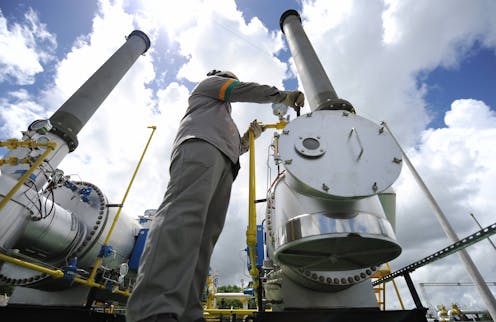
The U.S. and European Union are working on a pledge to cut methane emissions by at least 30% this decade[1], President Joe Biden announced[2] on Sept. 17, 2021, and he urged countries around the world to join in ahead of the U.N. climate summit later this year.
The move is a big deal for efforts to slow climate change – and also for health. While methane isn’t as abundant as carbon dioxide, it’s a far more potent greenhouse gas[3] at warming the planet and also a source of unhealthy air pollution.
Drew Shindell[4], a climate scientist and physicist who led a recent U.N. report on methane[5], explains the urgency and how the benefits of reducing methane emissions far outweigh the costs.
Why is methane a concern, and is this goal enough?
Methane emissions have been going up very quickly[6], and research shows they need to drop by nearly half by 2030 to meet the Paris climate agreement[7] goal of keeping global warming under 1.5 degrees Celsius (2.7 F) on the lowest-cost path. That means the world has a rapid U-turn to make.
The new pledge, if taken up widely and implemented, would dramatically change the world’s methane trajectory. It’s an ambitious minimum target, and ideally the 30% will have to be substantially exceeded to increase the chances of methane following a 1.5 C path.
The good news is that the world has a lot to gain by cutting these emissions.
Methane is a potent greenhouse gas, but it’s also a precursor of surface ozone[8], which is a toxic air pollutant. So, reducing methane improves the quality of the air we breathe at the same time that it reduces climate change, and the results are almost immediate.
A NASA computer animation shows large sources of increasing methane emissions.Methane is also valuable. If you capture methane from a landfill, you have a source of income right there. Capture it from leaking natural gas pipelines, and it pays for itself, because that’s the whole point of these pipelines – they transport methane as natural gas.
With the technology already available today, the world could cut methane emissions from fossil fuels, agriculture and rotting waste by 45% within a decade. That would avoid 0.3 degrees Celsius (0.5 F) of warming, which might not sound like much, but it’s one-fifth of the Paris climate agreement budget[9] of 1.5 C.
So, you get climate benefits, you get public health benefits and it’s also a financial win for the companies capturing the methane.
It’s not like this is rocket science. A large part of the methane being released is from natural gas[10] pipelines and storage, oil and gas pumping and landfills – and those are all problems companies know how to fix. Furthermore, recent satellite and aircraft data suggest that many sources have larger emissions than once thought, especially in the energy sector. This suggests that actively working on methane reductions may bring more benefits than initial estimates and could put countries well over the 30% goal of the pledge.
[Over 110,000 readers rely on The Conversation’s newsletter to understand the world. Sign up today[11].]
How does cutting methane improve health?
Methane causes ground-level ozone, which contributes to a lot of respiratory problems[12], including asthma in children, respiratory infections and chronic obstructive pulmonary disorders. There’s pretty robust evidence that it can also exacerbate cardiovascular disease[13].
Both methane and ozone are also greenhouse gases that cause global warming, which creates more health risks, particularly through heat exposure.
We looked at medical research and modeling[14], and used that to figure out what’s at stake. We found that for every million tons of methane emitted, about 1,430 people die prematurely, there are about 4,000 asthma-related emergencies and 300 million work hours are lost to the health effects. To put that into context, around 370 million tons[15] of methane are released annually due to human activities.
If you reduce methane emissions in 2022, you’ll see the ozone response in 2022, whereas you have to wait to see the climate effects until the climate system adjusts over at least a decade.
What’s causing methane emissions to rise so quickly?
Global emissions are going up. That’s easy to measure by chemical sampling of the air, and satellites can monitor large methane sources. But which sources are most responsible is a tougher question.
Global methane emissions were fairly level about 15 to 20 years ago, and then they started creeping up. Now, especially over the past five years or so, they’ve been rising at a fast rate.
Some studies point to the rise of hydraulic fracturing[16], which quickly expanded gas production and roughly parallels the recent methane increase. Others say livestock and the increasing global demand for meat[17] played a big role. Some point to natural sources[18] – particularly wetlands in the tropics responding to climate change.
The most likely scenario is that it’s a combination of all three[19].
The bottom line is that the overall methane emissions have to be lowered[20] to slow climate change. If the increase is coming from fossil fuel or waste or livestock, then countries need to go after the human sources. If it’s coming from natural systems that are responding to climate change, they still have to go after those human sources of methane. Cutting methane emissions is the strongest leveragefwe to slow those feedbacks down.
If cutting methane pays for itself, and the technology exists, why isn’t more being done?
The oil and gas industry itself is divided on methane. Many of the big companies supported the U.S. methane emissions rules[21] that were set by the Obama administration – and later rolled back by the Trump administration[22] – because they know capturing methane pays for itself. It’s not an onerous economic burden on them, and supporting it can improve the image of the industry.
For small operators, however, the upfront costs of equipment and the need to hire labor to inspect the pipelines may be harder.
For example, if a company is going to repair a pipeline, it can close off a section, bring in a compressor, and pump all of the excess gas farther down the line before starting to work on it. Doing that requires getting a compressor and having the trucks to move it and the staff to maintain it. A lot of studies have found that these investments[23] pay for themselves[24] in a few years because of the value of the methane saved. But many small operators find it simpler to just vent the gas into the atmosphere when they want to work on the pipe.
A similar problem exists with landfills and waste. As organic matter like food waste decomposes, it releases methane. Many landfills in developed countries already capture some of that methane gas. But many developing countries don’t have managed landfills or even trash pickup, making it impossible to capture the biogas.
Our report[25] lists a few recommendations, in addition to technical solutions, that can be used for landfills everywhere, including better waste sorting so organic material is kept out of landfills and used for compost instead, and reducing food waste overall. That can also reduce hunger if unused foods are gathered and distributed.
Agriculture[26] also has some straightforward solutions. Eating a healthy diet that, for many people, means cutting out excess red meat would go a long way in reducing the amount of livestock being produced for slaughter. These kinds of health and food security programs could boost the total methane reductions well beyond the 30% goal. Encouraging changes in food consumption can be politically dicey, but this is a huge emissions source. We’re not going to keep warming under 1.5 C without dealing with it.
Read more: 4 strategies for a global breakthrough on energy and climate change[27]
This is an updated version of an article originally published on May 6, 2021.
References
- ^ by at least 30% this decade (edition.cnn.com)
- ^ President Joe Biden announced (www.whitehouse.gov)
- ^ a far more potent greenhouse gas (www.epa.gov)
- ^ Drew Shindell (nicholas.duke.edu)
- ^ a recent U.N. report on methane (www.ccacoalition.org)
- ^ going up very quickly (www.ccacoalition.org)
- ^ Paris climate agreement (unfccc.int)
- ^ precursor of surface ozone (www.ccacoalition.org)
- ^ Paris climate agreement budget (unfccc.int)
- ^ natural gas (theconversation.com)
- ^ Sign up today (theconversation.com)
- ^ contributes to a lot of respiratory problems (doi.org)
- ^ exacerbate cardiovascular disease (doi.org)
- ^ medical research and modeling (doi.org)
- ^ around 370 million tons (doi.org)
- ^ hydraulic fracturing (doi.org)
- ^ livestock and the increasing global demand for meat (doi.org)
- ^ natural sources (www.globalcarbonproject.org)
- ^ combination of all three (doi.org)
- ^ overall methane emissions have to be lowered (www.ccacoalition.org)
- ^ supported the U.S. methane emissions rules (www.eenews.net)
- ^ and later rolled back by the Trump administration (www.nytimes.com)
- ^ these investments (www.iea.org)
- ^ pay for themselves (rhg.com)
- ^ Our report (www.ccacoalition.org)
- ^ Agriculture (theconversation.com)
- ^ 4 strategies for a global breakthrough on energy and climate change (theconversation.com)