4 ways time of day, month and year raise your risk of crashes
- Written by: Tom Langen, Professor of Biology, Clarkson University
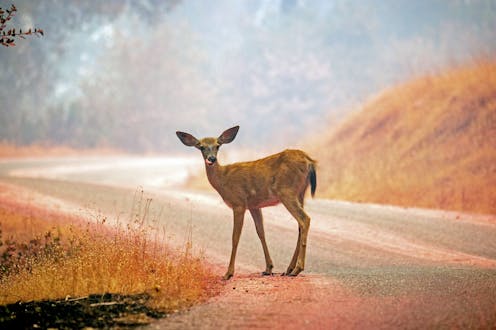
Autumn is here starting Wednesday, and that means the risk of hitting deer on rural roads and highways is rising, especially around dusk and during a full moon.
Deer cause over 1 million motor vehicle accidents in the U.S. each year, resulting in more than US$1 billion[1] in property damage, 200 human deaths and 29,000 serious injuries. Property damage insurance claims average around $2,600 per accident, and the overall average cost, including severe injuries or death, is over $6,000.
While avoiding deer – as well as moose, elk and other hoofed animals, known as ungulates[2] – can seem impossible if you’re driving in rural areas, there are certain times and places that are most hazardous, and so warrant extra caution.
Transportation agencies, working with scientists, have been developing ways to predict where deer and other ungulates enter roads so they can post warning signs or install fencing or wildlife passages under or over the roadway. Just as important is knowing when these accidents occur.
My former students Victor Colino-Rabanal[3], Nimanthi Abeyrathna[4] and I have analyzed over 86,000[5] deer-vehicle collisions[6] involving white-tailed deer in New York state using police records over a three-year period. Here’s what our research and other studies show about timing and risk:
Time of day, month and year matters
The risk of hitting a deer varies by time of day, day of the week, the monthly lunar cycle and seasons of the year.
These accident cycles are partly a function of driver behavior – they are highest when traffic is heavy, drivers are least alert and driving conditions are poorest for spotting animals. They are also affected by deer behavior[7]. Not infrequently, deer-vehicle accidents involve multiple vehicles, as startled drivers swerve to miss a deer and collide with a vehicle in another lane, or they slam on the breaks and are rear-ended by the vehicle behind.
In analyzing thousands of deer-vehicle collisions, we found that these accidents occur most frequently[9] at dusk and dawn, when deer are most active and drivers’ ability to spot them is poorest. Only about 20% of accidents occur during daylight hours. Deer-vehicle accidents are eight times more frequent per hour of dusk than daylight, and four times more frequent at dusk than after nightfall.
During the week, accidents occur most frequently on days that have the most drivers on the road at dawn or dusk, so they are associated with work commuter driving patterns and social factors such as Friday “date night” traffic.
Over the span[10] of a month, the most deer-vehicle accidents occur during the full moon, and at the time of night that the moon is brightest. Deer move greater distances from cover and are more likely to enter roadways when there is more illumination at night. The pattern holds for deer and other ungulates in both North America and Europe[11].
Over a year, by far the highest numbers of deer-vehicle accidents are in autumn, and particularly during the rut, when bucks search and compete to mate with does. In New York state, the peak number of deer-vehicle accidents occurs in the last week of October and first weeks of November[12]. There are over four times as many deer-vehicle accidents during that period than during spring. Moose-vehicle accidents show a similar pattern[13].
That high-risk period is also when daylight saving time ends – it happens on Nov. 7, 2021, in the U.S. Shifting the clock one hour back[14] means more commuters are on the road during the high-risk dusk hours. The result is more cars driving at the peak time of day and during the peak time of the year for deer-vehicle accidents.
Overall, given that most U.S. states and more than 70 countries have seasonal “daylight saving” clock shifts[15], elevated ungulate-vehicle accident rates caused by clock shift may be a widespread problem.
[Over 100,000 readers rely on The Conversation’s newsletter to understand the world. Sign up today[16].]
There is a longstanding debate about the benefit of a daylight saving clock shift, given how it disrupts humans’ circadian rhythms, causing short-term stress and fatigue[17]. Risk of deer-vehicle accidents may be another reason to reconsider whether clock shifts are worthwhile.
Deer still cross roads at any time
It’s important to remember that deer-vehicle accidents can occur at any time of day or night, on any day of the year – and that deer can show up in urban areas as well as rural ones.
The insurance company State Farm found that on average, U.S. drivers have a 1 in 116 chance of hitting an animal[18], with much higher rates in states such as West Virginia, Montana and Pennsylvania. Over the 12 months ending in June 2020, State Farm counted 1.9 million insurance claims for collisions with wildlife nationwide. Around 90% of those involved deer[19].
Where deer or other ungulates are likely to be present, drivers should always be alert and cautious, especially at dawn, dusk, on bright moonlit nights and during the fall rut.
References
- ^ resulting in more than US$1 billion (www.ecologyandsociety.org)
- ^ moose, elk and other hoofed animals, known as ungulates (doi.org)
- ^ Victor Colino-Rabanal (scholar.google.com)
- ^ Nimanthi Abeyrathna (www.researchgate.net)
- ^ analyzed over 86,000 (doi.org)
- ^ deer-vehicle collisions (doi.org)
- ^ affected by deer behavior (doi.org)
- ^ Education Images/Universal Images Group via Getty Images (www.gettyimages.com)
- ^ accidents occur most frequently (doi.org)
- ^ Over the span (doi.org)
- ^ Europe (doi.org)
- ^ last week of October and first weeks of November (doi.org)
- ^ Moose-vehicle accidents show a similar pattern (doi.org)
- ^ Shifting the clock one hour back (doi.org)
- ^ seasonal “daylight saving” clock shifts (dx.doi.org)
- ^ Sign up today (theconversation.com)
- ^ disrupts humans’ circadian rhythms, causing short-term stress and fatigue (doi.org)
- ^ 1 in 116 chance of hitting an animal (newsroom.statefarm.com)
- ^ Around 90% of those involved deer (www.fhwa.dot.gov)