COVID-19 cases rise when schools open – but more so when teachers and students don't wear masks
- Written by: Zoë Hyde, Epidemiologist, The University of Western Australia
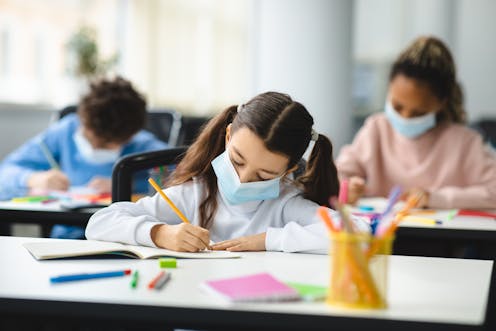
As students return to schools in Victoria and New South Wales after months of lockdowns, many people may be worried about the risks to their kids – and transmission overall.
The role that schools play in transmission of the virus that causes COVID-19 has been difficult to work out, but new evidence can finally answer that question. Schools do amplify community transmission, but the good news is that some relatively simple mitigation measures can make schools much safer places.
To successfully navigate the next phase of the pandemic and protect our kids, we need to switch to a so-called “vaccine-plus[1]” strategy – vaccination together with measures to clean the air[2].
What new evidence says about opening schools
A new study[3] conducted in the United States found school reopening in late 2020 was associated with an increase in COVID-19 cases and deaths.
Some of the increase can be attributed to other restrictions being eased at the same time, and to parents having the ability to return to the workplace, where transmission also occurs.
But importantly, cases and deaths increased most in counties where students and teachers did not have to wear masks at school.
We shouldn’t be surprised at this finding, because face masks are one of the most effective ways to prevent the spread of COVID-19. An investigation into school outbreaks, supported by the US Centers for Disease Control (CDC), found that schools without an indoor mask requirement were 3.5 times more likely to have an outbreak[4] than schools in which students and staff did have to wear masks.
This is why the CDC recommends universal indoor masking[5] by all children aged two and older, as well as teachers and visitors to schools, regardless of whether they’re vaccinated.
More evidence to support masks in schools
One of the reasons it has been hard to see transmission in schools is because children generally have mild symptoms. This leads to infections going undetected. But the picture is very different when researchers actively look for cases.
Read more: Can't get your kid to wear a mask? Here are 5 things you can try[6]
Researchers in Belgium conducted a study[7] where primary school children and their teachers were tested once per week for 15 weeks. They found many instances of transmission between children and adults that spread beyond the school to the children’s parents and to the teachers’ partners. Some mitigation measures were in place in the school, but not mask wearing.
Other measures help too
Perhaps the most dramatic example of failing to protect schools comes from England. Schools reopened this September without a mask mandate and with very little investment in ventilation.
Within one month, random testing showed[8] that 8% of secondary school children and 3% of pre-primary and primary school children had an active infection.
This occurred despite more than 80%[9] of people aged 16 and older having received two vaccine doses. Accordingly, infections in adults were much lower — around 1% or less in all age groups.
This clearly shows that high levels of vaccination in adults aren’t sufficient to protect children, because children easily transmit the virus to each other.
Read more: We may need to vaccinate children as young as 5 to reach herd immunity with Delta, our modelling shows[10]
It also shows that infections in children don’t simply reflect overall community transmission. Schools play a key role in amplifying the spread of COVID-19.
Why we need to protect children
We need to prevent infections in children for a number of reasons. First, although most children with COVID-19 experience mild illness, a small proportion become unwell enough to need hospitalisation[11].
This might not sound like a big problem, but we can expect almost all of Australia’s 3.8 million children to eventually get infected if we don’t vaccinate them. A small proportion of this is a big number, and could easily overwhelm children’s hospitals[12], which is what happened in the US[13].
Children who get COVID-19 can also be left with persistent symptoms, known as long COVID[14]. It’s not clear exactly how often this occurs, but the condition is common enough that England’s National Health Service has set up 15 long COVID clinics[15] for children. In Israel, long COVID clinics have long waiting lists[16].
Read more: No, we can’t treat COVID-19 like the flu. We have to consider the lasting health problems it causes[17]
High levels of transmission in children also leads to educational disruption. Two weeks after the start of the autumn term in England, more than 100,000 children were absent from school[18] due to confirmed or suspected COVID-19.
And children can easily transmit the coronavirus[19] to other children and to adults. This will lead to parents and others in the wider community getting sick, including some vaccinated people.
Although COVID-19 vaccines are very good at preventing severe disease, they’re not perfect, and breakthrough infections can occur[20]. To keep breakthrough infections to a minimum, we must keep community transmission low.
Here’s how we can make schools safer
It’s not difficult to make schools much safer places, but it does require putting more emphasis on cleaning the air rather than cleaning our hands. This is because COVID-19 is caused by an airborne virus[21] that can drift through the air like cigarette smoke.
Independent scientific advisory group OzSAGE recently launched comprehensive guidance[22] on how to prevent this type of transmission in schools.
OzSAGE recommends vaccinating children, their parents, and teachers as soon as possible; increasing ventilation and using HEPA air filters[23] to clean indoor air; and ensuring masks are worn by all staff and children who can safely wear them.
Read more: From vaccination to ventilation: 5 ways to keep kids safe from COVID when schools reopen[24]
These measures will likely have benefits beyond the pandemic. Stuffy air in classrooms isn’t good for learning, and academic outcomes have been shown to improve[25] with ventilation.
Cleaning the air is an investment for our children’s future.
References
- ^ vaccine-plus (insightplus.mja.com.au)
- ^ measures to clean the air (ozsage.org)
- ^ new study (www.pnas.org)
- ^ 3.5 times more likely to have an outbreak (www.cdc.gov)
- ^ recommends universal indoor masking (www.cdc.gov)
- ^ Can't get your kid to wear a mask? Here are 5 things you can try (theconversation.com)
- ^ study (jamanetwork.com)
- ^ random testing showed (www.ons.gov.uk)
- ^ more than 80% (www.gov.uk)
- ^ We may need to vaccinate children as young as 5 to reach herd immunity with Delta, our modelling shows (theconversation.com)
- ^ unwell enough to need hospitalisation (theconversation.com)
- ^ easily overwhelm children’s hospitals (journals.lww.com)
- ^ happened in the US (www.npr.org)
- ^ long COVID (theconversation.com)
- ^ 15 long COVID clinics (www.england.nhs.uk)
- ^ long waiting lists (www.haaretz.com)
- ^ No, we can’t treat COVID-19 like the flu. We have to consider the lasting health problems it causes (theconversation.com)
- ^ more than 100,000 children were absent from school (www.theguardian.com)
- ^ children can easily transmit the coronavirus (theconversation.com)
- ^ breakthrough infections can occur (www.cdc.gov)
- ^ airborne virus (onlinelibrary.wiley.com)
- ^ comprehensive guidance (ozsage.org)
- ^ HEPA air filters (www.cdc.gov)
- ^ From vaccination to ventilation: 5 ways to keep kids safe from COVID when schools reopen (theconversation.com)
- ^ academic outcomes have been shown to improve (www.wired.com)