Australian journalism needs more than better protection, it needs better standards
- Written by: Andrew Podger, Honorary Professor of Public Policy, Australian National University
Australia may be leading the world[1] in measures to protect public interest journalism from the threats arising from media restructuring and news aggregators such as Google and Facebook, but it has yet to properly address the related need for firm professional standards.
At the moment the Australian Press Council[2] deals with complaints about the print and online content of the newspapers, magazines and journals that fund it.
Among those publishers are the two biggest: Nine and News Corp[3].
Other big publishers[4] are not or cannot be members, among them Guardian Australia, The Conversation and the ABC.
A separate Independent Media Council[5] deals with complaints against newspapers operated by Seven-West media, which funds it. The Independent Council handles about 30 complaints a year, whereas the Press Council handles more than 1,000.
Complaints against the news content of licensed radio and television stations are handled by the government’s Australian Communications and Media Authority[6].
There have been attempts to lift standards
It is nearly a decade since
the government’s Finkelstein Review recommended a government-funded statutory body[7] take over the role and functions of the Australian Press Council and the news-related functions of the Communications and Media Authority
the government’s subsequent Convergence Review recommended an industry-led body with some government funding to oversee journalistic standards for news and comment regardless of the platform[8] on which it is posted
Neither recommendation was implemented, though the threat of government regulation did lead to significant reforms[9] to the Press Council on which I served between 2012 and 2021.
The reforms the Council Chair Julian Disney drove strengthened its independence from the organisations that funded it, and its ability to not only to consider complaints but also to review its general principles, develop new standards and guidelines and to establish education and promotion activities.
Read more: 10 years after Finkelstein, media accountability has gone backwards[10]
Publisher members agreed to double their fees and to enter into contracts requiring them to give four years’ notice should they leave. A more rigorous approach was introduced for handling complaints with adjudications being made by panels of members representing the pubic and journalists only.
The government is inching towards more
The government has raised the possibility of trying again, its green paper[11] last year on broadcasting promising to “implement a staged program of reform towards ‘platform neutral’ media regulation”.
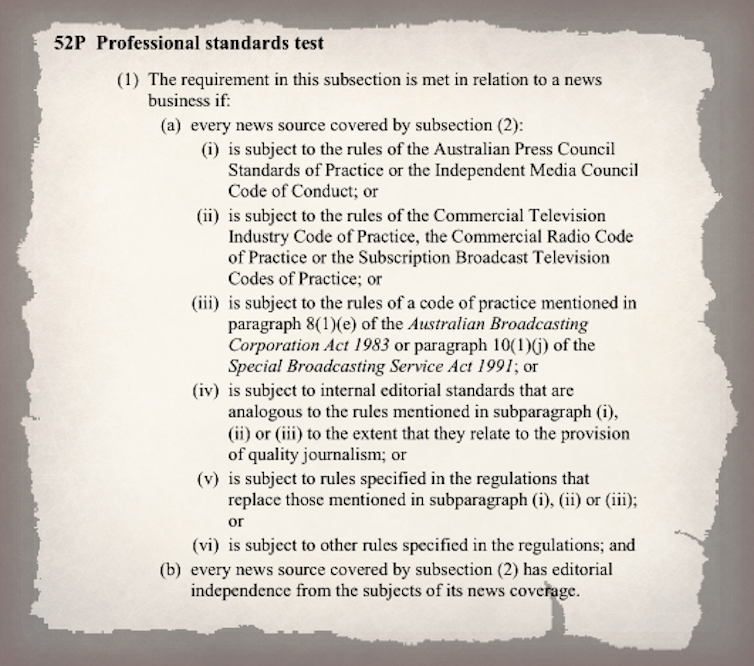
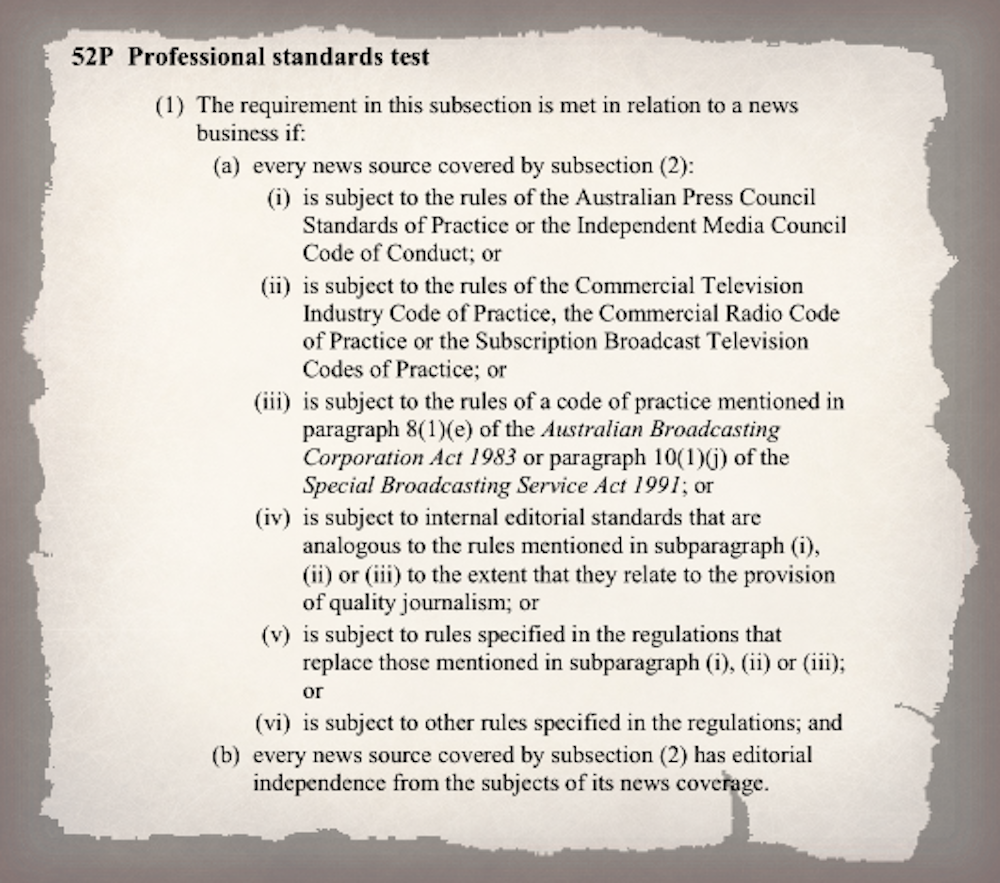
The legislation that set up this year’s mandatory bargaining code[12] with platforms including Facebook edged down this path by requiring news organisations that wanted to use the code to pass a “professional standards test[13]”.
But the test required little more than that they be subject to one of the existing bodies or have internal standards.
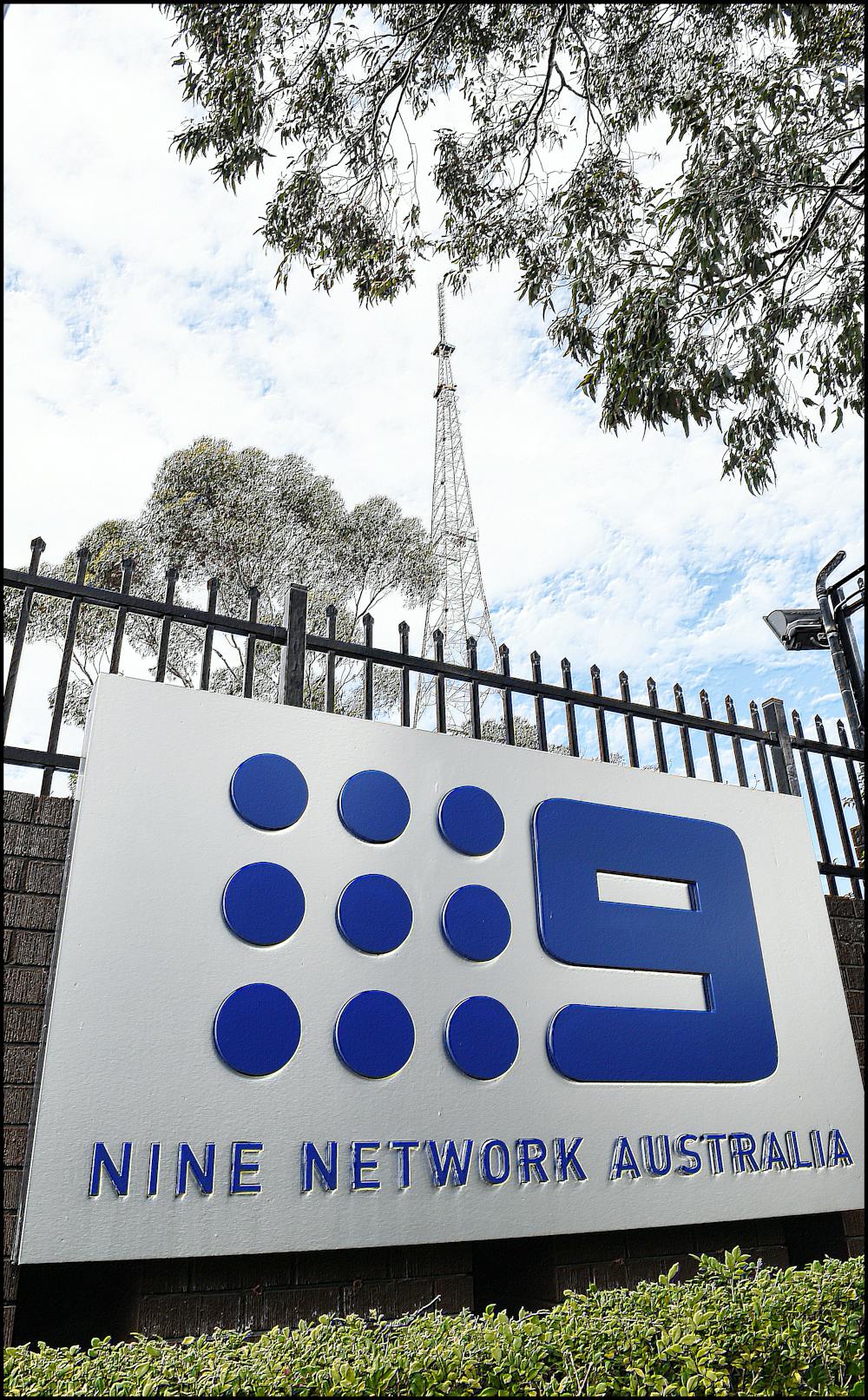 Nine would have its television stations regulated like its newspapers.
Dean Lewins/AAP
The obvious starting point for the second category is to replace or restructure the Press Council.
The ambit of the new or expanded body would include the news and current affairs responsibilities of the Australian Communications and Media Authority.
That way Nine would have its television stations regulated in the same way as its newspapers.
There was a good reason for rejecting the Finkelstein inquiry’s idea of a government-funded statutory authority to replace the council: self-regulation is more consistent with press freedom.
But government funding is almost certainly needed (on top of industry funding) if the council or a body like it is able to do its job properly.
Using spectrum revenue for funding as is proposed for the PING Trust would be one way to providing government funding without government interference.
Read more:
The TV networks holding back the future[22]
Regulating digital publishing is more difficult because much of it is international, although there is a strong case for some form of independent oversight of algorithms to limit the risk of social harm.
One thing that could be done in Australia is for digital platforms and publishers to voluntarily adopt an improved version of the Digital Industry Group’s code.
Users would be able to better assess the quality of information on platforms or sites if they knew whether the source was a member of the Press Council or its replacement and how they could take part in its complaints-handling processes.
References^ leading the world (ministers.treasury.gov.au)^ Australian Press Council (www.presscouncil.org.au)^ Nine and News Corp (www.presscouncil.org.au)^ Other big publishers (www.smh.com.au)^ Independent Media Council (www.independentmediacouncil.com.au)^ Australian Communications and Media Authority (www.acma.gov.au)^ government-funded statutory body (www.abc.net.au)^ regardless of the platform (web.archive.org)^ reforms (www.presscouncil.org.au)^ 10 years after Finkelstein, media accountability has gone backwards (theconversation.com)^ green paper (www.infrastructure.gov.au)^ mandatory bargaining code (www.accc.gov.au)^ professional standards test (www.legislation.gov.au)^ Treasury Laws Amendment (News Media and Digital Platforms Mandatory Bargaining Code) Act 2021 (www.legislation.gov.au)^ Code of Practice on Disinformation and Misinformation (digi.org.au)^ discussion paper (www.acma.gov.au)^ asked for by the authority (www.acma.gov.au)^ Press Council chief fires parting shot at News Corp (theconversation.com)^ Public Interest News Gathering (PING) Trust (minister.infrastructure.gov.au)^ parliamentary inquiry (www.aph.gov.au)^ Media, Entertainment and Arts Alliance (www.meaa.org)^ The TV networks holding back the future (theconversation.com)
Nine would have its television stations regulated like its newspapers.
Dean Lewins/AAP
The obvious starting point for the second category is to replace or restructure the Press Council.
The ambit of the new or expanded body would include the news and current affairs responsibilities of the Australian Communications and Media Authority.
That way Nine would have its television stations regulated in the same way as its newspapers.
There was a good reason for rejecting the Finkelstein inquiry’s idea of a government-funded statutory authority to replace the council: self-regulation is more consistent with press freedom.
But government funding is almost certainly needed (on top of industry funding) if the council or a body like it is able to do its job properly.
Using spectrum revenue for funding as is proposed for the PING Trust would be one way to providing government funding without government interference.
Read more:
The TV networks holding back the future[22]
Regulating digital publishing is more difficult because much of it is international, although there is a strong case for some form of independent oversight of algorithms to limit the risk of social harm.
One thing that could be done in Australia is for digital platforms and publishers to voluntarily adopt an improved version of the Digital Industry Group’s code.
Users would be able to better assess the quality of information on platforms or sites if they knew whether the source was a member of the Press Council or its replacement and how they could take part in its complaints-handling processes.
References^ leading the world (ministers.treasury.gov.au)^ Australian Press Council (www.presscouncil.org.au)^ Nine and News Corp (www.presscouncil.org.au)^ Other big publishers (www.smh.com.au)^ Independent Media Council (www.independentmediacouncil.com.au)^ Australian Communications and Media Authority (www.acma.gov.au)^ government-funded statutory body (www.abc.net.au)^ regardless of the platform (web.archive.org)^ reforms (www.presscouncil.org.au)^ 10 years after Finkelstein, media accountability has gone backwards (theconversation.com)^ green paper (www.infrastructure.gov.au)^ mandatory bargaining code (www.accc.gov.au)^ professional standards test (www.legislation.gov.au)^ Treasury Laws Amendment (News Media and Digital Platforms Mandatory Bargaining Code) Act 2021 (www.legislation.gov.au)^ Code of Practice on Disinformation and Misinformation (digi.org.au)^ discussion paper (www.acma.gov.au)^ asked for by the authority (www.acma.gov.au)^ Press Council chief fires parting shot at News Corp (theconversation.com)^ Public Interest News Gathering (PING) Trust (minister.infrastructure.gov.au)^ parliamentary inquiry (www.aph.gov.au)^ Media, Entertainment and Arts Alliance (www.meaa.org)^ The TV networks holding back the future (theconversation.com)