Chill, this week's news on wages points to anything but hyperinflation
- Written by: Richard Holden, Professor of Economics, UNSW
Suddenly people are talking about inflation, even hyperinflation, in a way they haven’t since the 1980s.
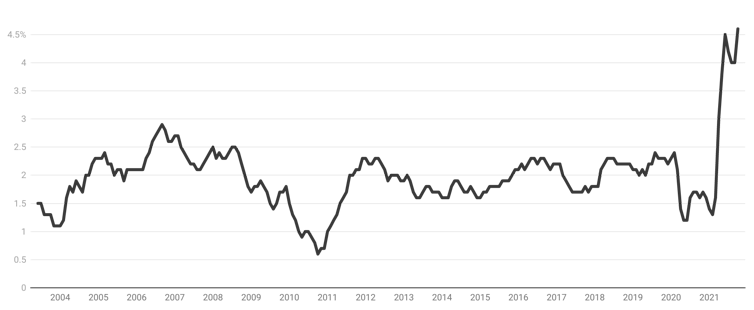
In October the United States posted its highest annual consumer price index increase in 30 years, with inflation up 6.2%[1] and “core” (excluding volatile prices) inflation of 4.6%.
US underlying inflation
US consumer price index for all urban consumers, all items less food and energy, city average. US Bureau of Labor Statistics, St Louis Fed[2]Former US Treasury Secretary Larry Summers – arguably the finest policy economist of his generation – contends that what’s happening is not transitory.
He says soon inflation could soon climb to double digits, where it hasn’t been for 40 years.
There are plenty of other leading economists, including Nobel Prize winner Paul Krugman[3], who argue that what’s happening is just temporary, part of the adjustment to post-pandemic life, akin to the tyres of a car spinning uselessly[4] before they gain traction.
Closer to home, the data are less alarming.
Only 12 of the 55 top economists surveyed by the Economic Society of Australia and The Conversation saw a serious risk of prolonged above-target inflation.
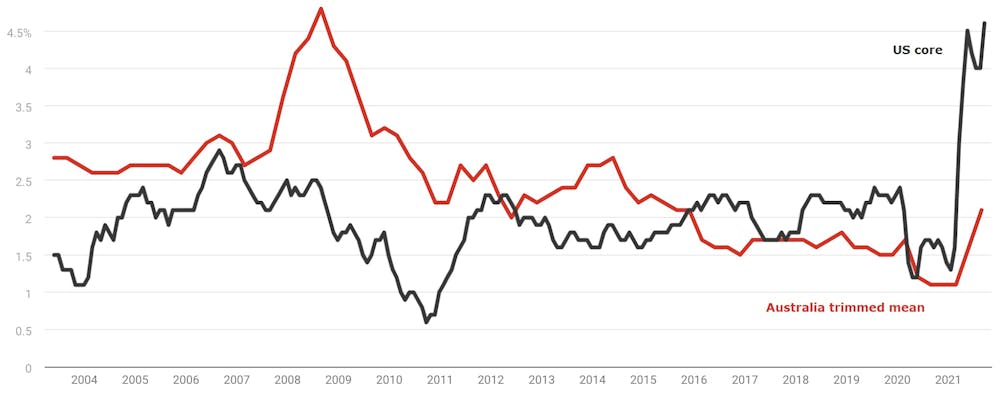
US and Australian underlying inflation
 The Massachusetts Institute of Technology Billion Prices Project[15] has trawled through massive quantities of daily data and arrived at much the same conclusions about inflation as the official data.
Australia’s underlying inflation rate has been below the centre of the Reserve Bank’s target band for a record seven years. Too little inflation runs the risk of causing people to delay buying things, sending the economy backwards, which means it has been important to get inflation back up.
Read more:
What's in the CPI and what does it actually measure?[16]
Doing it, as we are beginning to, ought to be seen as a policy success.
Yes, we have to be careful not to push inflation too high. But we should also be careful to avoid not finishing the job of getting inflation (and wages growth) back to where they should be. We’ve got some way to go.
References^ with inflation up 6.2% (www.bls.gov)^ US Bureau of Labor Statistics, St Louis Fed (fred.stlouisfed.org)^ Paul Krugman (www.nytimes.com)^ spinning uselessly (www.nytimes.com)^ Australian Bureau of Statistics, US Bureau of Labor Statistics (www.abs.gov.au)^ Recent Trends in Inflation (www.rba.gov.au)^ 2.2% (www.abs.gov.au)^ changes in timing (www.abs.gov.au)^ 1.5% (www.abs.gov.au)^ 2.1% (www.abs.gov.au)^ Weimar Republic (scihi.org)^ Top economists see no prolonged high inflation, no rate hike next year (theconversation.com)^ inflation "truthers (noahpinion.substack.com)^ basket (theconversation.com)^ Billion Prices Project (www.thebillionpricesproject.com)^ What's in the CPI and what does it actually measure? (theconversation.com)
The Massachusetts Institute of Technology Billion Prices Project[15] has trawled through massive quantities of daily data and arrived at much the same conclusions about inflation as the official data.
Australia’s underlying inflation rate has been below the centre of the Reserve Bank’s target band for a record seven years. Too little inflation runs the risk of causing people to delay buying things, sending the economy backwards, which means it has been important to get inflation back up.
Read more:
What's in the CPI and what does it actually measure?[16]
Doing it, as we are beginning to, ought to be seen as a policy success.
Yes, we have to be careful not to push inflation too high. But we should also be careful to avoid not finishing the job of getting inflation (and wages growth) back to where they should be. We’ve got some way to go.
References^ with inflation up 6.2% (www.bls.gov)^ US Bureau of Labor Statistics, St Louis Fed (fred.stlouisfed.org)^ Paul Krugman (www.nytimes.com)^ spinning uselessly (www.nytimes.com)^ Australian Bureau of Statistics, US Bureau of Labor Statistics (www.abs.gov.au)^ Recent Trends in Inflation (www.rba.gov.au)^ 2.2% (www.abs.gov.au)^ changes in timing (www.abs.gov.au)^ 1.5% (www.abs.gov.au)^ 2.1% (www.abs.gov.au)^ Weimar Republic (scihi.org)^ Top economists see no prolonged high inflation, no rate hike next year (theconversation.com)^ inflation "truthers (noahpinion.substack.com)^ basket (theconversation.com)^ Billion Prices Project (www.thebillionpricesproject.com)^ What's in the CPI and what does it actually measure? (theconversation.com)