The Times Australia
Google AI
The Times World News

.

Like most of the fashion industry, there's a blind spot in Country Road's ethical focus

  • Written by Harriette Richards, Research Associate, Cultural Studies, The University of Melbourne
Like most of the fashion industry, there's a blind spot in Country Road's ethical focus

Amid the catwalk shows and millinery workshops, a key theme of this year’s Melbourne Fashion Week[1] was sustainablity, “offering designers with strong ethical foundations an opportunity to join our runways, or opening up dialogue on sustainability into our talks program”.

Events during the week included industry representatives discussing “shifting the status quo[2]” and moving “beyond greenwashing[3]”. On the panel at the latter event was Eloise Bishop, head of sustainability at Country Road Group, one of Australia’s largest specialty fashion retailers.

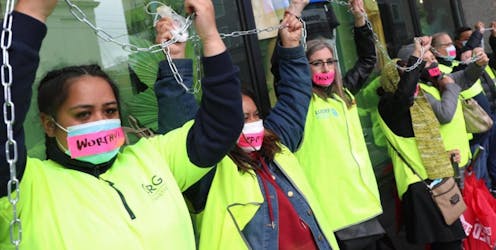
Meanwhile workers from the company were on strike, chaining themselves together and staging other protests outside Country Road stores in pursuit of better wages and working conditions.

Among the complaints of these workers, mostly women from the company’s distribution warehouse in Melbourne’s west, was being paid an average of A$23 an hour[4], compared to about A$30 for workers doing similar work at the Pacific Brands warehouse across the road.

On Monday the workers returned to work after reaching an agreement with the company that includes improved job security, union recognition and a 13.3% pay rise over four years. That’s about an extra $3 an hour.

While this has brought the strike to a celebratory end, questions remain. How could a company so highly regarded for its commitment to sustainability have provoked staff to strike for almost a fortnight?

Lower marks for worker empowerment

Country Road Group is a subsidiary of South Africa’s Woolworths Holdings Ltd[5] (which also owns David Jones). The company’s clothing brands include Country Road, Witchery, Trenery, Politix and Mimco. Despite the pandemic, in the past fiscal year Country Road Group’s sales grew by 13.5% to A$1.05 billion[6].

The company is considered by many an industry leader on ethics and sustainability. The 2021 Ethical Fashion Guide[7] compiled by Baptist World Aid, for example, awarded it an overall “A” grade. It did well on four of five rating criteria, scoring an “A+” on its policies and governance, “A+” for trading and risk, “A” for supplier relationships and human rights monitoring, and another “A” for environmental sustainability.

On worker empowerment, however, it scored just a “C”.

These results suggest the company has a blind spot in addressing concerns about labour conditions in its supply chain.

Country Road Group scores better on environmental sustainability than worker empowerment.
Country Road Group scores better on environmental sustainability than on worker empowerment. Nick-D/Wikimedia, CC BY[8][9]

Supply-chain blind spots

In part because of the disparities between how the fashion industry markets its products and the way workers are treated, the global fashion industry is a notorious example of exploitation engendered by opaque supply chains.

Questions about ethics become divided across asymmetrical lines: the global North as fashion consumer and the global South as fashion producer.

Read more: Why the fashion industry keeps failing to fix labour exploitation[10]

Country Road Group's Modern Slavery Statement
Modern Slavery Statements Register[11] Attempts to bring greater transparency[12] and accountability to these supply chains include Australia’s Modern Slavery Act. This requires large companies to submit an annual statement to a public registry outlining efforts to identify and eliminate the risk of exploitative labour practices. Country Road Group’s 2020 Modern Slavery statement[13] states the company is “committed to upholding the highest social, ethical and environmental standards in its supply chains”. But commitment to ethics is arguably easier when the “problem” of labour rights is far away and things like modern slavery statements (which rely on third party auditing) can help to conceal unethical practices. What happens when the issue is on our doorstep? Read more: At last, Australia has a Modern Slavery Act. Here's what you'll need to know[14] Fair pay for all We often think about the concept of a “living wage[15]” in relation to garment workers overseas. But these warehouse workers told their union representatives they could not afford to live on the wages paid by Country Road Group, much less clothe themselves or their children in the very garments they pick and pack at the warehouse. According to industry body the Australian Fashion Council[16], 77% of the 489,000 workers employed in Australia’s fashion and textile industry’s workforce are female. This makes fair pay and conditions in the industry an important driver of women’s economic advancement. Industrial action is about more than money; it is about respect and recognition. Responsibility for change in the fashion industry is frequently feminised[17]. Women are not only the primary workforce; they are at the front lines of sustainable action, consumer activism and labour rights movements. It was a proposed strike by members of the International Ladies Garment Workers Union in New York in 1909 that led to the establishment of International Women’s Day[18]. The move towards sustainability and ethical production in the fashion industry is necessary. But if action does not extend to the realities of all workers across the supply chain, the rhetoric is empty. Note: co-author Lauren Kate Kelly is a researcher with the United Workers’ Union, which covers Country Road warehouse employees.

References

  1. ^ Melbourne Fashion Week (mfw.melbourne.vic.gov.au)
  2. ^ shifting the status quo (mfw.melbourne.vic.gov.au)
  3. ^ beyond greenwashing (mfw.melbourne.vic.gov.au)
  4. ^ A$23 an hour (www.news.com.au)
  5. ^ Woolworths Holdings Ltd (www.woolworthsholdings.co.za)
  6. ^ A$1.05 billion (www.smh.com.au)
  7. ^ 2021 Ethical Fashion Guide (baptistworldaid.org.au)
  8. ^ Nick-D/Wikimedia (commons.wikimedia.org)
  9. ^ CC BY (creativecommons.org)
  10. ^ Why the fashion industry keeps failing to fix labour exploitation (theconversation.com)
  11. ^ Modern Slavery Statements Register (modernslaveryregister.gov.au)
  12. ^ transparency (www.google.com)
  13. ^ 2020 Modern Slavery statement (modernslaveryregister.gov.au)
  14. ^ At last, Australia has a Modern Slavery Act. Here's what you'll need to know (theconversation.com)
  15. ^ living wage (oxford.universitypressscholarship.com)
  16. ^ Australian Fashion Council (ausfashioncouncil.com)
  17. ^ feminised (www.tandfonline.com)
  18. ^ International Women’s Day (www.harpersbazaar.com)

Read more https://theconversation.com/like-most-of-the-fashion-industry-theres-a-blind-spot-in-country-roads-ethical-focus-172295

Times Magazine

Worried AI means you won’t get a job when you graduate? Here’s what the research says

The head of the International Monetary Fund, Kristalina Georgieva, has warned[1] young people ...

How Managed IT Support Improves Security, Uptime, And Productivity

Managed IT support is a comprehensive, subscription model approach to running and protecting your ...

AI is failing ‘Humanity’s Last Exam’. So what does that mean for machine intelligence?

How do you translate ancient Palmyrene script from a Roman tombstone? How many paired tendons ...

Does Cloud Accounting Provide Adequate Security for Australian Businesses?

Today, many Australian businesses rely on cloud accounting platforms to manage their finances. Bec...

Freak Weather Spikes ‘Allergic Disease’ and Eczema As Temperatures Dip

“Allergic disease” and eczema cases are spiking due to the current freak weather as the Bureau o...

IPECS Phone System in 2026: The Future of Smart Business Communication

By 2026, business communication is no longer just about making and receiving calls. It’s about speed...

The Times Features

Parks Victoria launches major statewide recruitment drive

The search is on for Victoria's next generation of rangers, with outdoor enthusiasts encouraged ...

Labour crunch to deepen in 2026 as regional skills crisis escalates

A leading talent acquisition expert is warning Australian businesses are facing an unprecedented r...

Technical SEO Fundamentals Every Small Business Website Must Fix in 2026

Technical SEO Fundamentals often sound intimidating to small business owners. Many Melbourne busin...

Most Older Australians Want to Stay in Their Homes Despite Pressure to Downsize

Retirees need credible alternatives to downsizing that respect their preferences The national con...

The past year saw three quarters of struggling households in NSW & ACT experience food insecurity for the first time – yet the wealth of…

Everyday Australians are struggling to make ends meet, with the cost-of-living crisis the major ca...

The Week That Was in Federal Parliament Politics: Will We Have an Effective Opposition Soon?

Federal Parliament returned this week to a familiar rhythm: government ministers defending the p...

Why Pictures Help To Add Colour & Life To The Inside Of Your Australian Property

Many Australian homeowners complain that their home is still missing something, even though they hav...

What the RBA wants Australians to do next to fight inflation – or risk more rate hikes

When the Reserve Bank of Australia (RBA) board voted unanimously[1] to lift the cash rate to 3.8...

Do You Need a Building & Pest Inspection for New Homes in Melbourne?

Many buyers assume that a brand-new home does not need an inspection. After all, everything is new...