China's school textbooks reflect the rise of Xi Jinping's personality cult
- Written by: Shih-Wen Sue Chen, Senior Lecturer in Writing and Literature, Deakin University
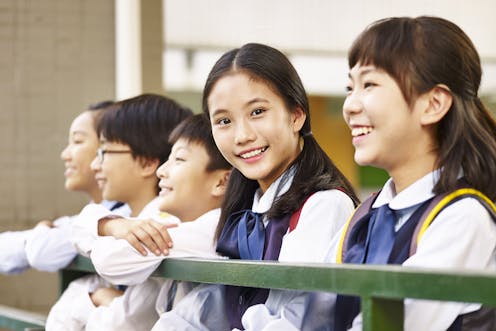
When students in China returned to classrooms in September 2021, they were provided with a new series of textbooks[1] outlining China’s president Xi Jinping, or “Grandpa Xi’s”, political philosophy[2].
Each textbook on “Xi Jinping Thought on Socialism with Chinese Characteristics for the New Era”, as Xi’s political philosophy is officially called, is tailored to students at primary, secondary, and tertiary levels.
“Xi Jinping Thought” was enshrined into the Chinese Communist Party’s (CCP) Constitution[3] in 2017. Although the main stated aims are to remain committed to reform and build a “moderately prosperous society”, the realities[4] of this political philosophy has been a tightening of party discipline and curtailing of social freedom.
Read more: China's sixth plenum will consolidate Xi Jinping's power and chart the country's ambitions for the next 5 years[5]
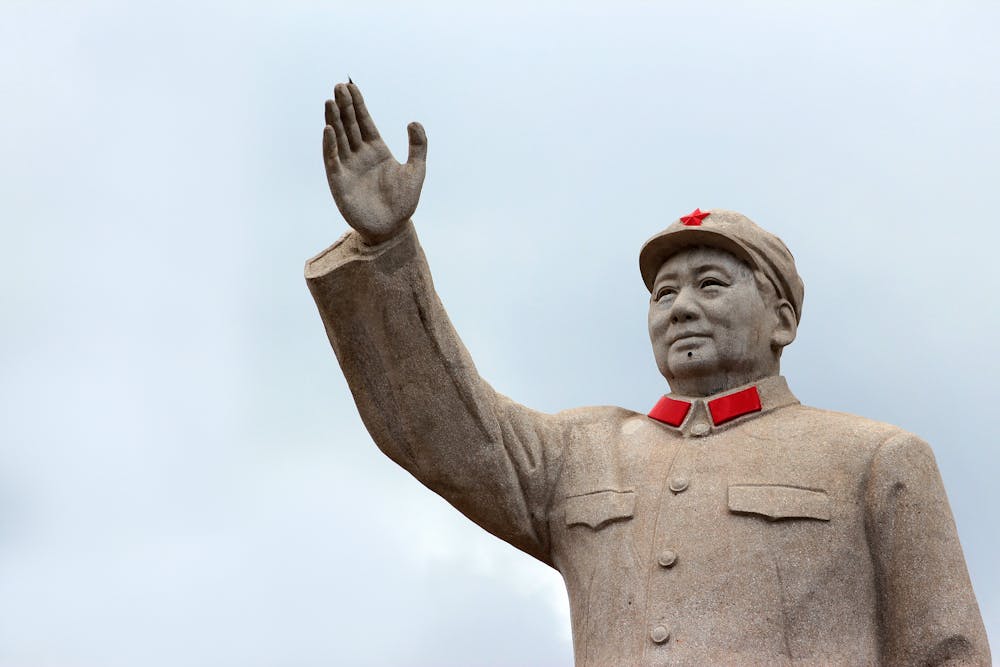
While prior textbooks were focused on the CCP, the new versions centre on China’s paramount leader. In this way they reflect the growing personality cult of Xi Jinping, eerily reminiscent of the days of China’s founding father Mao Zedong.
The rise of the personality cult
According to China’s National Textbook Committee[6], the
textbooks reflect the will of the Communist Party of China and the nation and directly impact the direction and quality of talent cultivation.
In particular, the Committee[7] stated:
Primary schools should foster love and right understanding for the Party, country and socialism in students.
The core socialist values[8] highlighted in the textbooks include prosperity, patriotism and friendship.
Targeted at children, the moniker of “Grandpa Xi” is part of the ongoing strategy towards creating a personality cult in China. Authoritarian regimes like the Soviet Union also used the grandfather figure (“Grandpa Lenin”) as part of propaganda aimed at children. This enhanced Lenin’s personality cult[9] across the Soviet nations.
Political scientist Pao-min Chang[10] defines the personality cult as
The artificial elevation of the status and authority of one man […] through the deliberate creation, projection and propagation of a godlike image.
Like Lenin, a personality cult around Mao Zedong emerged during China’s Cultural Revolution (1966–1976). Although later leaders Deng Xiaoping, the architect of China’s economic reform, and Wen Jiabao, who was Premier between 2003 and 2013, are popularly known as “Grandpa Deng” and “Grandpa Wen,” they did not overtly push for this image.
Xi returns to Mao in his efforts to build a personality cult[11] around himself. Since coming to power, he has cultivated the image of being “a man of the people” in a bid to make his authoritarianism more palpable to the masses.
Little red children and Grandpa Xi
The new primary school textbooks emphasise Xi’s wisdom, friendliness and care for the children. Early signs of this strategy can be seen in government propaganda video, Grandpa Xi is Our Big Friend, that circulated online in 2015.
The video was recorded[12] at Yan'an Yucai Primary School in Shaanxi. The location is significant because the school was founded by Mao Zedong in 1937.
Read more: Xi Jinping puts his stamp on Communist Party history, but is his support as strong as his predecessors?[13]
In the video, Xi Jinping is not presented as a distant authority figure. Instead, Grandpa Xi is a caring “big friend.” The children sing that his “warm smile” is “brighter than the sun.” Images of children waving sunflowers and lyrics that describe Xi’s visit as “better than the warmth of a spring day” serve to accentuate his friendly disposition.
Most importantly, the children sing about the need to “study diligently” to “achieve the Chinese Dream”. This dream is Xi Jinping’s vision for China to become a prosperous society.
The children wear red scarves and red stars in the video. These symbols[15] represent the national flag. The colour red alludes to the blood of revolutionary martyrs[16]. They remind children of their connection to the nation and the Party.
Xi wears a red scarf in the video. In one scene, he places a red scarf over the shoulders of a child. This accessory and gesture are depicted in the 2021 primary school textbooks as well. The act of placing a scarf on a child signifies children taking on the mantle of happily fulfilling Grandpa Xi’s vision.
The CCP’s Young Pioneers
The textbook for lower primary students contain photos of Xi planting trees with children and meeting them at school.
The books include statements such as:
Grandpa Xi Jinping is very busy with work, but no matter how busy he is, he still joins our activities and cares about our growth.
Xi shares his memories of being emotional when joining the Young Pioneers of China (the CCP’s youth organisation) in 1960. He then invites readers to describe their own feelings about becoming a part of the Young Pioneers, thus encouraging young people to join.
The textbooks use illustrations with speech bubbles to make the ideological content more interesting. Some illustrations are of students sitting around a table teaching each other Grandpa Xi’s expectations to become a person of “good moral character” and who is “diligent and thrifty”.
The books also emphasise acquiring knowledge about “science and technology,” as well as being “creative and innovative”.
The children must cultivate these markers of good citizenship to become what the books refer to as “qualified builders and successors of socialism”. This rhetoric of children as the hope of the nation[17] has been in use since the late nineteenth century.
Read more: Academic Chongyi Feng: profits, freedom and China’s 'soft power' in Australia[18]
The emphasis on being “qualified” suggests children must live up to the expectations set out by Xi. The textbooks imply this is only possible because of Grandpa Xi’s continued care for them.
This image of Grandpa Xi as a “big friend” is a gentler form of propaganda than that seen during Mao’s Cultural Revolution. Propaganda aimed at children during the Cultural Revolution positioned the Party as the surrogate parent. It also highlighted children’s violence[19] as they fought for the socialist cause. Young Red Guards sang patriotic songs and read the Little Red Book. These rituals fostered Mao’s cult of personality.
It remains to be seen whether the new school curriculum is a harbinger of future deification of Xi Jinping.
References
- ^ new series of textbooks (mobile.twitter.com)
- ^ political philosophy (www.aljazeera.com)
- ^ Constitution (www.xinhuanet.com)
- ^ realities (journals.openedition.org)
- ^ China's sixth plenum will consolidate Xi Jinping's power and chart the country's ambitions for the next 5 years (theconversation.com)
- ^ National Textbook Committee (www.chinadaily.com.cn)
- ^ Committee (www.chinadaily.com.cn)
- ^ core socialist values (www.chinadaily.com.cn)
- ^ personality cult (link.springer.com)
- ^ Pao-min Chang (www.jstor.org)
- ^ personality cult (utsynergyjournal.org)
- ^ recorded (www.dwnews.com)
- ^ Xi Jinping puts his stamp on Communist Party history, but is his support as strong as his predecessors? (theconversation.com)
- ^ Shutterstock (www.shutterstock.com)
- ^ symbols (muse.jhu.edu)
- ^ martyrs (doi.org)
- ^ hope of the nation (cup.cuhk.edu.hk)
- ^ Academic Chongyi Feng: profits, freedom and China’s 'soft power' in Australia (theconversation.com)
- ^ children’s violence (books.google.co.nz)