a history warrior who worked for a better Australia
- Written by: Janet McCalman AC, Emeritus Redmond Barry Distinguished Professor, The University of Melbourne
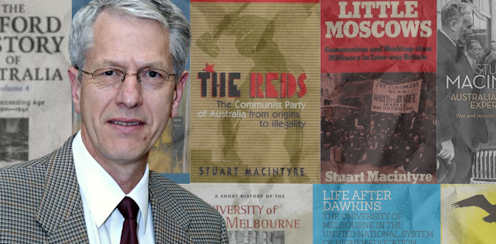
Stuart Macintyre has gone. To those whose lives touched his, an Australian history community without him seems hugely empty.
For almost half a century he was there in the lives and work of his students, his colleagues, his comrades and his friends. He was one of those commanding people against whom others measure their ideas, their work and their politics. He has gone far too early, but he has left an extraordinary legacy.
He was assiduous. He always answered letters and later, emails, immediately. He was a close and constructive critic of his students’ work and a dedicated supervisor. While he taught general Australian history, many will remember his classes on the working class in history and literature with deep pleasure. As an academic leader he was assured. As a historian in the public realm, he was an unrelenting defender of good scholarship and academic freedom.
He was the prime target of the conservatives in the history wars[1] and condemned as a partisan scholar by other frankly partisan scholars[2] , but I remember well his generous reconciliation with Geoffrey Blainey[3] some years later. He was a history warrior[4] for the discipline of history.
Read more: The past is not sacred: the 'history wars' over Anzac[5]
He had deep feelings: for his family and friends, his heritage, his institutions, his comrades, and for a fairer world. He took a not uncommon path from Scotch College to the Communist Party. On leaving the Party, he remained its best historian[6] and his final work, the second volume[7] of that history, is just about to be released : he lived just long enough to complete it despite withering chemotherapy.
But his public legacy will be the books. His productivity was prodigious, and many have been not a little envious. But again, that productivity came from his assiduousness: sitting down every night he was home to write for two hours. He had, like many great historians, a highly retentive memory and an epic collection of books that he had actually read. For everyone it was “ask Stuart” and Stuart would know.
That command of detail, and the years in the archives, made him our greatest historian of politics and society from the late 19th century to the present day.
He was fascinated by political actors, largely male because of the times, and he probed character, ideas and actions forensically. They were not all “great men”, but they were powerful and influential figures from all sides of politics.
He opened his volume for the Oxford History of Australia — The Succeeding Age, 1901-1942[8] — with portraits of five Australians: one of them the tycoon father of a distinguished politician who became a baron; another Australia’s finest lyric poet labouring in heartbreak land, forever longing for the lovely woman he was too poor and sick to marry; a working man who became a man of substance; a poor woman beset by loss and poverty and an Aboriginal stockman forced to straddle his traditional world and working for rations for whites.
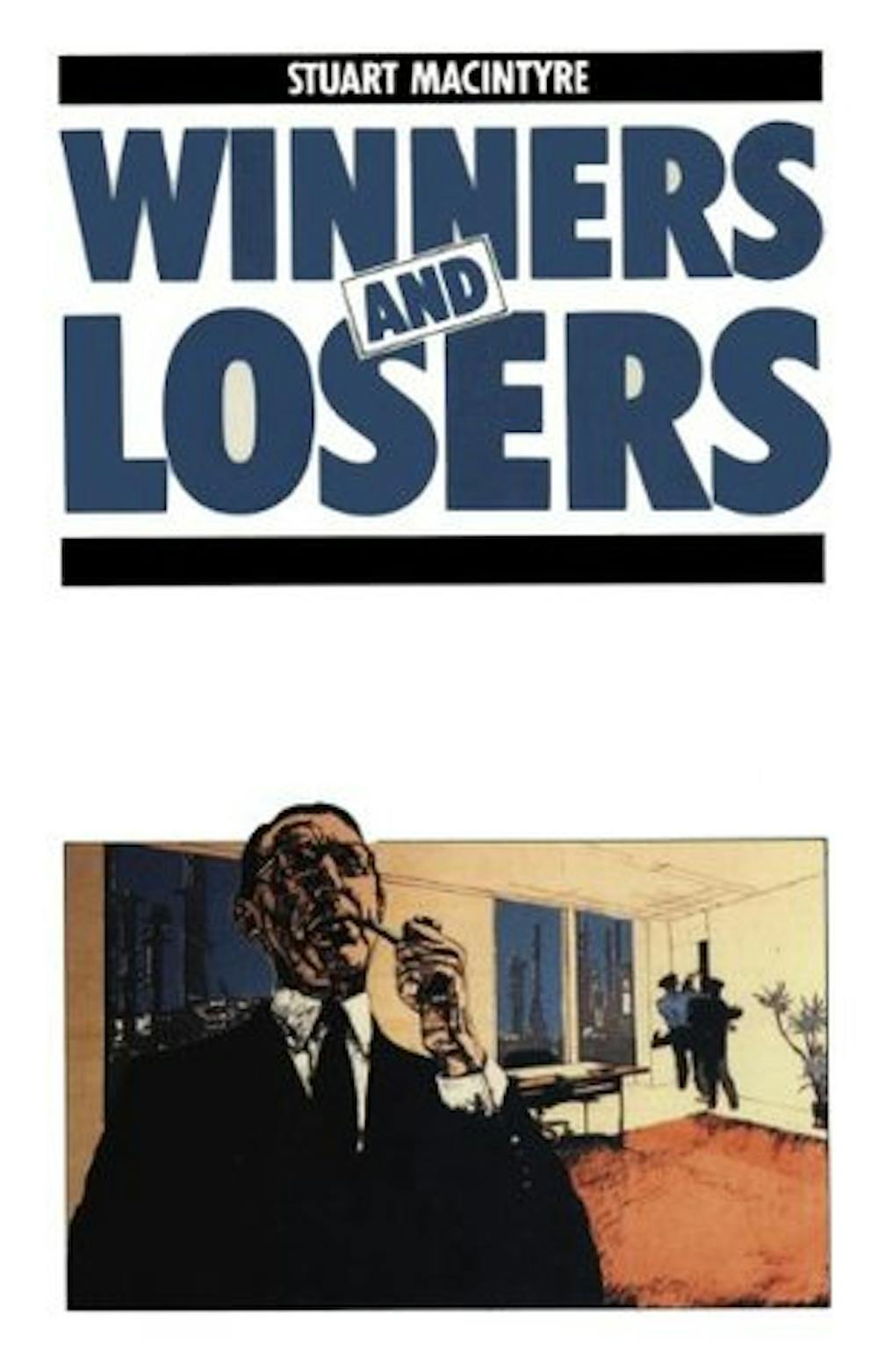
 goodreads
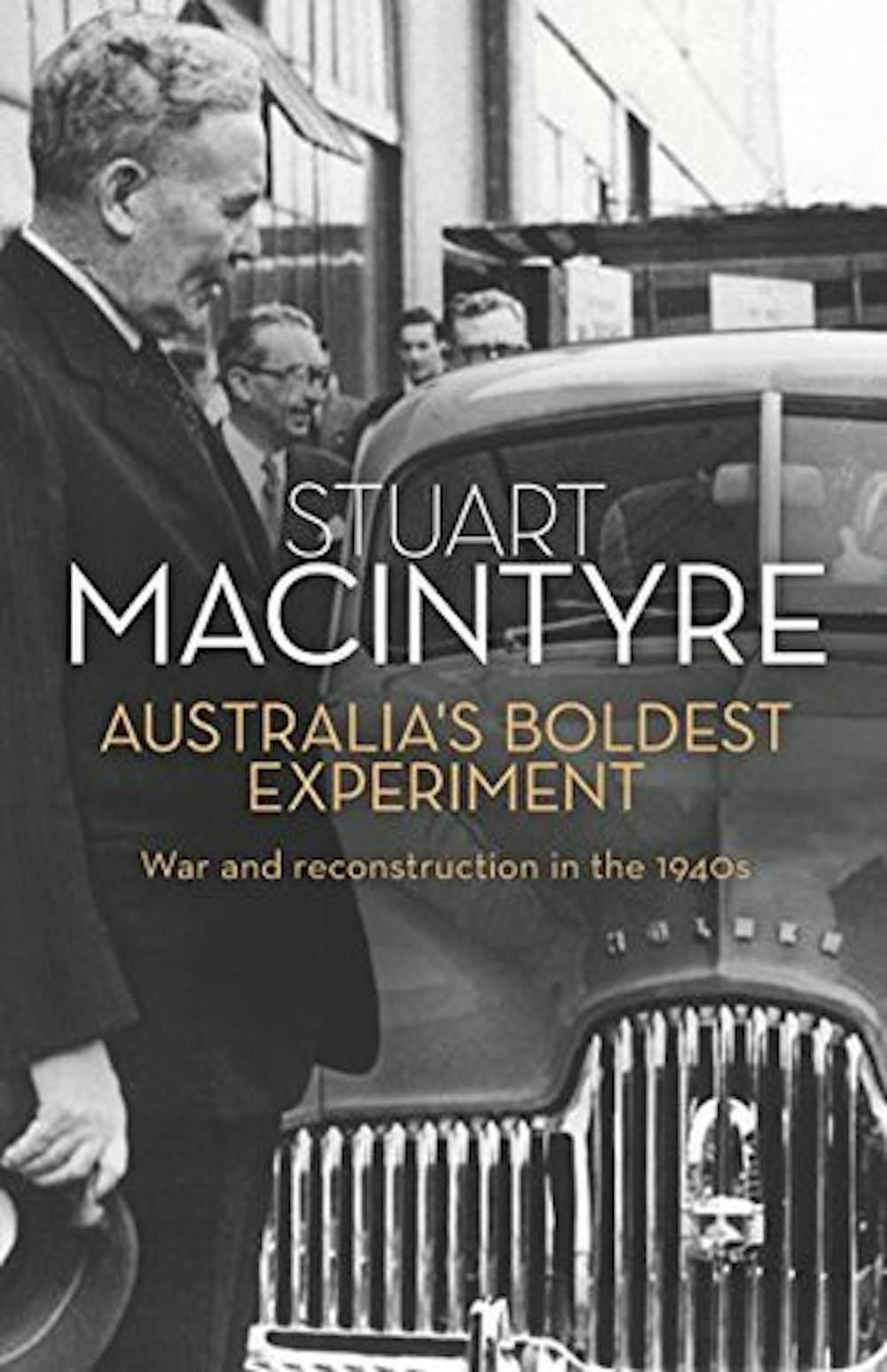
His greatest work is arguably his penultimate monograph: Australia’s Boldest Experiment: war and reconstruction in the 1940s[14] (published in 2015). It promises to be his most influential because for our own time of existential crisis, he shows how Labor prime ministers, John Curtin and Ben Chifley, advised by the brilliant public servant Dr H.C. Coombs, began building modern Australia amidst the stringencies of war: to win the peace as well as the war.
It is a book about political vision and moral courage, and it is now the bible of the Albanese Labor Party. Macintyre’s greatest legacy may yet be written in a better Australia, and it’s the one that would please him most.
References^ in the history wars (www.goodreads.com)^ partisan scholars (quadrant.org.au)^ Geoffrey Blainey (en.wikipedia.org)^ history warrior (search.library.uq.edu.au)^ The past is not sacred: the 'history wars' over Anzac (theconversation.com)^ its best historian (www.goodreads.com)^ second volume (www.allenandunwin.com)^ Oxford History of Australia — The Succeeding Age, 1901-1942 (www.goodreads.com)^ winners and losers (www.goodreads.com)^ he understood (www.goodreads.com)^ A Proletarian Science (www.goodreads.com)^ colonial liberalism (www.goodreads.com)^ history and place (www.goodreads.com)^ Australia’s Boldest Experiment: war and reconstruction in the 1940s (www.goodreads.com)
goodreads
His greatest work is arguably his penultimate monograph: Australia’s Boldest Experiment: war and reconstruction in the 1940s[14] (published in 2015). It promises to be his most influential because for our own time of existential crisis, he shows how Labor prime ministers, John Curtin and Ben Chifley, advised by the brilliant public servant Dr H.C. Coombs, began building modern Australia amidst the stringencies of war: to win the peace as well as the war.
It is a book about political vision and moral courage, and it is now the bible of the Albanese Labor Party. Macintyre’s greatest legacy may yet be written in a better Australia, and it’s the one that would please him most.
References^ in the history wars (www.goodreads.com)^ partisan scholars (quadrant.org.au)^ Geoffrey Blainey (en.wikipedia.org)^ history warrior (search.library.uq.edu.au)^ The past is not sacred: the 'history wars' over Anzac (theconversation.com)^ its best historian (www.goodreads.com)^ second volume (www.allenandunwin.com)^ Oxford History of Australia — The Succeeding Age, 1901-1942 (www.goodreads.com)^ winners and losers (www.goodreads.com)^ he understood (www.goodreads.com)^ A Proletarian Science (www.goodreads.com)^ colonial liberalism (www.goodreads.com)^ history and place (www.goodreads.com)^ Australia’s Boldest Experiment: war and reconstruction in the 1940s (www.goodreads.com)