Could we really deflect an asteroid heading for Earth? An expert explains NASA's latest DART mission
- Written by: Gail Iles, Senior Lecturer in Physics, RMIT University
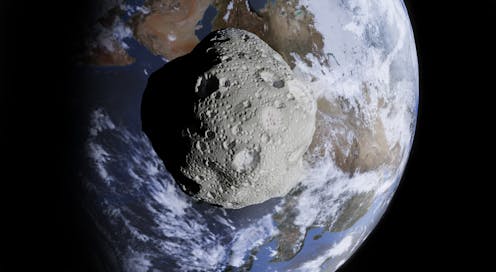
A NASA spacecraft the size of a golf cart has been directed to smash into an asteroid, with the intention of knocking it slightly off course. The test aims to demonstrate our technological readiness in case an actual asteroid threat is detected in the future.
The Double Asteroid Redirection Test (DART) lifted off aboard a SpaceX rocket from California on November 23, and will arrive at the target asteroid system in September, next year.
The mission will travel to the asteroid Didymos, a member of the Amor group of asteroids[1]. Every 12 hours Didymos is orbited by a mini-moon, or “moonlet”, Dimorphos. This smaller half of the pair will be DART’s target.
Are we facing an extinction threat from asteroids?
We’ve all seen disaster movies in which an asteroid hits Earth, creating an extinction event similar to the one that killed off the dinosaurs millions of years ago. Could that happen now?
Well, Earth is actually bombarded frequently by small asteroids, ranging from 1-20 metres in diameter. Almost all asteroids of this size disintegrate in the atmosphere and are usually harmless.
There is an inverse relationship[2] between the size of these object and the frequency of impact events. This means we get hit much more frequently by small objects than larger ones – simply because there are many more smaller objects in space.
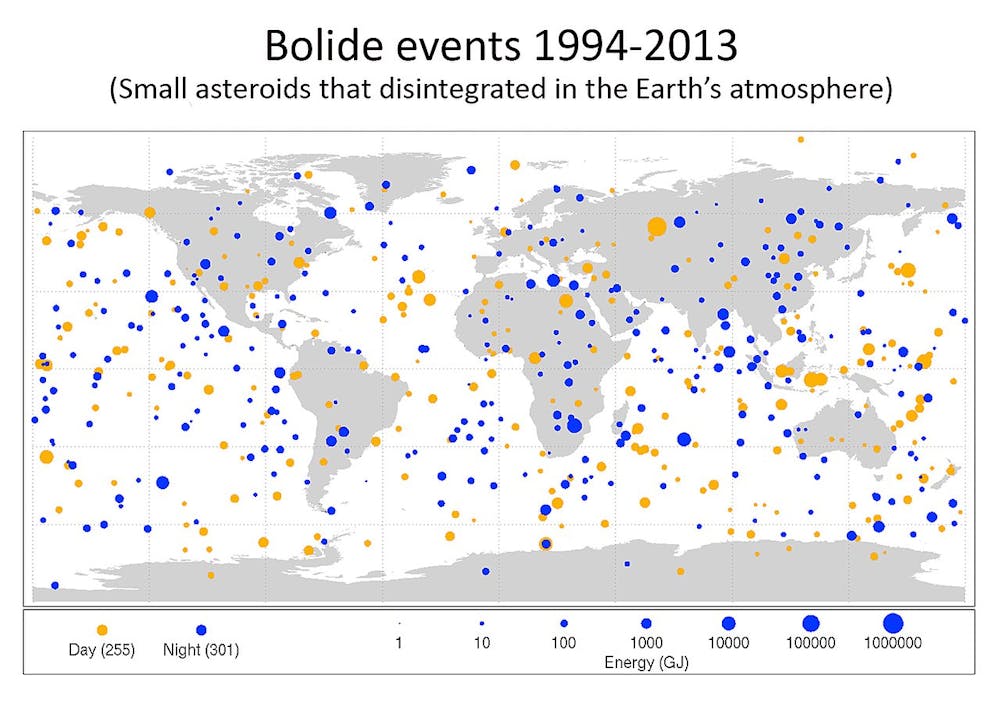
Asteroids with a 1km diameter strike Earth every 500,000 years, on average. The most “recent” impact of this size is thought to have formed the Tenoumer impact crater in Mauritania[3], 20,000 years ago. Asteroids with an approximate 5km diameter impact Earth about once every 20 million years.
The 2013 Chelyabinsk meteoroid[4], which damaged buildings in six Russian cities and injured around 1,500 people, was estimated to be about 20m in diameter.
Assessing the risk
NASA’s DART mission has been sparked by the threat and fear of a major asteroid hitting Earth in the future.
The Torino scale[5] is a method for categorising the impact hazard associated with a near-Earth object (NEO). It uses a scale from 0 to 10, wherein 0 means there is negligibly small chance of collision, and 10 means imminent collision, with the impacting object being large enough to precipitate a global disaster.
The Chicxulub impact[6] (which is attributed to the extinction of non-avian dinosaurs) was a Torino scale 10. The impacts that created the Barringer Crater, and the 1908 Tunguska event, both correspond to Torino Scale 8.
With the increase of online news and individuals’ ability to film events, asteroid “near-misses” tend to generate fear in the public. Currently, NASA is keeping a close eye on asteroid Bennu, which is the object with the largest “cumulative hazard rating” right now. (You can keep up to date too[7]).
With a 500m diameter, Bennu is capable of creating a 5km crater on Earth. However, NASA has also said there is a 99.943% chance the asteroid will miss us.
Brace for impact
At one point in their orbit around the Sun, Didymos and Dimorphos come within about 5.9 million km of Earth. This is still further away than our Moon, but it’s very close in astronomical terms, so this is when DART will hit Dimorphos.
DART[8] will spend about ten months travelling towards Didymos and, when it’s close by, will change direction slightly to crash into Dimorphos at a speed of about 6.6km per second.
The larger Didymos is 780m in diameter and thus makes a better target for DART to aim for. Once DART has detected the much smaller Dimorphos, just 160m in diameter, it can make a last-minute course correction to collide with the moonlet.
The mass of Dimorphos is 4.8 million tonnes and the mass of DART at impact will be about 550kg. Travelling at 6.6km/s, DART will be able to transfer a huge amount of momentum to Dimorphos, to the point where it’s expected to actually change the moonlet’s orbit around Didymos.
This change, to the tune of about 1%, will be detected by ground telescopes within weeks or months. While this may not seem like a lot, 1% is actually a promising shift. If DART were to slam into a lone asteroid, its orbital period around the Sun would change by only about 0.000006%, which would take many years to measure.
 The DART mission dates and timeline events.
Johns Hopkins University
The DART mission dates and timeline events.
Johns Hopkins University
So we’ll be able to detect the 1% change from Earth, and meanwhile the pair will continue along its orbit around the Sun. DART will also deploy a small satellite ten days before impact to capture everything.
This is NASA’s first mission dedicated to demonstrating a planetary defence technique[9]. At a cost of US$330 million, it’s relatively cheap in space mission terms. The James Webb Telescope[10] set to launch next month, costs close to US$10 billion[11].
There will be little to no debris from DART’s impact. We can think of it in terms of a comparable event on Earth; imagine a train parked on the tracks but with no brakes on. Another train comes along and collides with it.
The trains won’t break apart, or destroy one another, but will move off together. The stationary one will gain some speed, and the one impacting it will lose some speed. The trains combine to become a new system with different speeds than before.
So we won’t experience any impact, ripples or debris from the DART mission.
Is the effort really worth it?
Results from the mission will tell us just how much mass and speed is needed to hit an asteroid that may pose a threat in the future. We already track the vast majority of asteroids that come close to Earth, so we would have early warning of any such object.
That said, we have missed objects in the past[12]. In October 2021, Asteroid UA_1[13] passed about 3,047km from Earth’s surface, over Antarctica. We missed it because it approached from the direction of the Sun. At just 1m in size it wouldn’t have caused much damage, but we should have seen it coming.
Building a deflection system for a potential major asteroid threat would be difficult. We would have to act quickly and hit the target with very good aim.
One candidate for such a system could be the new technology developed by the US spaceflight company SpinLaunch[14], which has designed technology to launch satellites into orbit at rapid speeds. This device could also be used to fire masses at close-passing asteroids.
Read more: Where do meteorites come from? We tracked hundreds of fireballs streaking through the sky to find out[15]
References
- ^ Amor group of asteroids (cneos.jpl.nasa.gov)
- ^ inverse relationship (en.wikipedia.org)
- ^ Tenoumer impact crater in Mauritania (en.wikipedia.org)
- ^ 2013 Chelyabinsk meteoroid (earthsky.org)
- ^ Torino scale (en.wikipedia.org)
- ^ Chicxulub impact (www.planetary.org)
- ^ up to date too (cneos.jpl.nasa.gov)
- ^ DART (dart.jhuapl.edu)
- ^ planetary defence technique (www.nasa.gov)
- ^ James Webb Telescope (www.nasa.gov)
- ^ US$10 billion (www.planetary.org)
- ^ missed objects in the past (www.livescience.com)
- ^ Asteroid UA_1 (en.wikipedia.org)
- ^ SpinLaunch (www.spinlaunch.com)
- ^ Where do meteorites come from? We tracked hundreds of fireballs streaking through the sky to find out (theconversation.com)