Medical examiners and coroners have borne a heavy burden during the COVID-19 pandemic and have often felt invisible and unsupported
- Written by: Staci Zavattaro, Professor of Public Administration, University of Central Florida
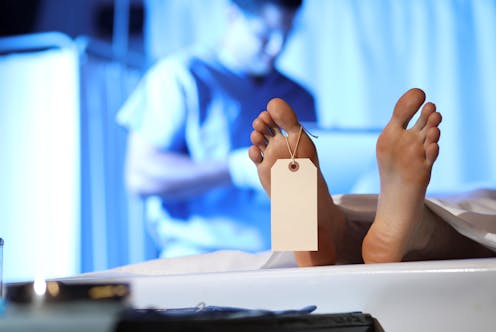
“We stopped doing heads.”
It was the second time I’d heard a medical examiner say this while I was studying how the roles of medical examiners and coroners have changed during the COVID-19 pandemic.
A medical examiner from Ohio explained to me that opening a skull is one of the most dangerous parts of an autopsy[1] in the COVID-19 era. This is because the kind of saw often used during autopsies has a beating motion that produces aerosols – among the primary modes of transmission[2] of SARS-CoV-2, the virus that causes COVID-19. The medical examiner explained that his office would not open a skull unless absolutely necessary for the exam and then would use a high-powered vacuum to reduce particle spread from the process.
This was one of several policies[3] and practices medical examiners and coroners in the U.S. had to change when adapting to the ongoing pandemic.
In the early months of the pandemic, doctors and nurses – or “front-line” health care workers – received much-deserved praise and recognition for their heroic actions. This included New Yorkers banging on pots and pans[4] every night at 7 p.m. and Denver residents howling like wolves at 8 p.m. in support of front-line workers for months in 2020 – a tradition that returned in 2021[5] a year after the pandemic began.
But “death care” workers such as coroners and medical examiners, who also are providing critical services during the ongoing pandemic, have been far less celebrated and recognized. Yet they have been struggling under the unceasing pressure of excess deaths[6], backed-up funeral systems[7] and increased data-gathering responsibilities[8]. They have also had to take on additional tasks of reporting COVID-19 data for public health purposes. And these workers have suffered a lot of burnout[9].
I am a public administration professor[10] who is studying public servants in death care services[11]. My work has highlighted the need to better understand the complex roles that these medical professionals play, especially when much of their work is unseen and not well understood by the general public.
The roles of medical examiners and coroners
Since the beginning of the pandemic, medical examiners and coroners have dealt with repeated COVID-19 surges that as of November 2021 have left more than 768,000[13] Americans dead. Public health and reporting requirements following COVID-19 deaths added to these professionals’ already heavy workloads.
Medical examiners and coroners[14] are public servants charged with carrying out medical, scientific and legal death investigations. Medical examiners have board-certified medical training in pathology, forensic pathology or another associated medical field and are appointed by county commissioners or other leaders. Coroners[15], who receive training in medical and legal investigation, are elected to their roles by voters.
Outside of the context of COVID-19, these death care workers are called in to investigate suspicious, unnatural deaths. The process of death investigation in the U.S. is complicated and bureaucratic, and each state sets its own criteria[16]. Some states have medical examiner systems, others have a coroner system, while still others might have a hybrid approach.
The COVID-19 pandemic has highlighted the need for additional safety precautions to reduce exposure and spread[17] for the protection of medical examiners, coroners and death investigation teams.
COVID-19 and excess deaths
Throughout the pandemic, public-facing offices of medical examiners’ and coroners’ offices might have closed, following COVID-19 guidelines, but the behind-the-scenes operations accelerated. The Centers for Disease Control and Prevention estimates that COVID-19[18] contributed to more than 902,000[19] excess deaths[20] – meaning deaths in addition to those statistically projected[21] for an area based on past trends – in the U.S. as of late November 2021.
From Bexar County, Texas, Feb. 24, 2021: One example of the increased workload faced by death care workers during the pandemic.One challenge that became critical in the early months of the pandemic was distinguishing cause of death from manner of death. Cause of death[22] refers to a specific and immediate injury, disease or condition that led to a death. Manner of death[23] is a medical and legal description grouping deaths into five categories for public health purposes: natural, accident, homicide, suicide or undetermined.
These distinctions are critical for accurately tracking and reporting whether someone died from COVID-19-related complications or whether someone died while carrying the virus but from another cause such as a car accident or heart attack, for example. Initially, there was no agreed-upon standard[24] for deciding what constituted a COVID-19-related death. As COVID-19 deaths surged early in the pandemic, some people began to question those numbers[25], given the medical complexities and unknowns associated with the virus. The CDC eventually provided guidance[26] in April 2020 on how COVID-19 deaths should be officially reported.
Supporting death care workers as the pandemic drags on
Research has shown that – long before the pandemic – medical examiners and coroners, who deal daily with psychological stressors such as handling human remains and talking with grieving families, were at high risk of depression and post-traumatic stress[27]. COVID-19 has taken an already stressful job and added additional pressure[28].
A 2020 study collected stories from forensic workers[29] at the University of Michigan who had to drastically change policies for their personal safety while also finding ways to support and assist grieving families. For example, when social distancing rules prohibited in-person memorial services, the team devised thoughtful ways to use photographs to preserve a loved one’s memory. For example, one biomedical photographer provided families with high-quality photos of their loved one’s hands or tattoos.
[Over 140,000 readers rely on The Conversation’s newsletters to understand the world. Sign up today[30].]
The ongoing pandemic means death care workers are still providing these much-needed services to families. One quality and research manager I spoke with from a medical examiner’s office in Minnesota noted that people who work at funeral homes are often left out of the support network that health care professionals have received during the pandemic. “People believe that health care ends at death, and it does not,” he said.
References
- ^ dangerous parts of an autopsy (doi.org)
- ^ primary modes of transmission (www.cdc.gov)
- ^ one of several policies (doi.org)
- ^ New Yorkers banging on pots and pans (www.npr.org)
- ^ returned in 2021 (www.msn.com)
- ^ excess deaths (www.cdc.gov)
- ^ backed-up funeral systems (www.abcactionnews.com)
- ^ increased data-gathering responsibilities (www.aamc.org)
- ^ lot of burnout (fortune.com)
- ^ public administration professor (scholar.google.com)
- ^ studying public servants in death care services (www.taylorfrancis.com)
- ^ Gina Ferazzi/Los Angeles Times via Getty Images (www.gettyimages.com)
- ^ have left more than 768,000 (www.cdc.gov)
- ^ Medical examiners and coroners (www.ncbi.nlm.nih.gov)
- ^ Coroners (www.cdc.gov)
- ^ each state sets its own criteria (www.cdc.gov)
- ^ reduce exposure and spread (www.cdc.gov)
- ^ estimates that COVID-19 (www.cdc.gov)
- ^ more than 902,000 (www.cdc.gov)
- ^ excess deaths (doi.org)
- ^ deaths in addition to those statistically projected (theconversation.com)
- ^ Cause of death (www.clarkcountyohio.gov)
- ^ Manner of death (www.clarkcountyohio.gov)
- ^ there was no agreed-upon standard (www.aamc.org)
- ^ question those numbers (www.aamc.org)
- ^ CDC eventually provided guidance (www.cdc.gov)
- ^ high risk of depression and post-traumatic stress (doi.org)
- ^ added additional pressure (www.ama-assn.org)
- ^ collected stories from forensic workers (doi.org)
- ^ Sign up today (memberservices.theconversation.com)