The US is making plans to replace all of its lead water pipes from coast to coast
- Written by: Gabriel Filippelli, Chancellor's Professor of Earth Sciences and Executive Director, Indiana University Environmental Resilience Institute, IUPUI
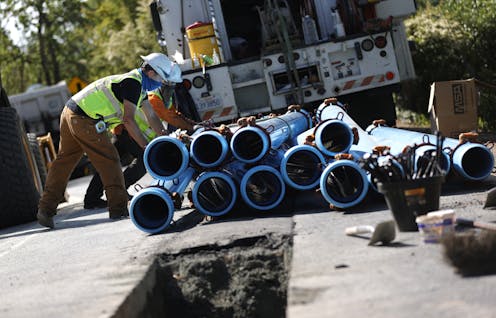
The Biden administration has released a plan to accelerate removal of lead water pipes and lead paint[1] from U.S. homes. As a geochemist and environmental health researcher[2] who has studied the heartbreaking impacts of lead poisoning in children for decades, I am happy to see high-level attention paid to this silent killer, which disproportionately affects poor communities of color[3].
Childhood lead poisoning has declined significantly in the U.S.[4] over the past 50 years. That’s largely due to the elimination of leaded gasoline in the 1980s and the banning of most lead-based paints.
But the U.S. Environmental Protection Agency estimates that up to 10 million households and 400,000 schools and child care centers[5] have service lines or other fixtures that contain lead. These pipes are ticking time bombs that can leach toxic lead into drinking water if they corrode. As long as they remain in service, children and families are vulnerable.
The same is true of lead paint, which is still present in many homes built before consumer use of lead paint was banned in 1978. Because it tastes sweet, children sometimes chew on paint chips or painted wood.
The Biden administration will spend US$15 billion[6] from the recently enacted infrastructure bill to replace lead service lines, faucets and fixtures over the next five years and is seeking additional money in the pending Build Back Better Act[7] to reduce lead hazards in public housing and low-income communities. I see this as a key priority, since Black children and children living in poverty have average blood lead levels that are 13% higher than the national average.
Lead poisoning does permanent damage
Lead poisoning is a major public health problem because lead has permanent impacts on the brain, particularly in children. Young brains are still actively forming[8] the amazing network of neurons that comprise their hardware.
Neurons are designed to use calcium, the most abundant mineral in the human body, as a transmitter to rapidly pass signals. Lead molecules look a lot like calcium molecules, so if they are present in a child’s body, they can penetrate the brain, impair neuron development and cause permanent neural damage.
Children with lead poisoning have lower IQs, poor memory recall, high rates of attention deficit disorder and low impulse control. They tend to perform poorly at school[9], which reduces their earning potential as adults. They also face increased risk of kidney disease[10], stroke and hypertension[11] as they age. Research has found strong connections between lead poisoning and incarceration for violent crimes[12].
Today researchers estimate that about 500,000 U.S. children[13] still have elevated blood lead levels. Health experts widely agree that there is no known “safe” blood lead concentration[14].
Where are the lead pipes?
The Biden administration’s plan calls for replacing 100% of lead service lines across the nation – a goal that the EPA aims to write into regulations by 2024[15]. Step 1 is finding the pipes.
Most U.S. cities have countless miles of lead service lines buried beneath streets and sidewalks and feeding into people’s homes. Utilities don’t know where many of these aging lines are and don’t have enough data to map them. Replacing them will require significant analysis, modeling, data and some guesswork.
Old service lines have caused lead poisoning outbreaks in such places as Washington, D.C.; Flint, Michigan[16]; and Newark, New Jersey[17]. The chemistry is a bit different[18] in each case.
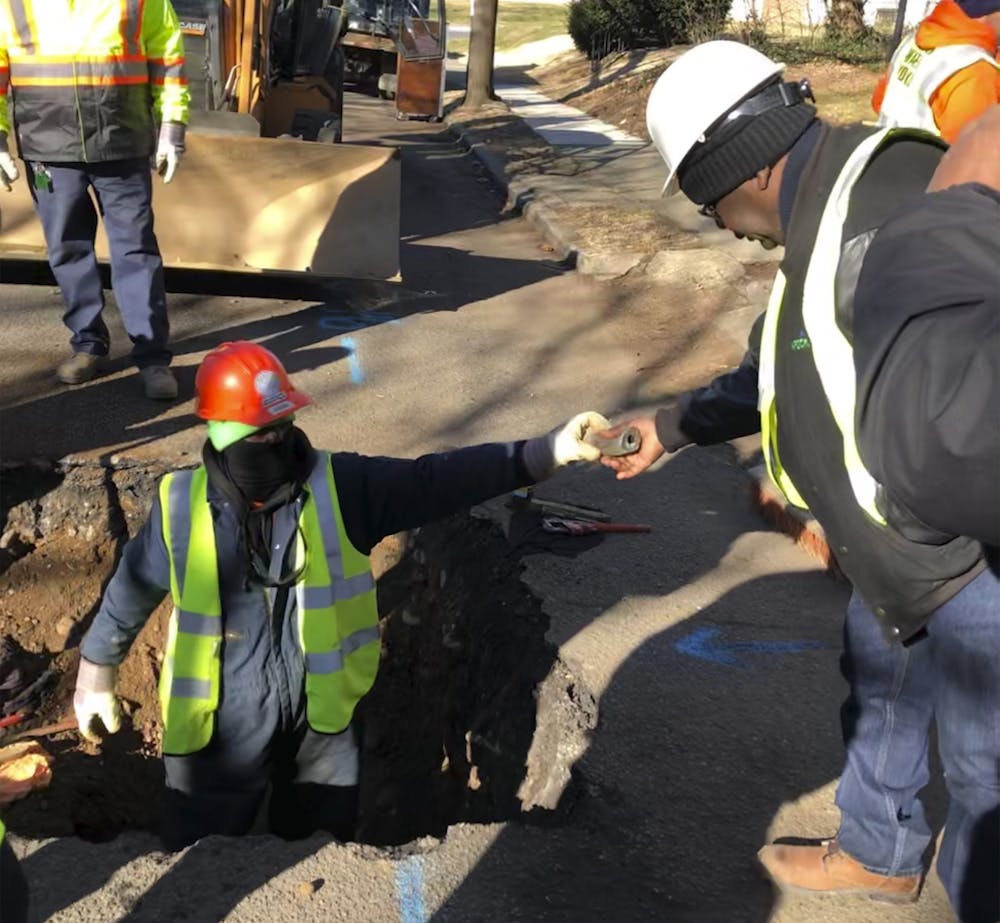
Lead service lines typically develop a protective “plaque” of minerals on their inside walls after a short time, which effectively separates the toxic lead pipe from the water flowing through it. This coating, which is called scale, remains stable if the chemistry of the water coursing through it doesn’t change. But if that chemistry is altered, disaster can ensue.
In 2002, Washington, D.C., shifted from chlorine to chloramine for treating its water supply. Chloramine is a more modern disinfectant that does not form dangerous reactive chlorinated byproducts[20] as chlorine can.
This rapidly corroded the protective plaque lining the city’s pipes, flushing highly absorbable lead into homes. Tens of thousands of children were exposed[21] over two years before the problem was adequately identified and fixed.
In Flint, state-appointed managers decided to save money during a fiscal crisis in 2014 by switching from Detroit water to water from the Flint River. But regulators did not require enough chemical analysis[22] to determine what additives should be used to maintain the pipe plaque. And they skipped the typical step of adding phosphate, which binds chemically with lead and prevents it from leaching out of pipes, in order to save about $100 per day[23].
Corrosion chemistry is well controlled in many U.S. cities, but it is not a perfect science. And utilities don’t always have detection systems that adequately alert water suppliers to dangers at the tap. That’s why removing lead pipes is the only sure way to avoid the threat of more water crises.
Households can use some basic tests to identify water pipes that may be made of lead.Cities will need to innovate
While $15 billion is a big investment, experts agree that it’s not enough to replace all lead pipes nationwide[24]. For example, the estimated cost of replacing all of Flint’s lead service lines is about $50 million[25] – and there are thousands of U.S. cities to fix[26].
My own city, Indianapolis, has a population of about 850,000 – about 10 times larger than Flint – and officials have only a rough idea of where to find the lead service lines. There are ways to statistically model[27] the likelihood that a given portion of the water system has lead service lines, using information such as water main sizes, locations and construction dates, but they are imperfect.
Cities will need to get creative to make whatever funds they get go as far as possible. As one example, I am working with colleagues to develop a citizen science project that will provide thousands of tests for lead at taps around Indianapolis[28]. This effort, a partnership with the University of Notre Dame funded by the U.S. Department of Housing and Urban Development, may augment modeling with real data on levels of lead in homes, and will increase public awareness of this issue.
[Over 140,000 readers rely on The Conversation’s newsletters to understand the world. Sign up today[29].]
In spite of these challenges, I believe more urgency on this issue is long overdue. Every lead pipe that’s replaced will pay off in higher lifetime earnings and lower rates of illness for families that gain access to safer tap water.
This is an updated version of an article[30] originally published on May 4, 2021.
References
- ^ lead water pipes and lead paint (www.whitehouse.gov)
- ^ geochemist and environmental health researcher (scholar.google.com)
- ^ disproportionately affects poor communities of color (doi.org)
- ^ declined significantly in the U.S. (doi.org)
- ^ up to 10 million households and 400,000 schools and child care centers (www.whitehouse.gov)
- ^ will spend US$15 billion (www.whitehouse.gov)
- ^ Build Back Better Act (www.congress.gov)
- ^ still actively forming (developingchild.harvard.edu)
- ^ perform poorly at school (www.cdc.gov)
- ^ kidney disease (www.kidney.org)
- ^ stroke and hypertension (doi.org)
- ^ incarceration for violent crimes (www.brookings.edu)
- ^ about 500,000 U.S. children (www.aafp.org)
- ^ no known “safe” blood lead concentration (www.who.int)
- ^ write into regulations by 2024 (www.nbcboston.com)
- ^ Flint, Michigan (www.britannica.com)
- ^ Newark, New Jersey (www.njspotlight.com)
- ^ The chemistry is a bit different (doi.org)
- ^ AP Photo/Mike Catalini (newsroom.ap.org)
- ^ form dangerous reactive chlorinated byproducts (theconversation.com)
- ^ Tens of thousands of children were exposed (www.washingtonpost.com)
- ^ did not require enough chemical analysis (doi.org)
- ^ about $100 per day (www.scientificamerican.com)
- ^ it’s not enough to replace all lead pipes nationwide (www.brookings.edu)
- ^ about $50 million (www.freep.com)
- ^ thousands of U.S. cities to fix (www.vox.com)
- ^ statistically model (www.wateronline.com)
- ^ thousands of tests for lead at taps around Indianapolis (www.hud.gov)
- ^ Sign up today (memberservices.theconversation.com)
- ^ article (theconversation.com)