It's still not too late to fix the rapid antigen testing debacle. Why the national cabinet decision is wrong and must be reversed
- Written by: Stephen Duckett, Director, Health and Aged Care Program, Grattan Institute
Yesterday’s national cabinet meeting[1] was called to address another COVID crisis – not the crisis about burgeoning case numbers, nor the crisis about hospital staff being overwhelmed.
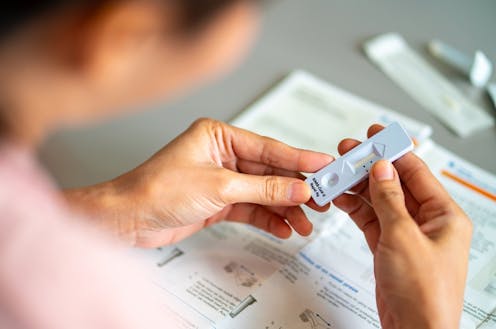
This crisis was of the Commonwealth’s own making – what to do about the mess it is in about pricing and availability of rapid antigen tests[2] for use at home.
The problem was foreseeable. The UK government ordered rapid antigen tests from manufacturers in January 2021[3]. The tests have been distributed to the public since April 2021[4]. Sooner or later it was inevitable pressure would mount for the same policy in Australia.
Read more: Rapid antigen tests have long been used overseas to detect COVID. Here's what Australia can learn[5]
There were 4 options
Before this week’s national cabinet meeting, the Commonwealth government had four options.
1. Head in sand, fingers in ears, problem goes away
This was tried and failed[6]. A variant of this was to attempt to deflect the issue as being about removing GST on rapid antigen tests[7]. That also failed and GST on the tests remain.
2. Encourage states to provide free tests
This has also been tried, with the Commonwealth offering a 50% subsidy[8] to states that come on board. Some have accepted the deal to make rapid antigen tests available in some circumstances[9], but not universally. Details of these circumstances are still unclear.
3. Implement a 2-tier scheme with rapid antigen tests free for the identified poor and not for others
This is an inequitable throwback to the pre-Medicare world. It suffers from a key problem of any means-tested program. There will be those at the margins of eligibility who cannot afford the test but need to use it.
Pathology tests are covered by Medicare, with out-of-hospital tests almost universally bulk billed[10] (so largely free to the consumer). This and the free availability of PCR tests create important precedents for universal free access to rapid antigen tests.
Politically, means-testing also lays the Commonwealth open to a “Mediscare[11]” type campaign, with accusations the government is seeking to undermine Medicare.
4. Make rapid antigen tests free
This would have heeded the calls of public health experts, the medical profession[12] and economists[13] to make rapid antigen tests free, as a critical public health screening tool.
Here’s what happened
The Commonwealth leaned on the states into supporting option three with a touch of option two.
Over 6 million Australians[14] will get access to ten rapid antigen tests to use at home over a three-month period. It is unclear how this number was set. Close contacts in Victoria, for example, are recommended to use five rapid antigen tests for each exposure[15] to a known case.
Free tests will be distributed through pharmacies to check people’s eligibility, presumably adding an extra cost in the distribution chain. Pharmacies will presumably be paid to manage this process.
New rules make it harder to track virus spread
At national cabinet on December 30, close contacts were redefined as people exposed for more than four hours[16]. This was designed to reduce pressure on testing centres and it did. However, this move immediately underestimated the true COVID rate in the community. Those asymptomatic people with COVID, but exposed for less than four hours, no longer presented for testing.
National cabinet yesterday further hampered the government’s ability to monitor case numbers by more actions to reduce demand on testing. In all states other than Western Australia, people with a positive rapid antigen test no longer need to have a confirmatory PCR test.
Both changes make it harder to track the progress of the virus.
Read more: Taking your first rapid antigen test? 7 tips for an accurate result[17]
Bad public health and bad economics
The national cabinet outcome on rapid antigen tests fails on two criteria for decision-making during a pandemic: what is good for the public health and what is sensible economically.
A public health fail
The main public health objective during a pandemic is to minimise transmission – this was the point of the extended lockdowns in south-east Australia and the main point of mask mandates and state border closures. A secondary objective is to minimise the impact of COVID on those infected, mainly via vaccinations.
The public health rationale for home rapid antigen tests rests on their role in reducing the likelihood infectious people will go out and infect others. People should therefore be encouraged to use the test if worried about transmitting the virus, particularly if asymptomatic. So from a public health perspective, we want to maximise the use of rapid antigen tests to reduce asymptomatic but potentially infectious people spreading the virus.
Read more: Home rapid antigen testing is on its way. But we need to make sure everyone has access[18]
Young people generally have more social contacts and are more likely to spread the virus. Unfortunately, young people are less likely to be eligible for free tests under the Commonwealth’s means-testing regime, and also less likely to be able to afford the tests. They will therefore likely use the test less than would be desirable on public health grounds and this will in turn lead to more spread of the virus, including to higher-risk, older relatives.
An economic fail
The economic case for widespread rapid antigen tests rests on two bases. The main benefit from my use of this test falls on other people – if I test positive, I isolate and don’t infect others.
In a normal market the price of a product reflects the benefit (utility) that I get from it. For rapid antigen tests, most of the benefit falls on others and so the price set in the market will not lead to the optimum number of tests been purchased. As the objective is to maximise people who think they may spread COVID using the test, the price of a rapid antigen test should be zero or as close to that as possible.
Read more: Morrison's political judgement goes missing on rapid antigen test debacle[19]
Because rapid antigen tests are cheap to produce and the cost to the community of infections is high, there is also a cost-effectiveness argument for maximising use of rapid antigen tests.
One argument against rapid antigen tests is so-called moral hazard – if a product is free people might consume too much of it. The evidence about moral hazard is weak[20]. But sticking a swab up one’s nose is not pleasant and so is probably sufficient deterrent against frivolous use.
We need a u-turn
Despite the national cabinet decisions, the case for free rapid antigen tests remains. People who want to do the right thing will continue to be annoyed at having to pay to protect others. The community will not be as well protected as it should be.
This is yet another wrong decision by the Commonwealth government in its mishandling of the pandemic, and it should urgently reverse its decision and provide free rapid antigen tests for everyone.
Read more: Australia has not learned the lessons of its bungled COVID vaccine rollout[21]
References
- ^ national cabinet meeting (www.pm.gov.au)
- ^ rapid antigen tests (theconversation.com)
- ^ January 2021 (www.gov.uk)
- ^ April 2021 (www.gov.uk)
- ^ Rapid antigen tests have long been used overseas to detect COVID. Here's what Australia can learn (theconversation.com)
- ^ tried and failed (www.theage.com.au)
- ^ removing GST on rapid antigen tests (www.afr.com)
- ^ 50% subsidy (www.pm.gov.au)
- ^ in some circumstances (www.aap.com.au)
- ^ almost universally bulk billed (www1.health.gov.au)
- ^ Mediscare (theconversation.com)
- ^ medical profession (www.ama.com.au)
- ^ economists (www.afr.com)
- ^ Over 6 million Australians (www.pm.gov.au)
- ^ five rapid antigen tests for each exposure (www.coronavirus.vic.gov.au)
- ^ more than four hours (www.pm.gov.au)
- ^ Taking your first rapid antigen test? 7 tips for an accurate result (theconversation.com)
- ^ Home rapid antigen testing is on its way. But we need to make sure everyone has access (theconversation.com)
- ^ Morrison's political judgement goes missing on rapid antigen test debacle (theconversation.com)
- ^ moral hazard is weak (academic.oup.com)
- ^ Australia has not learned the lessons of its bungled COVID vaccine rollout (theconversation.com)