How to respond and avoid panic
- Written by: Flavio Macau, Associate Dean Teaching & Learning, Edith Cowan University

Australia has experienced plenty of supermarket shortages since the COVID pandemic began. The emerging crisis now is a bit different.
In 2020 and 2021, empty shelves were due to spikes in demand, as shoppers responded to lockdowns by buying more toilet paper, pasta and other consumables. This disrupted the usual rhythms of predictable supply chains. Apart from the first wave in March 2020, shortages were localised.
Now the shortages are due to supply-side problems, and occurring (almost) nationally. As Omicron infections surge in every state apart from Western Australia, supply chains are being crippled by the sheer number of transport, distribution and shop workers now sick or required to isolate.
The major problem now is in transport and distribution. The Transport Workers’ Union says a third to half[1] of Australia’s truck drivers are off work. Woolworths chief executive Brad Banducci said on Friday[2] more than 20% of distribution centre staff and more 10% of store workers are absent.
There are also problems in production, particularly in meat processing – an industry prone to the spread of COVID-19[3]. Hundreds of workers in eastern states abattoirs are off work, according to Meat Industry Council chief executive Patrick Hutchinson. He has warned[4] of severe shortages within weeks due to the lack of rapid antigen tests.
Read more: Treating workers like meat: what we've learnt from COVID-19 outbreaks in abattoirs[5]
A self-fulfilling crisis
Then, of course, there is the response of shoppers to shortages (or the expectation of shortages). We’ve seen how this works multiple times: products disappear from shelves, people buy more in response. Fear of shortages become a self-fulfilling prophecy.
Coles has already imposed buying limits[6] on certain meat items (except for WA) and warned customers to expect shortages for all of January. Woolworths and ALDI have not (apart from limits on hard-to-get rapid antigen tests).
But they might be forced to. That depends mostly on what happens in the next weeks in NSW, which plays a large role in national grocery logistics and where COVID-19 infections are surging.
So what to do?
What you can do
Open your freezer, go to your pantry. Do you have three weeks’ worth of essential items? Mince, pasta, rice, flour, beans, toilet paper?
I’ve been following these issues closely over the past two years. All of Australia’s supermarket supply crises were dealt with in less than three weeks. You really don’t need more than that.
If you don’t have three weeks’ supply, and have both the space and money to stock, go for it. If not now, because there is a shortage, then in the next opportunity. This is not about panic-buying or hoarding. I’m not suggesting you buy a year’s worth of toilet paper or tinned food. Just always have enough so you can have peace of mind next time.
Read more: Disagreeability, neuroticism and stress: what drives panic buying during the COVID-19 pandemic[7]
Supermarket restrictions
The pandemic has exposed the brittleness of just-in-time supply-chain management, which over decades honed the amount of stock held by manufacturers, wholesalers and retailers to a minimum. This was fine for maximising profits in good times. Now the times call for more of a just-in-case approach, with enough flexibility to avoid the system collapsing in a crisis.
Supermarkets have already made changes to avoid repeats of the supply crises of 2020 and 2021 by keeping more stock on hand. But this alone can’t solve the problem. The grocery business is competitive. Floor and refrigeration space is finite. They can’t afford to overstock.
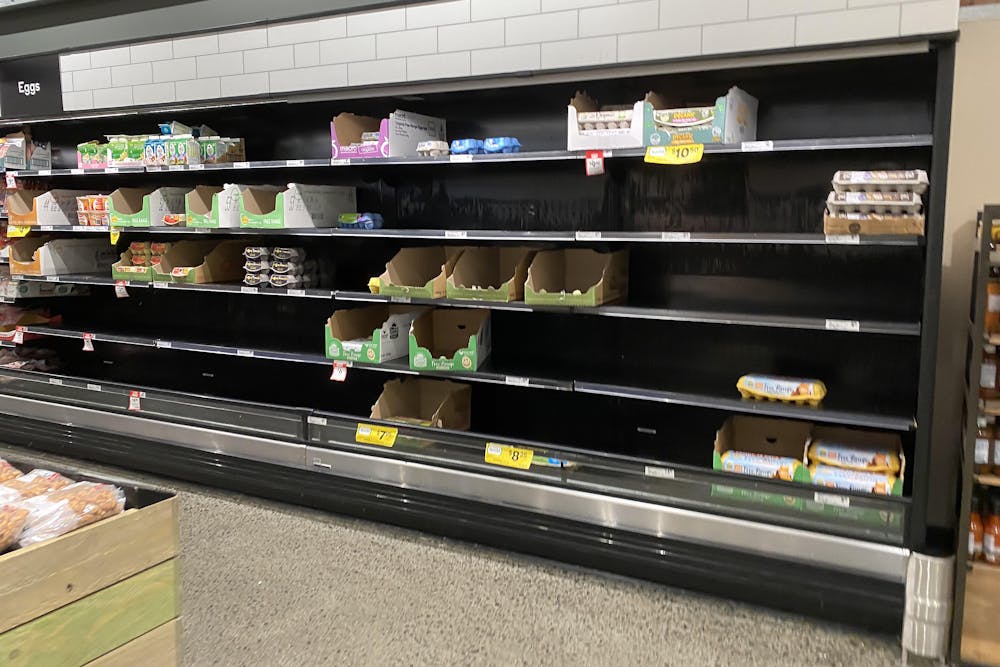 Shelves of eggs at a supermarket in Sydney, January 7 2022. Mick Tsikas/AAP
What they can do is move to a more decentralised system for restricting quantities of items customers can buy when shortages do occur.
Every store can calculate safety stock levels to protect them from supply-chain fluctuations. When an item is about to go missing from the shelves they shouldn’t have to wait for a decision from the central office to restrict quantities. They should be able to do it on the spot, while corporate headquarters works out alternatives.
When the problem is not lack of inventory but insufficient people to move products from warehouses to stores, the solution is visibility – letting consumers know about staff shortages, that there’s more than enough product on its way as soon as logistics allow, and that other stores are better supplied.
Cooperation is key
It is unlikely every store will be equally hit by labour shortages at the same time. Imagine evolving to a point where a Coles store with empty shelves informs shoppers the product is available two blocks away at the IGA.
For this to happen, of course, requires cooperation between competitors, and therefore easing of the usual anti-cartel rules that expressly prohibit collusion. But there is a clear precedent for this. In April 2020 the Australian Competition and Consumer Commission gave temporary authorisation to telcos, banks, medical suppliers and supermarkets to collaborate[8] to ensure supply of essential goods and services.
Read more: Look who's talking: Australia's telcos, banks and supermarkets granted exemption to cartel laws[9]
There is a clear case for supermarkets to cooperate now – and for the foreseeable future, with the Australian Retailers Association expecting the supply chain issues to continue for at least 12 months[10].
Both federal and state governments can help set the rules of engagement, and provide accurate and actionable information to give the correct dimension of the problem. They have, for example, data from past decisions such as the effect of Victoria’s restrictions on abattoirs[11] in 2020.
If everyone is ready, doing what they can, we may reach a culture of resilience in Australia where empty shelves in supermarkets is but a bitter memory.
References
- ^ third to half (www.abc.net.au)
- ^ said on Friday (www.9news.com.au)
- ^ spread of COVID-19 (theconversation.com)
- ^ He has warned (7news.com.au)
- ^ Treating workers like meat: what we've learnt from COVID-19 outbreaks in abattoirs (theconversation.com)
- ^ already imposed buying limits (www.9news.com.au)
- ^ Disagreeability, neuroticism and stress: what drives panic buying during the COVID-19 pandemic (theconversation.com)
- ^ to collaborate (theconversation.com)
- ^ Look who's talking: Australia's telcos, banks and supermarkets granted exemption to cartel laws (theconversation.com)
- ^ at least 12 months (www.news.com.au)
- ^ restrictions on abattoirs (www.abc.net.au)