Don't say the Aboriginal flag was 'freed' – it belongs to us, not the Commonwealth
- Written by: Bronwyn Carlson, Professor, Indigenous Studies and Director of The Centre for Global Indigenous Futures, Macquarie University
Today we woke to the news the Australian government has negotiated with the designer of the Aboriginal flag Harold Thomas, and copyright for the flag will be transferred to the Commonwealth. The government has now stated the flag is freely available for public use. Prime Minister Scott Morrison stated[1]:
We’ve freed the Aboriginal flag for Australians.
While many Indigenous people are celebrating[2] today and rejoicing in the idea the flag has been “freed,” I am not so sure.
I think we should all take a moment to pause and consider what this new “ownership” might represent.
A brief history of the flag
The flag was first flown at Victoria Square on Kaurna Country, on National Aborigines Day in July in 1971.
In 1972, it became the official flag for the Aboriginal Tent Embassy[3] which was established on Ngunnawal Country.
In 1995, William Hayden, Governor General of Australia proclaimed both the Aboriginal flag and the Torres Strait Islander flag (designed by the late Bernard Manok as) “Flags of Australia[4]” under the Flags Act 1953.
But the truth is the Aboriginal flag has always been our flag. We didn’t need an act of parliament to recognise its significance.
A national flag?
National flags are seen as sacred objects by many: in many countries, to desecrate the flag carries penalties[5]. As citizens, we are expected to revere the national flag and to be proud of what it represents.
But the Australian national flag represents white sovereignty and a belief in national unity.
The national flag symbolises both patriotism and nationalism. Nowhere was this more evident than when Morrison wore a mask sporting the design of the flag[6]. The flag/mask drapes his face with the most prominent national symbol for all to see. When wearing this mask, the prime minister literally embodies the symbolism of nation and all that stands for.
The national flag is flown at schools and all prominent government buildings. It is, for many Australians, a site of heightened emotion where the main response is a sense of belonging to what Benedict Anderson called an “imagined community[7]”.
Of course, the Union Jack is another nation’s flag. It belongs to the United Kingdom. It represents our dispossession[8] and is a constant reminder of our forced and continued colonisation.
The Union Jack does not represent us, our history or our future aspirations.
A symbol of strength
The Aboriginal flag is a symbol of our strength as an ancient people who preceded the symbolic and real effects of national borders.
The Aboriginal flag does not belong to all Australians. It belongs, like the land, to us as a symbol of our sovereignty. Morrision’s statement about having “freed” the flag for all is offensive.
It is ours; he has no authority to “free” it. The Aboriginal flag cannot just be “freed”. It is an emblem of our emotion, our loves and losses. It holds our faith, our hope and our future.
I grew up in the 70s and 80s. When I saw the Aboriginal flag, I felt a sense of pride and belonging. As a young person, I wasn‘t aware there were any copyright issues or that there were legalities that needed to be considered.
I always knew I belonged to what the flag stood for: our survival, our resilience as Indigenous people, and our steadfastness in the face of the on-going and omnipresent colonial struggles that continue to affect us today.
Our sorrows and our unity
On Australia Day, we see the Australian national flag waving take place. There is both banality and symbolism to this ritual.
For some, the flag is waved without thought as to what it might mean to others: it is just part of the ritual of the national holiday. For many, it is emotionally charged and can generate fervour and national pride. I am not sure many people stop to think about the flag’s design, its history or what it might mean to some non-white Australians.
But the design of the Aboriginal flag is intimately connected to our struggle for land rights.
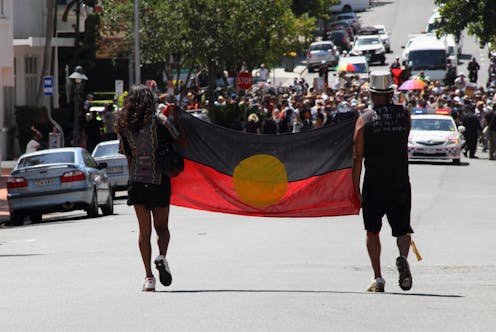
The red represents the land, the yellow the life-giving sun and the black Aboriginal people.
The flag is a symbol of our unceded sovereignty of our lands. It represents a powerful symbol of resistance in our ongoing battle with the Crown in terms of the unlawful claiming of our lands as terra nullius[9].
Read more: Henry Reynolds: Australia was founded on a hypocrisy that haunts us to this day[10]
How is it possible it can be so seamlessly hijacked in order to be incorporated – “freed” – into another set of meanings? Allowed onto the market for anyone to use? I see this act of “freeing” our flag as an act of arrogance at the very least.
One could also say it is a violent appropriation of what Aboriginal people deem to be a symbol of reverence.
Our flag contains our sorrows and our unity as a colonised people. It is not a “free-for-all” symbol. Nor is it a symbol that can be neatly injected into the national psyche as a means of expressing some kind of racial unity that overshadows the injustice and inequality Aboriginal people experience on a daily basis.
It is the fabric of our souls. When it flies, we can see ourselves in flight as we once were, free nations.
References
- ^ stated (www.pm.gov.au)
- ^ are celebrating (twitter.com)
- ^ Aboriginal Tent Embassy (theconversation.com)
- ^ Flags of Australia (www.deadlystory.com)
- ^ carries penalties (en.wikipedia.org)
- ^ mask sporting the design of the flag (newsroom.unsw.edu.au)
- ^ imagined community (en.wikipedia.org)
- ^ represents our dispossession (www.theguardian.com)
- ^ terra nullius (theconversation.com)
- ^ Henry Reynolds: Australia was founded on a hypocrisy that haunts us to this day (theconversation.com)