From rock carvings to rock music – the prevalence of bees in art throughout human history
- Written by: Adrian Dyer, Associate Professor, RMIT University
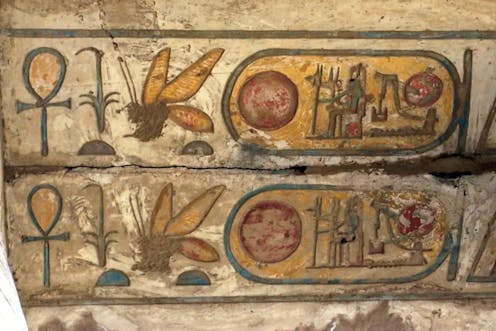
With a looming biodiversity crisis[1] and concerns over food security and sustainability[2], bees are frequently making news headlines[3].
The importance of bees in our society as pollinators and honey producers appears to have led to their increased popularity in many artistic endeavours, such as film, social media, gaming and contemporary art.
Is this new fascination with bees a recent phenomenon? In our new study[4], we explored how bees are represented throughout different cultures, time periods and art mediums.
Their representation in art would tell us how people at different times perceived bees, which we also found has led to bees being a source of inspiration for different art forms.
Bee art throughout time and cultures
Bees have been depicted in carvings, jewellery, coins, songs, tools and sculptures for thousands of years. One of the first known depictions of bees is in the form of rock art from 8000 BCE in the Spider Caves (Cuevas de la araña) in Spain[5]. It shows a person climbing a ladder to collect honey from a hive.
We examined the history of bees in culture and art from China, Central America, South America, and Australia. Centuries before the introduction of European honeybees[6], human societies in Central and South America had a close relationship with native stingless bees (Meliponini)[7].
Advanced agricultural societies like the Mayans developed apicultural techniques (The raising and care of bees for commercial or agricultural purposes) and kept native bees in their homes. Some gods in their pantheon were consecrated as protectors of the hives, while others were often represented in postures resembling landing bees in sculptures adorning temples.

While Chinese art has a long history of representing plants, it was during the Tang Dynasty (618-907)[8] that honeybees started to be represented in poetry and painting, when formal beekeeping and the use of bee products in traditional medicine increased.
Prior to the Tang Dynasty bees were regarded with suspicion due to the capacity of some bees to sting, revealing how a positive aesthetic representation of bees developed with an improved understanding of the value of bees to our environment and well-being[9].
Bee sounds in art culture and music
The buzzing sounds and signals[10] bees make have intrigued humans for centuries. Indeed, the “drone” music style popularised by the Beatles Tomorrow Never Knows[11] in name originates from Old English words representing male bees.
To the ear, ancient instruments like Australia’s First Nations Didgeridoo, Scottish Bagpipes, and India’s Tanpura resemble the rich and mesmerising drone sound of bees, and the ethnic communities of Southwestern China made special bee drums to celebrate cultural links to bees.
Bee-inspired music and song vary to accommodate the wide variety of experiences and emotions humans attempt to convey. In Britain during the 17th Century, Charles Butler scored the angelic Melissomelos[12] from his keen observations of bee “voices” and their societal structure.
In popular music, bees have been called upon to express human emotions[13], and explore musical dynamics and mastery[14].
Today, co-species collaborations like “Into”[15] by the music group Be directly employ honeybee sounds to present new ways of making music, while also promoting the plight of the precious providers.
Bees and architecture
Bees are some of nature’s best architects[16]. The hexagonal structures in honeybee hives have inspired building design and architecture throughout the world, as well as futuristic designs for Mars[17]. These bee-inspired buildings are evidenced across time and cultures, and represent different design goals. In some cases, bee inspired architecture forms the most stable and efficient structures.
Other buildings aim to highlight the importance of bees to humans. For example the New Zealand parliament’s “beehive” building[18] pays homage to the efficiency and cooperation of bees, and the experimental architecture of The Hive, which is a 14 metre aluminium lattice cuboid built to bring attention to honeybee decline[19]. Modern designs such as these reflect the perceived value of living or working like honeybees.
Bees in film and video games
Bees are increasingly represented in screen culture for both entertainment and environmental messaging like in the Bee Movie (2007)[20]. In the worldwide gaming phenomenon, Pokémon, the designs of a number of the imaginary creatures are based on bees, like female Combees[21] that collect resources for their colony.
Our work reveals bees have long played an important role in human society as pollinators, sources of nutrition as well as artistic inspirations and muses.
However, as many bee species are not as common as they once were in the environment, there has never been a more important time to understand and communicate about bees.
References
- ^ biodiversity crisis (www.unep.org)
- ^ food security and sustainability (www.fao.org)
- ^ news headlines (www.theguardian.com)
- ^ our new study (brill.com)
- ^ the Spider Caves (Cuevas de la araña) in Spain (en.wikipedia.org)
- ^ European honeybees (en.wikipedia.org)
- ^ native stingless bees (Meliponini) (en.wikipedia.org)
- ^ Tang Dynasty (618-907) (en.wikipedia.org)
- ^ environment and well-being (brill.com)
- ^ buzzing sounds and signals (www.youtube.com)
- ^ Tomorrow Never Knows (www.youtube.com)
- ^ Melissomelos (www.youtube.com)
- ^ human emotions (www.youtube.com)
- ^ musical dynamics and mastery (www.youtube.com)
- ^ “Into” (www.youtube.com)
- ^ nature’s best architects (www.frontiersin.org)
- ^ as well as futuristic designs for Mars (www.fastcompany.com)
- ^ New Zealand parliament’s “beehive” building (en.wikipedia.org)
- ^ honeybee decline (www.bbc.com)
- ^ Bee Movie (2007) (en.wikipedia.org)
- ^ Combees (bulbapedia.bulbagarden.net)