Teachers don’t have enough time to prepare well for class. We have a solution
- Written by: Julie Sonnemann, Deputy Program Director, School Education, Grattan Institute

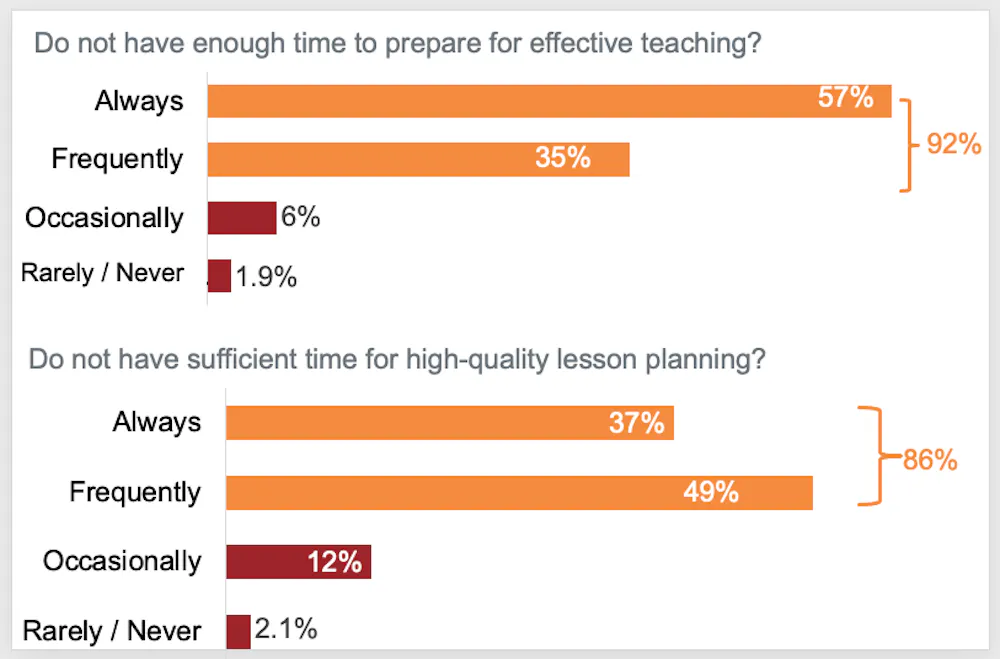
Almost all teachers (92%) in our study[1] out today said they don’t have enough time to prepare effectively for classroom teaching – the core of their job.
The Grattan Institute surveyed[2] 5,442 Australian teachers and school leaders across all states and territories, primary and secondary schools, and government and non-government schools. The survey was about teachers’ use of time.
Teachers told us they are too stretched to do everything we ask of them. When teachers aren’t supported to do their jobs well, teaching quality suffers and students lose out.
Beyond preparation for effective teaching, 86% of teachers reported they didn’t have time for high-quality lesson planning.
Teachers say they don’t have time to prepare well for lessons
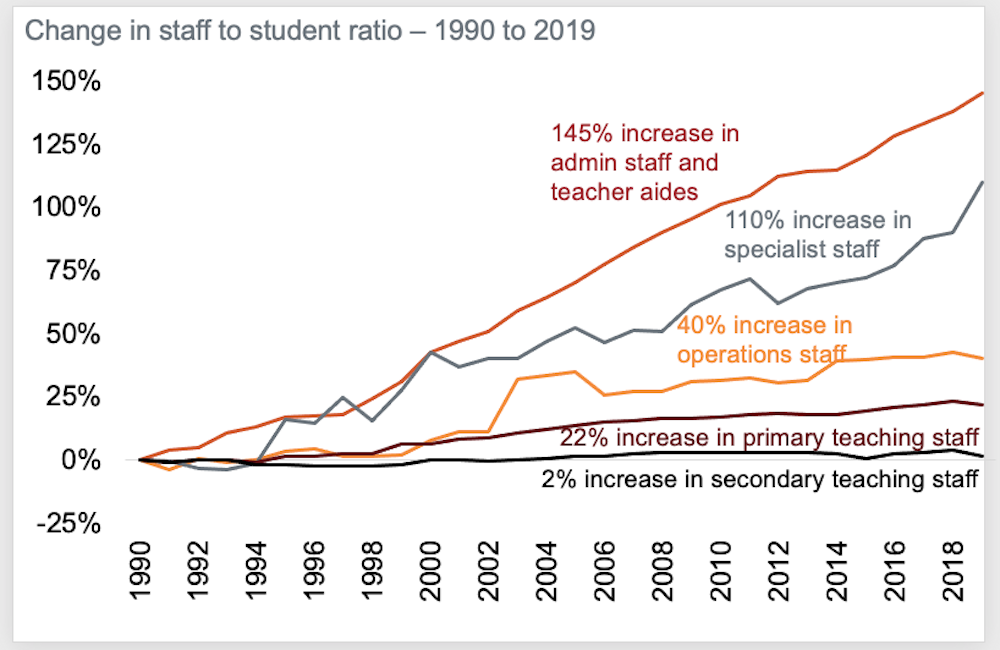 Administrative staff includes teacher aides and assistants. Specialist staff support students or teaching staff – this includes school counsellors and speech pathologists.
Grattan analysis of ABS 2020, Schools, Australia, 2019 (and previous years), Author provided[8]
In our survey about 68% of teachers agreed support staff could cover their extra-curricular activities. We estimate this would free up an additional two hours a week for teachers.
2. Help teachers reduce unnecessary tasks
Teachers consistently say they feel overburdened by administration. Streamlining administration where possible is important. But there are also significant opportunities to improve how teacher time is spent on core teaching-related work.
According to the OECD’s Teaching and Learning International Survey (TALIS)[9], Australian teachers spend about one-third of their time each week on core teaching activities such as correcting student work, preparing for lessons, teamwork and professional development.
This is four times as much as the time spent on general administration (8%), so any improvements in core teaching work could potentially free up large amounts of time.
Teachers don’t spend enough time actually teaching
Administrative staff includes teacher aides and assistants. Specialist staff support students or teaching staff – this includes school counsellors and speech pathologists.
Grattan analysis of ABS 2020, Schools, Australia, 2019 (and previous years), Author provided[8]
In our survey about 68% of teachers agreed support staff could cover their extra-curricular activities. We estimate this would free up an additional two hours a week for teachers.
2. Help teachers reduce unnecessary tasks
Teachers consistently say they feel overburdened by administration. Streamlining administration where possible is important. But there are also significant opportunities to improve how teacher time is spent on core teaching-related work.
According to the OECD’s Teaching and Learning International Survey (TALIS)[9], Australian teachers spend about one-third of their time each week on core teaching activities such as correcting student work, preparing for lessons, teamwork and professional development.
This is four times as much as the time spent on general administration (8%), so any improvements in core teaching work could potentially free up large amounts of time.
Teachers don’t spend enough time actually teaching
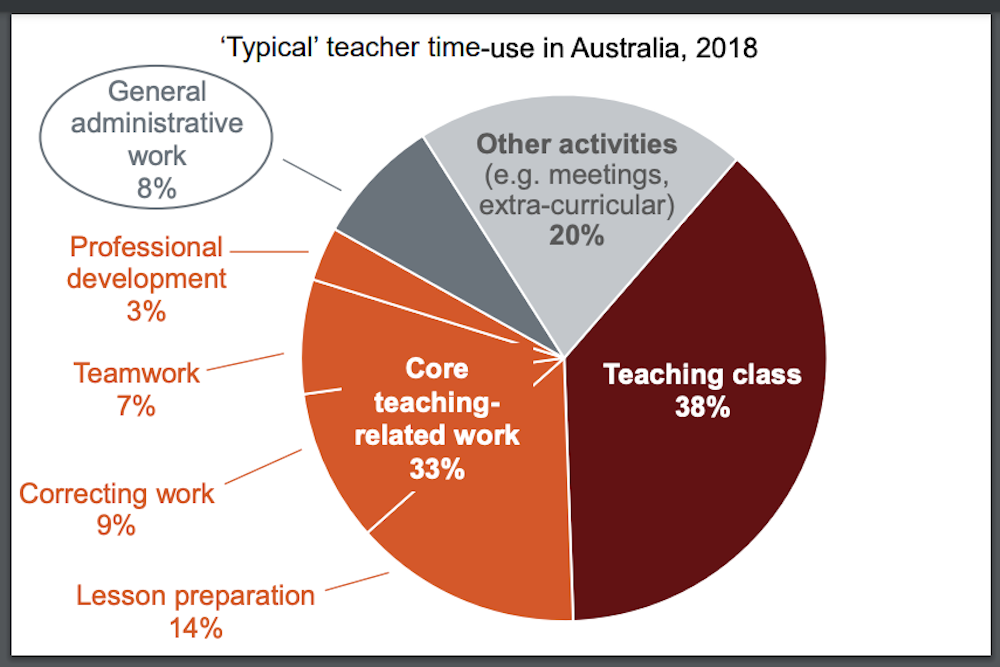 Lower secondary teachers in Australia. General administrative work includes communication, paperwork and other clerical duties. Percentages may not add up to 100 due to rounding.
Grattan analysis of OECD (2019), Author provided[10]
Lesson preparation is one of the key activities teachers do weekly. Yet more than half of teachers say this involves a lot of searching for and creating their own curriculum unit and lesson plans, assessments and classroom resources. This work eats up a lot of time and is a significant barrier to teachers feeling prepared for the classroom.
Almost 90% of teachers agreed that having high-quality common resources for curriculum and lesson planning would help reduce their planning burden. This would free up an extra three hours a week.
3. Rethink how teachers’ work is organised
Policy decisions and industrial agreements shape the fundamental ways teachers’ work is organised in schools. For example, they set the number of face-to-face teaching hours required each week, the number of students in each class and expectations about the work teachers do during term breaks.
Governments should ensure school leaders have the flexibility to rethink teachers’ work in ways that open up more preparation time. For example, school leaders should have the flexibility to make small increases in class sizes (say by two to three students). Most teachers said they were in favour of slight increases in class sizes in exchange for two hours of extra preparation time each week.
Read more:
Making better use of Australia's top teachers will improve student outcomes: here's how to do it[11]
School leaders should also have flexibility to schedule more structured preparation and planning activities in non-term time. In our survey 58% of teachers agreed working together for two or three extra days before each term could reduce their workloads during term.
Teachers agreed with several reforms
Lower secondary teachers in Australia. General administrative work includes communication, paperwork and other clerical duties. Percentages may not add up to 100 due to rounding.
Grattan analysis of OECD (2019), Author provided[10]
Lesson preparation is one of the key activities teachers do weekly. Yet more than half of teachers say this involves a lot of searching for and creating their own curriculum unit and lesson plans, assessments and classroom resources. This work eats up a lot of time and is a significant barrier to teachers feeling prepared for the classroom.
Almost 90% of teachers agreed that having high-quality common resources for curriculum and lesson planning would help reduce their planning burden. This would free up an extra three hours a week.
3. Rethink how teachers’ work is organised
Policy decisions and industrial agreements shape the fundamental ways teachers’ work is organised in schools. For example, they set the number of face-to-face teaching hours required each week, the number of students in each class and expectations about the work teachers do during term breaks.
Governments should ensure school leaders have the flexibility to rethink teachers’ work in ways that open up more preparation time. For example, school leaders should have the flexibility to make small increases in class sizes (say by two to three students). Most teachers said they were in favour of slight increases in class sizes in exchange for two hours of extra preparation time each week.
Read more:
Making better use of Australia's top teachers will improve student outcomes: here's how to do it[11]
School leaders should also have flexibility to schedule more structured preparation and planning activities in non-term time. In our survey 58% of teachers agreed working together for two or three extra days before each term could reduce their workloads during term.
Teachers agreed with several reforms
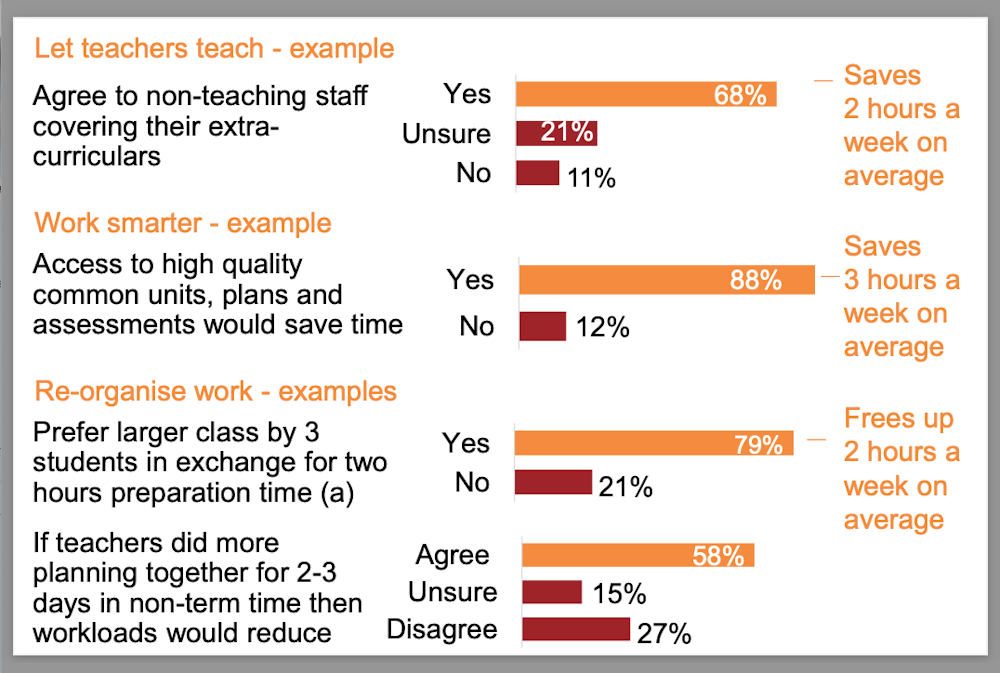 (a) answers to question about moving to larger classes are from primary school teachers only.
2021 Grattan survey on teachers’ time, Author provided[12]
What next
Our report calls on Australian governments to commit to a $60 million program to investigate and pilot the concrete options, including those tested in our report, that create more time for great teaching. That investment would be a tiny fraction (less than 0.1%) of the $65 billion Australia’s governments spend each year on school. This is a small price to pay to improve the way our schools operate and ease the workload burden on teachers.
Making sure teachers have enough time for great teaching should be a national imperative.
References^ our study (grattan.edu.au)^ Grattan Institute surveyed (grattan.edu.au)^ 2021 Grattan survey on teachers’ time (grattan.edu.au)^ Census data (www.abs.gov.au)^ OECD data (research.acer.edu.au)^ 'Exhausted beyond measure': what teachers are saying about COVID-19 and the disruption to education (theconversation.com)^ Making time for great teaching (grattan.edu.au)^ Grattan analysis of ABS 2020, Schools, Australia, 2019 (and previous years) (www.abs.gov.au)^ (TALIS) (www.oecd.org)^ Grattan analysis of OECD (2019) (grattan.edu.au)^ Making better use of Australia's top teachers will improve student outcomes: here's how to do it (theconversation.com)^ 2021 Grattan survey on teachers’ time (grattan.edu.au)
(a) answers to question about moving to larger classes are from primary school teachers only.
2021 Grattan survey on teachers’ time, Author provided[12]
What next
Our report calls on Australian governments to commit to a $60 million program to investigate and pilot the concrete options, including those tested in our report, that create more time for great teaching. That investment would be a tiny fraction (less than 0.1%) of the $65 billion Australia’s governments spend each year on school. This is a small price to pay to improve the way our schools operate and ease the workload burden on teachers.
Making sure teachers have enough time for great teaching should be a national imperative.
References^ our study (grattan.edu.au)^ Grattan Institute surveyed (grattan.edu.au)^ 2021 Grattan survey on teachers’ time (grattan.edu.au)^ Census data (www.abs.gov.au)^ OECD data (research.acer.edu.au)^ 'Exhausted beyond measure': what teachers are saying about COVID-19 and the disruption to education (theconversation.com)^ Making time for great teaching (grattan.edu.au)^ Grattan analysis of ABS 2020, Schools, Australia, 2019 (and previous years) (www.abs.gov.au)^ (TALIS) (www.oecd.org)^ Grattan analysis of OECD (2019) (grattan.edu.au)^ Making better use of Australia's top teachers will improve student outcomes: here's how to do it (theconversation.com)^ 2021 Grattan survey on teachers’ time (grattan.edu.au)