Has Captain Cook's ship Endeavour been found? Debate rages, but here's what's usually involved in identifying a shipwreck
- Written by: John McCarthy, ARC DECRA Fellow, Flinders University
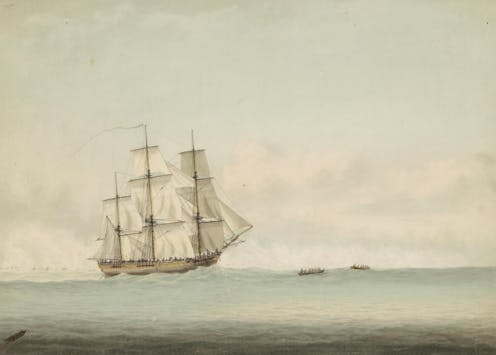
The Australian National Maritime Museum has announced[1] a shipwreck found in Newport Harbour, off Rhode Island in the United States, has been confirmed as Captain Cook’s ship, HMB Endeavour.
There have been very similar announcements[2] made over the years but have they finally made a definitive case?
By making its announcement[3], the Australian National Maritime Museum seems to have decided so, and there does seem to have been significant recent progress, centred on one shipwreck that matches the known details of the Endeavour closely.
However, reports soon emerged lead investigator on the Endeavour discovery – Dr Kathy Abbass from the Rhode Island Marine Archaeology Project – described the announcement as “premature” and that there “has been no indisputable data found.”
The announcement by the museum includes recognition[4] that there is not, and may never be, definitive proof but they appear satisfied the case has been made within reasonable doubt.
Video: Australian National Maritime Museum.I wasn’t part of this particular investigation so it’s not for me to say if this ship is Endeavour or not. But I have worked on many shipwreck investigations and have been involved in the discovery of a couple of shipwreck sites of this period.
So I can share a little bit about what’s usually involved in trying to piece together the identity of a ship when a wreck is found.
Read more: Sunken history: how to study and care for shipwrecks[5]
From the survey site to the lab
The first thing you will need is a detailed survey of the site. The process is similar to an archaeological survey on land, but for most shipwrecks you will be underwater. That makes it more difficult to take measurements precisely. Nowadays we also use 3D imaging techniques, high-resolution sonar and other specialist equipment to achieve a survey that is objective and highly accurate.
We focus on identifying “diagnostic features”, things that can identify the site and tie it to a particular period and ship-building tradition.
This could be the way the keel is built and how it is attached, or dimensions of timber frames. Often it is the smallest details that can hint at a certain ship-building tradition. One really useful indicator is the way the wood has been fastened together. Is it done with iron nails? In layers? Or tied with rope in a certain way?
Once your survey is complete, you might undertake some sampling to recover artefacts. We generally try to remove as little as possible of a shipwreck. The gold standard is to leave as much in-situ as possible but it is common to recover some material for analysis in the lab, such as bricks, cannon balls, timber, coins; anything that can help establish a chronology for a shipwreck.
Once you have got your evidence from the site, you can move onto analysis in the lab.
For timber, we often use a technique called dendrochronology[6], which is analysis of tree growth patterns. If you have enough timber of the right type, you can work out almost to the year when the timber was felled and even where it was grown.
We might x-ray metal materials, trying to work out what the objects originally looked like.

Sifting through historical records
Then we move onto historical research, analysing records of all ships lost in that general area.
We may draw on newspaper reports from the time, salvage records and marine insurance claims. Indeed, marine insurance was the original insurance because shipwreck was once so common and so costly.
We might look for court records to see if there was a dispute about the disposal of shipwreck material in that area at some point.
Historical attempts to salvage valuable material may also leave a paper trail and it was common to try to recover brass cannons (which were extremely valuable).
Shipwreck survivor accounts can be very valuable – these were often published as a popular reading material from the 17th century onward.
One of the best sources can be oral traditions and community memories; the story of a significant shipwreck can survive in local memory for generations. Just talking to local people can provide quite a lot of unique information.
It isn’t easy
Identification of a shipwreck is not easy.
In any given area, there are likely to be multiple records of shipwrecks. The task is usually to eliminate those recorded ship losses that don’t match up with the clues you have collected.
And there are often close similarities between ship types that make it hard to identify an exact ship. The Spanish Armada, for instance, resulted in the loss of many ships from the same area at the same time, so if you find one, it is easy to know it is an Armada ship, but much harder to say which one.
Working in a marine environment complicates matters greatly. Wooden shipwrecks tend to be poorly preserved on the seabed. If they are quite old, what you really get is the survival of the non-wooden parts; cannon balls, cannons, metal objects and glass.
That makes it difficult because shipwrecks are a huge collection of material and some of the material may be much older than the shipwreck itself, which can suggest a wreck is older than it really is.
You can also have shipwrecks that have more recent material on the site that has drifted there from elsewhere in the sea or even from another shipwreck. In Iceland we investigated a 17th century shipwreck[7] which had been partially covered by a later shipwreck.
Identifying ships is a long, arduous and painstaking process that usually takes many years and involves a host of challenges along the way. At all times, it is vital as a maritime archaeologist to remain objective and not fall into the trap of trying to bend evidence to fit a theory you have fallen in love with.
The repeated headlines about the Endeavour may have made some of the project team wary about definitive claims, but there will also be sites that we cannot prove the identity of with absolute certainty, and we will be forced to make our best judgement call.
Read more: What happens now we've found the site of the lost Australian freighter SS Iron Crown, sunk in WWII[8]
References
- ^ announced (www.abc.net.au)
- ^ announcements (edition.cnn.com)
- ^ announcement (www.abc.net.au)
- ^ recognition (youtu.be)
- ^ Sunken history: how to study and care for shipwrecks (theconversation.com)
- ^ dendrochronology (www.britannica.com)
- ^ 17th century shipwreck (ieeexplore.ieee.org)
- ^ What happens now we've found the site of the lost Australian freighter SS Iron Crown, sunk in WWII (theconversation.com)