Emma Beech's The Photo Box is an intimate and honest view of a life
- Written by: William Peterson, Associate Professor, Auckland University of Technology
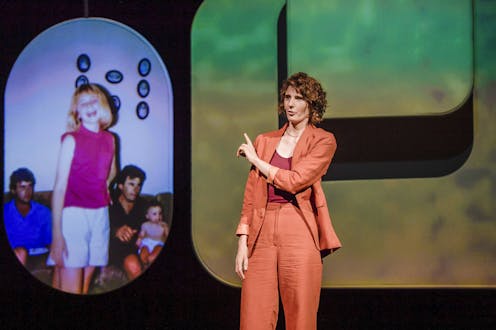
Review: The Photo Box, directed by Mish Grigor, Vitalstatitix and Brink Productions for Adelaide Festival
Emma Beech’s The Photo Box reminds us why we gather in small theatres to listen to a single performer tell us stories about their life.
In The Photo Box, Beech mines the personal, bringing the audience along for a ride that is delightful, moving and, at times, hilarious.
Beech is quite a presence: charming, open, disarming, and a fluid mover with a self-deprecating sense of humour.
The starting point for the work, she tells us early on, was when her father “started preparing for death” 24 years ago and curated family photos into nine boxes.
Aided by clever production and projection design (Meg Wilson and Chris Petridis), Beech brings these photographs to life, weaving stories of family, motherhood and what it feels like to come from a place many would regard as a backwater.
Read more: 'Theatre of the real': how artists at Perth Fringe World are stripping down to reveal their vulnerabilities[1]
Rough and real
Six screens of various height and sizes suggest family photo frames. Sitting on overhead tracks, Beech moves them into various positions as the projections on the screens flow fluidly and masterfully with the narrative.
Her hometown, Barmera on Lake Bonney in South Australia’s Riverlands is character in the story: the land on which her family’s stories are written.
“I always had the feeling that Barmera was a bit more shit than most places and that you were a bit shit for coming from there”, she says.
The youngest of nine children in a Catholic family, Beech pulls no punches when in comes to the town, her family or her personal life. Far from celebrating the folksy friendliness of small-town life, Beech’s Barmera is as rough and real as her storytelling.
By the time she came along as number nine, her mother Betty had spent virtually all her 20s and 30s producing children.
Answering the question of why, Betty’s response is simply: “We were Catholic of course. That’s what we did.”
Emotional logic
Originally, the autobiography unfolds in a chronological fashion, with photos of the young Emma moving through life’s milestones. The pattern is quickly upended.
Chronology is replaced by an emotional and psychological logic that moves and slices across time, capturing moments of revelation.
Beech’s stories are not just about herself: they are also about family members and partners. One story focuses on her brother Pete, the one who “stayed behind”, details of Pete’s life peppered throughout the larger storytelling arc.
We learn Pete runs the local hardware store; he can be short and gruff; he loves music and his mates; he’s not good at being alone.
Later, Beech tells us a story of walking down North Terrace one day and seeing a “sad looking man” outside the Royal Adelaide Hospital.
Pete’s wife was in hospital following a life-threatening brain aneurysm. As Beech approaches the sad man, she realises it is her brother, attended by his mates who stayed in the city for the 17 days his wife was in a coma.
Another story tells of the year she brought her Danish boyfriend to Barmera for a raucous and heavy-drinking family Christmas. The brothers-in-law, “the least respected members of the family”, are put in charge of cooking the meat, which they burn.
The relationship with the Dane didn’t survive Christmas.
Intimate and honest
Woven into The Photo Box are three intimate short films (filmmaker Shalom Almond with cinematographer Helen Carter), looking at Beech’s brother Pete in his home bar, her father in his comfy chair listening to André Rieu on his headphones, and her mother Betty, a devoted member of the Catholic Women’s League, cleaning the local church.
These films add a deeply textured experiential dimension to the story telling.
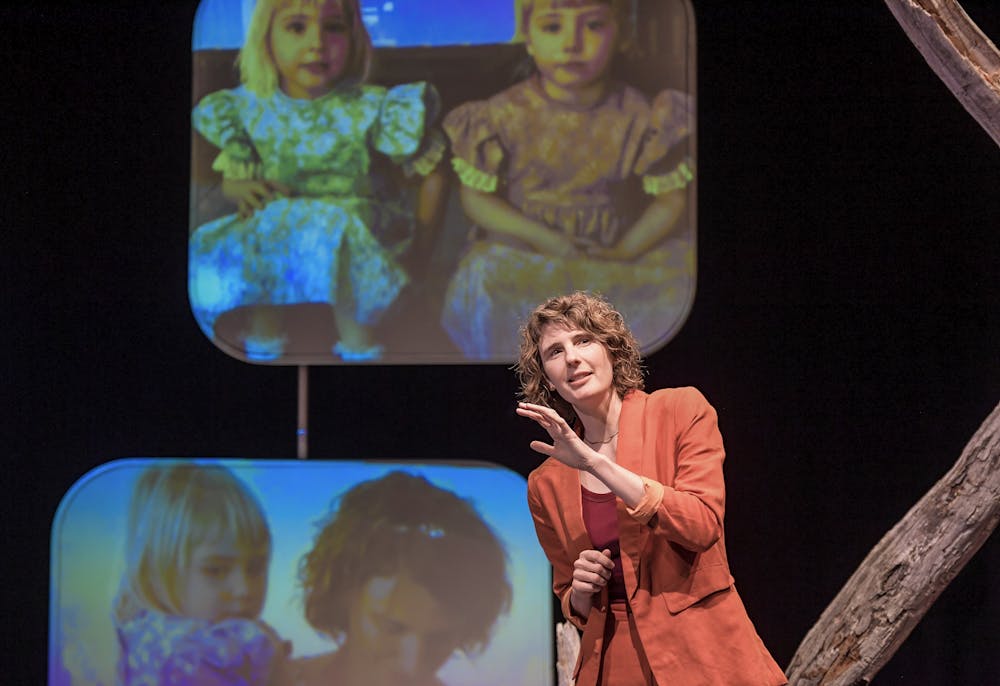
In her early 40s, Betty was a mother of nine. In her early 40s, Beech is the mother of triplets. This bond of motherhood brings the show toward its conclusion.
Earlier in the production, we learnt Betty has been secretly learning Italian and long dreamt of travelling to Italy. Now Betty looks into the camera toward the audience and says, “Ciao sono Betty” (I am Betty).
It is a beautiful, intimate moment that lingers.
For a solo autobiographical piece to fully engage that audience, it requires the intimate, honest qualities found in The Photo Box. Under the direction of Mish Grigor with dramaturgical contributions from Anne Thompson, this is a supremely local, intricately crafted and beautifully shaped work of theatre.
Season closed.