How the Ukraine war is dividing Orthodox Christians
- Written by: Jonathan L. Zecher, Research fellow, Australian Catholic University
There is a famous tale within Russian Orthodox Christianity that goes like this:
In the 16th century, Ivan IV – the Terrible, arguably the first Tsar of Russia – sought to extend his power and sent men to ravage those towns that had not submitted to him. At that time, Basil[1], a “fool for Christ”, came and offered him a gift of raw meat. It was Great Lent, the time when Christians fast from meat and dairy foods in preparation for Good Friday and Easter, and Ivan said that as an Orthodox Christian he would not eat meat. Basil responded: you drink the blood of humans, why not eat meat?
Ivan was shocked and repented his violence, and called off those attacks.
A house divided
When it comes to Russian ambitions, not much has changed since Ivan’s days, except the range and power of the weapons. But the current war has an important religious dimension, because both sides of the conflict are not merely Christian, they are members of the same church, sharing a thousand years of religious history.
Today, 71% of Russians and 78% of Ukrainians[2] identify as Orthodox Christians. In fact, until 2019[3], the Ukrainian Orthodox Church (UOC) was part of the Moscow Patriarchate (MP), and many parishes remain there (UOC-MP), in conflict with a self-governing Orthodox Church of Ukraine (UCO).
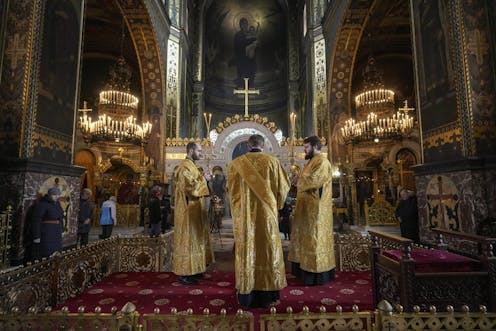
Moreover, on both sides, Orthodox Christianity is deeply woven into political life. Priests bless Kalashnikovs and tanks, and Russian cathedrals[4] are monuments to imperial ambition.
Likewise, a majority of both Ukrainians and Russians believe that being Orthodox is necessary to being Ukrainian or Russian, and both populations expect their religious leaders to play a role in political, even military, actions. In this world, the statements and actions of Orthodox leaders will have a profound effect on the war.
So how have Orthodox leaders responded to Russia’s invasion of Ukraine?
A fractured and fractious response
Unlike the Catholic Church, the Orthodox Church is divided into 17 self-governing jurisdictions, which together care for a global population in the hundreds of millions.
In this complicated situation, churches’ responses have ranged from justification to condemnation[6] of the war, and are all marked by prayers for peace and mercy.
Patriarch Kirill of Moscow confined his official remarks to asking both sides to “avoid civilian casualties[7]” while later preaching the war in sermons. His official request seems not to have influenced Russian tactics[8].
Epifaniy and Onufriy, rival leaders of Orthodox Christians in Ukraine, issued statements condemning the invasion. The latter, normally loyal to the Moscow patriarchate, called this a “fratricidal war”[9]“. He even likened it to the biblical story of Cain, who killed his brother Abel: the subtext is that Ukraine is the innocent Abel. It is quite possible UOC-MP parishes, alienated by Russia’s invasion and already refusing to commemorate their patriarch, Kyrill[10], will leave Moscow and join the self-determining Orthodox Church of Ukraine.
The strongest condemnation comes from the Ecumenical Patriarch, Bartholomew, in Constantinople (Istanbul), a long-time opponent[11] of the Moscow patriarchate. He not only condemns the war as an unprovoked invasion, but calls it[12] a "violation of human rights and the brutal violence against our fellow human beings”.
Georgia and Finland, which have experienced Russian aggression, both military and ecclesiastical, have condemned the invasion. Antioch (in Damascus, Syria) offers only its hopes for peace and unity. Serbia and Bulgaria remain supportive of the Russian advance.
Church leaders’ statements reflect their existing loyalty, fear, or dislike of Moscow – as both military and ecclesiastical power. Amid these varied responses, this war will likely redraw maps of Church jurisdictions, foster greater sympathy for Ukrainian self-determination, and lead to a global loss of respect for the MP.
But Orthodox tradition itself offers resources for a more profound response.
A voice of conscience
Orthodox Churches recently celebrated Forgiveness Sunday. The day begins Great Lent, a time when the Church’s hymns call not just for dietary fasting, but for an end to injustice, the release of the oppressed and, above all, repentance. Orthodox Christianity can, and should, be the voice of conscience calling Russian leaders to repentance, which amounts to an end to the invasion.
Patriarch Kirill used Forgiveness Sunday to justify Russia’s invasion of Ukraine[13] as a defence against anti-Christian values. The mental acrobatics required for his sermon are difficult to fathom.
On the other hand, hundreds of Russian Orthodox clerics, some of them war veterans themselves, have signed an open letter[14] calling for an immediate end to Russia’s war. These clerics speak from within Russian orthodoxy as both organisation and spiritual tradition.
Their rejection of war shows orthodoxy’s key tenets of repentance and sacrificial love. These virtues constitute the core of Orthodox Christian ethics, and are particularly emphasised during this time of Great Lent.
Of course, they’re dangerous virtues[15] when exercised against authoritarian rulers like Putin, but it is incumbent on church leaders and all Orthodox Christians to demand, and exemplify, both.
And what of Ivan the Terrible?
His repentance was fleeting, and he continued waging war throughout his life. To commemorate his military victories in Kazan, he commissioned the Pokrovsky Cathedral in Moscow. It was intended as another monument to Russian imperial glory.
But we know it by the name of that Russian Orthodox saint who demanded repentance of Ivan: St Basil’s[16].
References
- ^ Basil (www.oca.org)
- ^ 71% of Russians and 78% of Ukrainians (www.pewresearch.org)
- ^ until 2019 (theconversation.com)
- ^ Russian cathedrals (www.theguardian.com)
- ^ Sky History (www.history.co.uk)
- ^ have ranged from justification to condemnation (www.commonwealmagazine.org)
- ^ avoid civilian casualties (www.patriarchia.ru)
- ^ Russian tactics (www.ohchr.org)
- ^ fratricidal war” (orthochristian.com)
- ^ already refusing to commemorate their patriarch, Kyrill (www.europeantimes.news)
- ^ long-time opponent (link.springer.com)
- ^ calls it (ec-patr.org)
- ^ justify Russia’s invasion of Ukraine (www.patriarchia.ru)
- ^ an open letter (docs.google.com)
- ^ dangerous virtues (www.theguardian.com)
- ^ St Basil’s (upload.wikimedia.org)
Read more https://theconversation.com/how-the-ukraine-war-is-dividing-orthodox-christians-178319