The budget hands out $21 billion for 'regional Australia', but a quarter of it is going to a single project in Queensland
- Written by: Stewart Lockie, Director, The Cairns Institute, James Cook University
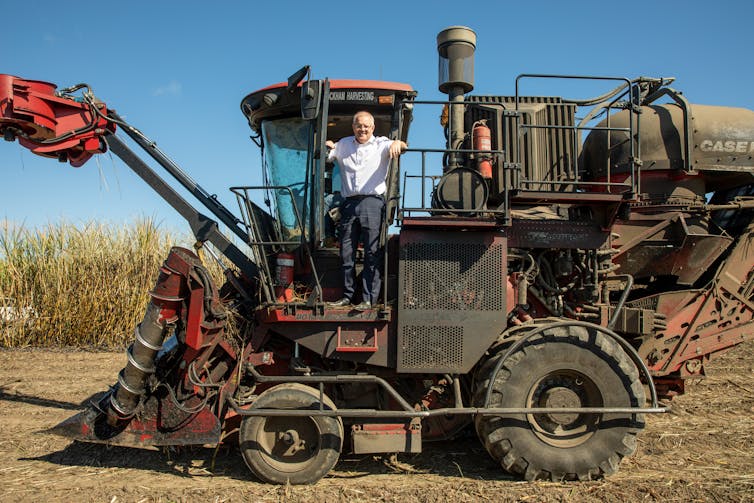
This years’s budget has offered up “unprecedented” funding for regional Australia, according to[1] the Morrison government’s budget sell.
The headline figure[2] is A$21 billion and is widely assumed to be part of the deal[3] Nationals leader Barnaby Joyce made with Prime Minister Scott Morrison in exchange for backing the Liberals’ net zero emissions plan late last year.
More than $20 billion of additional investment in Australia’s regions sounds like a lot of money. But at the same time, regional Australia is a big place.
What will this money do? How might it be received by voters?
What’s the $21 billion for?
The funding includes $3.7 billion for fast rail, $1 billion to protect the Great Barrier Reef, $678 million to seal roads on the Outback Way, and $1.3 billion on mobile and broadband coverage.
But instead of spreading the money thinly across the country, there is a heavy investment in a small number of big projects.
The lion’s share of the funding is swallowed up by four major projects. About $7 billion is set aside “turbocharging” four regions the government says already create wealth for Australia. These are: the Pilbara in Western Australia, North and Central Queensland, the Northern Territory, and the Hunter region in New South Wales (perhaps surprisingly, these areas include very few key marginal seats).
In fact, just one project accounts for a quarter of all new expenditure.
This is the $5.4 billion for construction of the Hells Gates Dam[4] near Townsville, and a further $1.7 billion for water and supply chain infrastructure to support agriculture in the surrounding region.
Once complete, Hells Gates is expected to deliver enough water to support 60,000 hectares of irrigation and $1.5 billion per year in increased agricultural output. A 2018 feasibility study[5] estimated it would create 12,647 construction jobs and 4,673 ongoing jobs, although concerns have been raised about the environmental impact on the Great Barrier Reef[6].
The Hells Gates fine print
The Hells Gates project is ambitious, but there’s a long way to go before construction is confirmed and money starts to flow.
With an election around the corner, the Coalition will be hoping regional voters see this commitment as a great example of government planning, rather than a distraction from more immediate needs. Whatever the business case, stumping up $7 billion plus for dam building and irrigation in the Burdekin is going to make the investments in other regions look positively anaemic.
Many regional voters may be left wondering how the government’s claim to be strengthening the regions with $21 billion to ensure they have the critical transport, water and communications infrastructure they need to grow adds up when so much of that investment is going into one region.
What’s left out?
We confront much the same issue in relation to the $1 billion to safeguard the Great Barrier Reef. Considering this investment is spread over ten years and addresses both marine and land-based management, as well as research, it’s arguably quite modest.
Read more: Poor policy and short-sightedness: how the budget treats climate change and energy in the wake of disasters[7]
It also begs the question why similar investment isn’t flagged to safeguard the Wet Tropics of Queensland[8] (located in the marginal seat of Leichhardt) and all the other Australian ecosystems threatened by global environmental change.
Part of the answer is there is already money allocated in the budget for a suite of environmental and natural resource management programs. There is $27 million flagged for agricultural biodiversity stewardship and an extra $27 million for Commonwealth National Parks. But is the right amount of funding going to the right places?
Beyond the headline figures
In principle, regional Australians benefit just like anyone else from budget measures[9] designed to ease cost-of-living pressures and provide essential services. They will likely benefit more than most city-based Australians from the temporary reduction in fuel excise[10].
The more time you spend in the budget documents, the more programs you find that are relevant to regional Australia but haven’t been labelled as such.
There is more than $600 million to expand the Indigenous Ranger Program[11] over the next six years. This will support the employment of an additional 1,089 Indigenous Rangers and formation of 88 new ranger groups. These will overwhelmingly be located – and contribute to improved natural and cultural resource management – in regional areas.
The Home Guarantee Scheme will be expanded and modified to include a Regional Home Guarantee[12] intended to help 10,000 eligible applicants into new homes in regional locations.
Read more: People and issues outside our big cities are diverse, but these priorities stand out[13]
If it is successful, the Critical Minerals Strategy[14] ($200 million over five years) will help diversify the Australian mining sector. Whether this helps regional workers will depend on the extent of automation, where jobs are located, and how much reliance is placed on fly-in, fly-out workers. We can’t take it for granted that the mere fact of economic activity leads to good employment or regional development outcomes.
Look beyond the fanfare about large infrastructure projects like Hells Gates, and what we are left with is a largely business-as-usual budget for regional Australia. The overarching narratives of transformational investment and water security fail to capture this continuity while, at the same time, offering a vision that excludes most regions.
What might this mean for voters?
What might this mean come election time?
The Coalition may fancy its chances of picking up a marginal seat like Hunter (held by Labor on a margin of 3%[15]), but most seats in the regions targeted for “turbocharged” growth are considered safe.
The main exceptions are Kennedy in North Queensland, held by the Katter Australia Party on 13.3%, and Herbert, centred on Townsville, which is held by the Liberal National Party on 8.4%. But travel north to Leichhardt, held by the LNP on a margin of 4.2%, and people are asking “what’s in the budget for us?”
Whatever the electoral strategy here, it’s not sandbagging marginal seats. In fact, it risks leaving voters in more marginal seats feeling ignored.
Big infrastructure spending is more likely to be about selling the Coalition’s credentials on economic recovery and nation-building. Whether this message cuts through may depend on whether voters believe the strategy will work, and whether they trust the Coalition to deliver it.
References
- ^ according to (www.theguardian.com)
- ^ headline figure (budget.gov.au)
- ^ part of the deal (www.smh.com.au)
- ^ Hells Gates Dam (www.abc.net.au)
- ^ feasibility study (www.hellsgatesproject.com.au)
- ^ Great Barrier Reef (www.theguardian.com)
- ^ Poor policy and short-sightedness: how the budget treats climate change and energy in the wake of disasters (theconversation.com)
- ^ Wet Tropics of Queensland (parks.des.qld.gov.au)
- ^ budget measures (theconversation.com)
- ^ reduction in fuel excise (theconversation.com)
- ^ Indigenous Ranger Program (www.smh.com.au)
- ^ Regional Home Guarantee (www.abc.net.au)
- ^ People and issues outside our big cities are diverse, but these priorities stand out (theconversation.com)
- ^ Critical Minerals Strategy (www.industry.gov.au)
- ^ margin of 3% (antonygreen.com.au)