One issue matters more to top economists than any other this election: climate change
- Written by: Peter Martin, Visiting Fellow, Crawford School of Public Policy, Australian National University
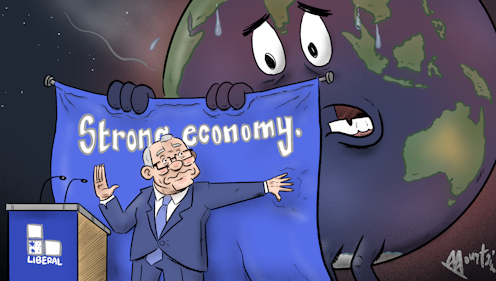
Offered a menu of issues to choose from as the most important in the May 21 election, Australia’s top economists have overwhelmingly zeroed in on one.
Three quarters of the 50 top economists surveyed by The Conversation and the Economic Society of Australia[1] have nominated “climate and the environment” as the most important issue for the incoming government and the most important in the election.
The 74% who nominated climate and the environment is more than twice the proportion that nominated the four substantial runners up: housing availability and affordability, health, tax reform, and education.
None of the 50 surveyed nominated “lower taxes” as important for the election or the incoming government, and only 8% nominated support for business.
The economists chosen for the survey are recognised as leaders in fields including economic modelling and public policy. Among them are former IMF, Treasury and OECD officials, and a former member of the Reserve Bank board.
Many noted that their priorities were at odds with those of both major parties.
Guyonne Kalb of The University of Melbourne observed that Australia was especially vulnerable to climate disasters, and that the population seemed to recognise this more than the government. Being the last nation to use outdated technologies was “never wise if it can be avoided”.
Read more: Below the Line: introducing The Conversation's new election podcast, hosted by Jon Faine[2]
Young Economist of the Year Stefanie Schurer[3] said Australia had fallen so far behind the richer countries on measures to reach net zero it ranked “dead last[4]” according to the Climate Council. It was not only embarrassing, but “incredibly shortsighted” given Australia’s exposure to extreme weather events.
Flavio Menezes of The University of Queensland said the needed transition was massive. To achieve net-zero by 2050 (a target accepted by both sides of politics) Australia would need an 800% increase in large-scale wind, solar and hydro generation, as well as a corresponding increase in the transmission capacity.
The current government’s motto of technology not taxes[5] was “an empty slogan”. Much of the needed spending would have to be funded by taxes.
A carbon tax would help
The University of Queensland’s John Quiggin described the campaign as the most depressing he had seen in more than 50 years of paying attention. Neither major party was offering anything substantive.
Several participants noted that a carbon price (or tax[6]) of the kind Australia had between 2012 and 2014[7] would provide a permanent incentive for every sector of the economy to find new ways to cut emissions, but was “not on the table”.
Consulting economist Rana Roy said Australia actually had several[8] types of carbon price in place, but their rates varied widely, with emissions in some sectors untaxed, while emissions in other sectors (such as petrol) were overtaxed.
Read more: Economists back carbon price, say benefits of net-zero outweigh costs[9]
The third of the economists surveyed who nominated tax reform as an important issue said it would be needed to deal with the other issues identified as important: housing affordability, health, and education.
Saul Eslake said in an ideal world both sides of politics should be having an intelligent conversation about the least damaging ways of raising the extra one to two percentage points of GDP in tax revenue that will be needed to fund priorities including aged care and the national disability insurance scheme.
Tax reform would help
The University of Melbourne’s Kevin Davis said next year’s planned stage three[10] tax cuts directed at higher earners (and costed by the Parliamentary Budget Office at $76.2 billion[11] over four years) should be scrapped on equity grounds alone.
Superannuation tax should also be reformed, and capital gains tax concessions reduced or axed. The “massive” tax concessions offered to home buyers and buyers of investment properties were among the chief reasons for high prices.
Curtin University’s Rachel Ong ViforJ said changes that moved away rewarding the ownership of non-productive assets toward rewarding work would be needed to address the intergenerational transmission of debt.
Higher productivity would help
The University of Sydney’s Nigel Stapledon said neither side of politics seemed focused on the emerging risk of 1970s and 1980s-style inflation.
The idea that the government could drive real wages growth without productivity improvements and not feed inflation was dodgy economics and risky policy.
Melbourne University’s John Freebairn said productivity growth had been below world’s best practice for a decade, making it hard to lift incomes and collect tax.
Read more: Cut emissions, not petrol tax. What economists want from the budget[12]
Tax reform itself could raise more tax by boosting productivity and cutting inequality, as could better regulations and less wasteful government spending.
Former OECD official Adrian Blundell-Wignall said Australia didn’t have a plan that offered less dependence on digging holes. Research and development and a highly educated population were the keys to driving sustainable growth.
But there’s little optimism
None of the 50 members of the panel was optimistic about either side of politics offering what was needed, at least during the campaign.
Eslake (a Tasmanian) said he was more likely to “tread in thylacine-poo on my front lawn of a morning” than to see the intelligent conversations that were needed between now and voting day.
Individual responses:
References
- ^ Economic Society of Australia (esaact.org.au)
- ^ Below the Line: introducing The Conversation's new election podcast, hosted by Jon Faine (theconversation.com)
- ^ Stefanie Schurer (esacentral.org.au)
- ^ dead last (www.climatecouncil.org.au)
- ^ technology not taxes (www.pm.gov.au)
- ^ or tax (www.ausstats.abs.gov.au)
- ^ 2012 and 2014 (www.theguardian.com)
- ^ several (theconversation.com)
- ^ Economists back carbon price, say benefits of net-zero outweigh costs (theconversation.com)
- ^ stage three (www.abc.net.au)
- ^ $76.2 billion (cdn.theconversation.com)
- ^ Cut emissions, not petrol tax. What economists want from the budget (theconversation.com)