No, Mr Morrison – the safeguard mechanism is not a 'sneaky carbon tax'
- Written by: Samantha Hepburn, Professor, Deakin Law School, Deakin University
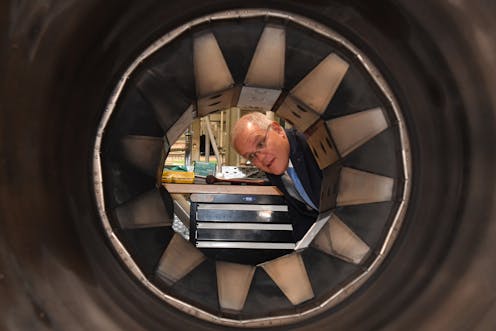
Prime Minister Scott Morrison this week claimed[1] Labor was planning a “sneaky carbon tax” should it win power, and Nationals senator Matt Canavan declared[2] the goal of net-zero emissions by 2050 was “dead”.
We can expect both these concepts to be thrown around a fair bit during the federal election campaign, so it’s worth getting a few things straight right now.
The safeguard mechanism is not a carbon tax
The Coalition’s claims of a “sneaky carbon tax” are a reference to Labor’s plans to tighten an existing policy known as the safeguard mechanism[3].
The safeguard mechanism was introduced by the Abbott Coalition government in 2016 – and it is not a carbon tax.
The mechanism was supposed to “safeguard” gains achieved through the Coalition’s then-named Emissions Reduction Fund, by ensuring the emissions cuts were not offset by increases elsewhere in the economy.
The rule applies to about 200 large industrial polluters that directly emit more than 100,000 tonnes of greenhouse gases a year, in sectors such as electricity, mining, gas, manufacturing and transport.
Under the safeguard mechanism, these polluters must keep their emissions below historical levels, known as a baseline. If they exceed the baseline, polluters can either buy carbon credits to offset the excess pollution, or apply to the Clean Energy Regulator for the baseline to be adjusted.
Baseline adjustments were allowed because no overall cap was placed on the amount of emissions produced. Without a cap, the regulator has greater flexibility to make adjustments.
This flexibility has meant the safeguard mechanism is ineffectual. In fact, since its implementation, companies subject to the mechanism have actually increased[4] their emissions by 7% overall.
Read more: Net zero by 2050 will hit a major timing problem technology can't solve. We need to talk about cutting consumption[5]
So, Labor has promised[6] to tighten the safeguard mechanism if it wins the election. This means large emitters will be less able to adjust their baselines, and gradually, their baselines will be reduced.
This approach coheres with the original purpose of the safeguard mechanism, and is supported by the Business Council of Australia and others.
Analysis suggests[7] Labor’s policy could avoid a substantial 213 million tonnes of greenhouse gas emissions entering the atmosphere by 2030.
Labor has indicated that emissions-intensive industries, such as large coal and gas exporters, will not be forced to cut pollution in a way that makes them less competitive internationally.
Australia’s never had a carbon tax
Let’s be clear. No Australian government has implemented a carbon tax – and any suggestion to the contrary is inaccurate.
The spectre of a so-called “carbon tax” has haunted Labor ever since the 2010 election campaign, when then Prime Minister Julia Gillard ruled out[8] implementing one.
Upon being returned to office, Gillard announced[9] plans to legislate a carbon price, in the form of an emissions trading scheme.
Not all carbon pricing amounts to a carbon tax. But the Abbott-led Coalition nonetheless sought to conflate the two and accused[10] Gillard of breaking a key election promise.
Greenhouse gas emissions, and associated climate change, come with costs. Extreme weather such as droughts and heatwaves damages crops and drives up demand for health care. Flooding, bushfires and sea level rise damages property.
Read more: China's demand for seaborne coal is set to drop fast and far. Australia should take note.[11]
Carbon pricing seeks to ensure those responsible for much of these costs – large polluters – either reduce their emissions or help pay for the social and environmental damage they cause.
Labor’s emissions trading scheme required polluters to report and pay for every tonne of carbon dioxide they produced, or face a financial penalty. The scheme was a success[12]: compliance was high and emissions reduction targets were met[13].
The policy, however, was short-lived. The Abbott government repealed it in July 2014.
Net-zero by 2050 is very much alive
So what of Senator Canavan’s claims[14] this week that net-zero emissions targets were “dead” and should be scrapped?
Canavan this week told the ABC:
“[UK Prime Minister] Boris Johnson said he is pausing the net zero commitment, Germany is building coal and gas infrastructure, Italy’s reopening coal-fired power plants. It’s all over. It’s all over bar the shouting here”.
Late last year, Australia committed to achieving net-zero emissions by 2050. That means cutting greenhouse gas emissions as far as possible, and then, for emissions that cannot be avoided, removing an equivalent amount from the atmosphere.
Net-zero emissions by 2050 is needed avert the worst impacts of climate change. Australia is also required to meet the target under its Paris Agreement obligations[15].
All Australian states and territories have committed to the net-zero goal. Victoria[16], the ACT[17] and Tasmania[18] have gone further and legislated net-zero as a target.
Australia may be a long way off achieving net-zero by 2050, particularly in the absence of a robust and credible carbon price. But Canavan is wrong to suggest the goal has been abandoned globally.
Some countries have already achieved[19] net-zero. The UK[20] has a legally binding net-zero target by 2050 and Germany has pledged[21] to get there by 2045.
Russia’s invasion of Ukraine has left countries such as Germany worried about their reliance on Russian gas, and this may see a short-term increase in fossil fuel use in Europe.
But the world remains largely committed to the net-zero target.
Just a few days ago, German finance minister Christian Lindner outlined the importance of the low-carbon transition to the nation’s energy security, describing[22] renewable energy as “freedom energy”.
So, contrary to Canavan’s suggestion, the world’s shift to clean energy is likely to accelerate in the longer term.
Read more: We found a hidden source of greenhouse gases – organic matter in groundwater[23]
References
- ^ claimed (www.news.com.au)
- ^ declared (www.news.com.au)
- ^ safeguard mechanism (www.industry.gov.au)
- ^ increased (www.smh.com.au)
- ^ Net zero by 2050 will hit a major timing problem technology can't solve. We need to talk about cutting consumption (theconversation.com)
- ^ promised (www.theguardian.com)
- ^ Analysis suggests (www.reputex.com)
- ^ ruled out (www.smh.com.au)
- ^ announced (www.abc.net.au)
- ^ accused (www.smh.com.au)
- ^ China's demand for seaborne coal is set to drop fast and far. Australia should take note. (theconversation.com)
- ^ success (theconversation.com)
- ^ met (australiainstitute.org.au)
- ^ claims (www.theguardian.com)
- ^ obligations (www4.unfccc.int)
- ^ Victoria (www.austlii.edu.au)
- ^ ACT (www.austlii.edu.au)
- ^ Tasmania (www.austlii.edu.au)
- ^ already achieved (www.statista.com)
- ^ The UK (commonslibrary.parliament.uk)
- ^ pledged (www.dw.com)
- ^ describing (greendealnews.org)
- ^ We found a hidden source of greenhouse gases – organic matter in groundwater (theconversation.com)
Read more https://theconversation.com/no-mr-morrison-the-safeguard-mechanism-is-not-a-sneaky-carbon-tax-182054