Lydia Ko’s 'time of the month' comment showed how far sportswomen have come – and how much still has to change
- Written by: Holly Thorpe, Professor in Sociology of Sport and Physical Culture, University of Waikato
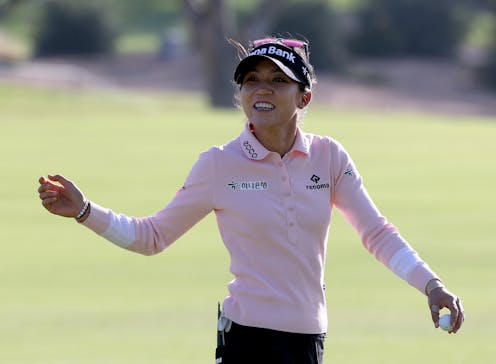
Last weekend’s LPGA event in California will likely be remembered as much for what was said[1] as the golf that was played. Asked about some on-course treatment she’d needed for back pain, world number three Lydia Ko replied matter-of-factly, “It’s that time of the month.”
The candid reference to her menstrual cycle had Golf Channel commentator Jerry Foltz flummoxed. Ko joked, “I know you’re at a loss for words, Jerry. Honesty it is.”
Ko has been celebrated for breaking the stigma[2] about menstruation in sport. But she is not the first elite athlete to talk to the topic. Chinese swimmer Fu Yuanhui made headlines[3] for telling the world she was on her period during the 2016 Rio Olympics.
But even though more athletes are speaking out about a normal physiological experience, the words “period” and “menstruation” still tend to shock commentators and audiences.
A long silence
A brief look at the history of women in sport helps explain these longstanding silences and taboos. In fact, women in the 19th century were considered[4] too “weak” and “fragile” to even participate in sport and vigorous physical activity.
Doctors and politicians – male, of course – warned women that running, cycling or playing tennis would compromise their ability to have children, including the threat that women’s wombs would fall out if they rode a bicycle.
We might seem to have come a long way, with modern women competing in almost every sport, demonstrating skill, competence, strength and courage. Yet discussion of many aspects of their female physiology – menstruation, menopause, pregnancy – has long been suppressed[5].
In many ways, the unruly, leaky female body[6] continues to be seen as problematic and a weakness, both in sport and society more broadly[7].
Read more: The pandemic’s disproportionate impact on women is derailing decades of progress on gender equality[8]
Muting of menstruation in sport
In this context, the menstrual cycle has often been seen as a “problem” in women’s sport. Research has revealed how sportswomen view it as an unwanted complication[9] for training and competition[10]. Some athletes have resorted to working around it for big events by manipulating the oral contraceptive.
It has been shown the menstrual cycle not only affects female reproduction, but also regulates[11] physiological, metabolic, thermoregulatory and cognitive functions. But even coaches well versed in sport science have trouble talking about the menstrual cycle.
Read more: The Black Ferns review shows – again – why real change in women’s high performance sport is urgently overdue[12]
Our own research[13] has shown most elite sportswomen don’t feel comfortable talking about menstrual health matters with male coaches and support staff, preferring to talk to women instead. While some coaches have adopted a more progressive approach[14], they remain the minority.
With a persistent culture of stigma and taboo, conversations about menstruation often happen in code, or quietly and privately among fellow sportswomen and women support staff.
An evolving science
Over the past two decades, however, a new wave of women in sport science has been leading important initiatives[15] in understanding how the menstrual cycle affects women’s training, performance and recovery.
Their research has examined an array of menstrual-health issues faced by sportswomen (and menstruating non-gender-conforming athletes), including conditions such as iron deficiency[16], menorrhagia[17] (heavy bleeding), amenorrhea[18] (chronic loss of menstruation), and RED-S[19] (relative energy deficiency in sport). The work represents a real change, with more research by women, with women, for women.
Some are advocating applying new training techniques[20] during the menstrual cycle, working with hormonal changes and the nuances of symptoms[21]. Menstrual-tracking apps and technologies[22] can help athletes and coaches better understand how the menstrual cycle effects an athlete’s health and performance.
Armed with such knowledge, athletes and teams are designing training, performance, recovery, injury prevention and rehabilitation, sleep, nutrition and well-being programmes around the menstrual cycle. In the process, menstruation is re-framed as a sign of health and power.
Read more: Toxic sport cultures are damaging female athletes' health, but we can do better[23]
‘Women are not small men’
Recognising the opportunities for improved performance, some national sports organisations – including the English Institute of Sport[24], the Australian Institute of Sport[25] and High Performance Sport New Zealand[26] – are investing (to varying degrees) in education campaigns for emerging and elite sportswomen, coaches and support people.
By better understanding the menstrual cycle, they can work with it rather than against it. But there are still gaps and silences.
Read more: Menstruation is not a taboo in women's sport, period[27]
For example, much of the research is conducted by white sports scientists on white sportswomen. Important cultural and religious ways of knowing menstruation[28] are ignored or overlooked – although some athletes[29] are drawing on Indigenous understandings of menstruation[30] as a time and source of strength and power.
Lydia Ko has restarted an important conversation, one we must keep having publicly and privately. As physiology and nutrition expert Stacy Sims has put it, “women are not small men[31]”, and their distinctive and varied physiologies are not weaknesses. Rather, they are strengths yet to be fully understood, harnessed and celebrated.
References
- ^ what was said (www.theguardian.com)
- ^ celebrated for breaking the stigma (edition.cnn.com)
- ^ made headlines (www.npr.org)
- ^ were considered (www.press.uillinois.edu)
- ^ has long been suppressed (www.scientificamerican.com)
- ^ leaky female body (www.routledge.com)
- ^ society more broadly (link.springer.com)
- ^ The pandemic’s disproportionate impact on women is derailing decades of progress on gender equality (theconversation.com)
- ^ unwanted complication (bmjopensem.bmj.com)
- ^ training and competition (journals.sagepub.com)
- ^ regulates (pubmed.ncbi.nlm.nih.gov)
- ^ The Black Ferns review shows – again – why real change in women’s high performance sport is urgently overdue (theconversation.com)
- ^ own research (www.frontiersin.org)
- ^ progressive approach (www.tandfonline.com)
- ^ important initiatives (link.springer.com)
- ^ iron deficiency (www.tandfonline.com)
- ^ menorrhagia (journals.plos.org)
- ^ amenorrhea (link.springer.com)
- ^ RED-S (journals.humankinetics.com)
- ^ new training techniques (link.springer.com)
- ^ nuances of symptoms (onlinelibrary.wiley.com)
- ^ Menstrual-tracking apps and technologies (www.theguardian.com)
- ^ Toxic sport cultures are damaging female athletes' health, but we can do better (theconversation.com)
- ^ English Institute of Sport (eis2win.co.uk)
- ^ Australian Institute of Sport (www.ais.gov.au)
- ^ High Performance Sport New Zealand (hpsnz.org.nz)
- ^ Menstruation is not a taboo in women's sport, period (theconversation.com)
- ^ ways of knowing menstruation (journals.humankinetics.com)
- ^ some athletes (www.newsroom.co.nz)
- ^ understandings of menstruation (www.mcleodsbooks.co.nz)
- ^ women are not small men (www.youtube.com)