No, Mr Morrison. Minority government need not create 'chaos' – it might finally drag Australia to a responsible climate policy
- Written by: Kate Crowley, Adjunct Associate Professor, Public and Environmental Policy, University of Tasmania
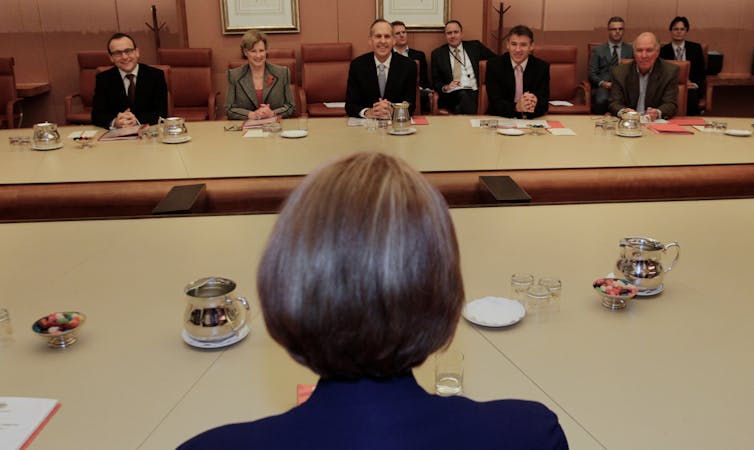
Labor might be leading[1] in the national polls, but a hung parliament after the May 21 election remains a distinct possibility.
So-called “teal” independents, whose blue conservatism is tinged with green concern for climate change, may well join Greens MP Adam Bandt and current independents on the lower house crossbench. Under that scenario, any minority government would need their support.
With the support of advocacy group Climate 200[2], the teals are campaigning on issues relevant to their electorates and raising funds locally. But high[3] on their agendas is a strong, science-based response to the climate crisis.
A weekend report by Nine newspapers suggested[4] most independents seeking a lower house seat would not strike a formal power-sharing deal with either the Coalition or Labor. This would leave a major party in minority government negotiating with the crossbench on every piece of legislation it wants to pass.
Almost all the 12 independents who were polled nominated climate change as a key priority they would seek progress on in any negotiations with a minority government.
Prime Minister Scott Morrison claims[5] the election of more independents to parliament would lead to “chaos”. But, as the experience of the Gillard Labor government shows, minority government can break intractable policy logjams.
Climate policy U-turn
The Gillard minority government reversed years[6] of climate policy failure by delivering carbon pricing and other reforms. This came at the behest[7] of the Greens and with the support[8] of independents Andrew Wilkie, Rob Oakeshott and Tony Windsor.
Carbon pricing prompted Australia’s greenhouse gas emissions to fall[9] for the first time.
But from 2013, under successive Coalition governments, climate policy hit reverse[10]. Renewable energy targets diminished[11]. Carbon pricing was abandoned and is now considered a political poisoned chalice.
The past decade of majority government has left Australia isolated[12] on the world stage for its lacklustre climate efforts.
Read more: Polls show a jump in the Greens vote – but its real path to power lies in reconciling with Labor[13]
Major parties forced to the negotiating table?
Heading into the election, neither[14] major party’s climate policy is aligned with the emissions reduction ambition of the global Paris Agreement.
The Coalition’s policy is consistent with 3℃ to 4℃ of global warming by 2050. Importantly, it has failed to ramp up its 2030 emissions target from the paltry figure adopted by the Abbott government – of 26% to 28% on 2005 levels.
Labor has a steeper 2030 emissions reduction target of 43% on 2005 levels. It is based upon reputable modelling but falls somewhat short for being consistent with 2℃, not 1.5℃, of global warming.
Neither major party would relish re-negotiating its climate policy with teal independents and the Greens. But consensus and policy action, on climate and other big issues, is possible under minority government.
As Tony Windsor this month pointed out[15], the Gillard minority government passed more legislation than any other, aside from John Howard’s in its final term. Former Queensland Premier Peter Beattie also insists[16] minority government can work.
And former Coalition Prime Minister Malcolm Turnbull this month hailed[17] the rise of the teal independents, who would sit on the cross bench, calling it “direct, democratic action from voters. People power, you might say.”
Read more: How do the major parties rate on climate policies? We asked 5 experts[18]
What the teals and Greens are offering
Climate change is a front-and-centre concern for the Greens and teal candidates, and any minority government would need to negotiate with them to form government and to manage their agendas.
Polls suggest independent teal MP Zali Steggall will be easily re-elected in the previously blue-ribbon Liberal seat of Warringah. She will reintroduce her ambitious climate change bill[19], likely with the support[20] of any other elected teal MPs and most of the crossbench.
This bill is modelled on the United Kingdom’s Climate Change Act[21]. It provides a means of coordinating climate policy action in line with the legislated targets of net zero emissions by 2050, and at least 60% emissions reduction by 2030.
Steggall’s “5 Steps to Net Zero[22]” comprise:
-
passing the climate change bill
-
getting to 80% renewable energy by 2030
-
cleaning up transport and getting to 76% new vehicle sales being electric by 2030
-
halving industry emissions
-
regenerating and future-proofing agriculture by rolling out 8 million hectares of tree planting and soil carbon storage, and investing in low-carbon agriculture practices and technologies.
The Greens would[23] replace coal and gas with renewables, and ban political donations from the fossil fuel industry. The party would fund households and small business to transition to renewables, implement a coal export levy and eventually phase out thermal coal exports.
The Greens want Australia to reaching net zero emissions by 2035 (compared to the government’s goal of 2050) and to reach 100% renewable energy by 2030.
Shifting the needle
The fate of effective national climate policy in Australia – policy that actually reduces emissions – now rests largely on the mix of members in the next parliament and the actions they support.
A majority Coalition win at the election would consign Australia to another term of climate inaction, leaving[24] the state and territory governments the only ones making progress.
If a minority Coalition government eventuates, the Greens won’t offer it support. If any teal independents did[25], we can expect them to cross the floor on climate policy to support any workable proposal from Labor that had the numbers to succeed.
Labor, the Greens and Steggall’s plans share common ground. But if Labor forms minority government, it will be pressured to accelerate the phase out fossil fuels and to steepen its 2030 emissions reduction target in line with the science.
One thing is clear: in the event a major party forms minority government after the election, it better be prepared to shift the needle in favour of more effective climate policy.
Read more: Labor’s 2030 climate target betters the Morrison government, but Australia must go much further, much faster[26]
References
- ^ leading (www.theaustralian.com.au)
- ^ Climate 200 (www.climate200.com.au)
- ^ high (www.smh.com.au)
- ^ suggested (www.smh.com.au)
- ^ claims (www.theguardian.com)
- ^ reversed years (theconversation.com)
- ^ behest (onlinelibrary.wiley.com)
- ^ support (www.abc.net.au)
- ^ fall (australiainstitute.org.au)
- ^ reverse (publishing.monash.edu)
- ^ diminished (www.theguardian.com)
- ^ isolated (www.sbs.com.au)
- ^ Polls show a jump in the Greens vote – but its real path to power lies in reconciling with Labor (theconversation.com)
- ^ neither (theconversation.com)
- ^ pointed out (www.heraldsun.com.au)
- ^ also insists (www.smh.com.au)
- ^ hailed (www.theguardian.com)
- ^ How do the major parties rate on climate policies? We asked 5 experts (theconversation.com)
- ^ bill (www.zalisteggall.com.au)
- ^ support (reneweconomy.com.au)
- ^ Climate Change Act (www.oecd.org)
- ^ 5 Steps to Net Zero (www.zalisteggall.com.au)
- ^ The Greens would (greens.org.au)
- ^ leaving (theconversation.com)
- ^ did (www.theguardian.com)
- ^ Labor’s 2030 climate target betters the Morrison government, but Australia must go much further, much faster (theconversation.com)