


Google AI
The Times Australia

Times Media Advertising

the enterprise bargaining system is broken, and in terminal decline

  • Written by: Anthony Forsyth, Distinguished Professor of Workplace Law, RMIT University
the enterprise bargaining system is broken, and in terminal decline

Real wages in Australia have been stagnating for the better part of a decade. Now, with higher inflation, they’re declining. So what can the new Albanese government, having campaigned hard on the previous government’s failures, do about it?

Making a submission to Australia’s industrial relations umpire, the Fair Work Commission, to lift the minimum hourly wage from A$20.33 to A$21.36, is one thing. If that push is successful, it would help the 2% of workers paid the minimum wage, as well as the 23% (about 2.2 million workers) on awards, whose rates would also lift.

Read more: Lifting the minimum wage is anything but reckless – it's what low earners need[1]

But there’s a bigger systemic problem the Albanese government needs to address – a flaw designed and implemented by a previous Labor government. Enterprise bargaining, the mechanism introduced 30 years ago for workers to collectively negotiate better wages and conditions, is broken.

It’s failing low-paid workers lacking bargaining power in particular, and is a big part of the reason for such poor wages in female-dominated professions such as aged care and child care.

Origin of enterprise bargaining agreements

Enterprise bargaining was introduced during the Hawke-Keating Labor era in the early 1990s, in partnership with the Australian Council of Trade Unions and the support of employer groups.

The Business Council of Australia had lobbied strongly for an enterprise focus for negotiating employment conditions, on the basis it`was the best way to tie wage claims to gains in productivity.

Prime Minister Paul Keating extols enterprise bargaining in parliament on June 24 1992.

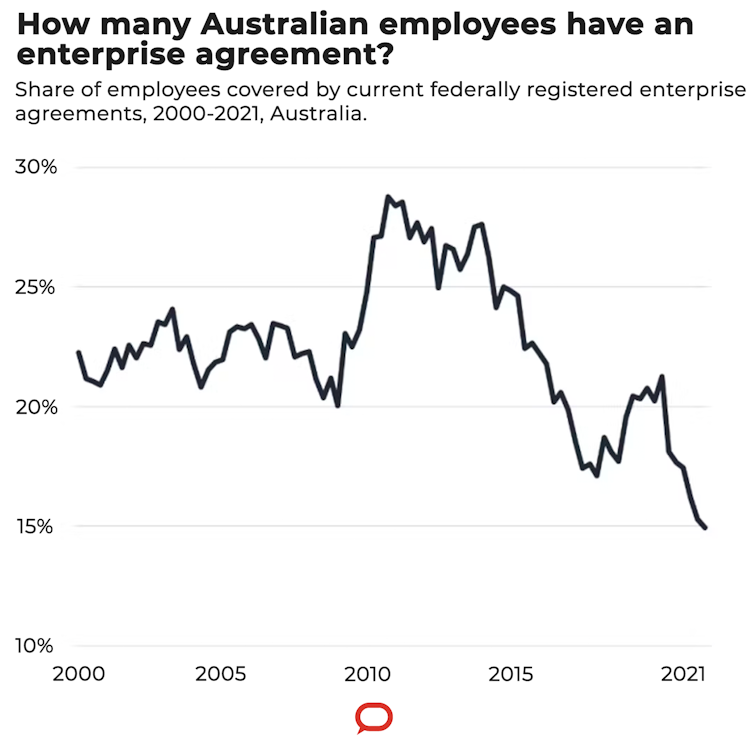
After 30 years, though, enterprise bargaining is in terminal decline, with ten years of shrinking agreement coverage in line with stagnant wages growth.

Research by labour law and policy experts Andrew Stewart, Jim Stanford and Tess Hardy published in May[2] shows the total number of enterprise agreements fell by more than half between 2013 and 2021 (from 23,500 agreements to 10,000).

Worse, the share of employees covered by a current enterprise agreement declined from an average of 27% in 2012 to just 15% by late 2021. This is shown in the following graph.

Australia Institute, The Wages Crisis Revisited, CC BY-ND[3] The Australian Industry Group and other business representatives blame this on the Fair Work Commission’s strict approach to the “better off overall test” and other statutory protections of employees’ interests in agreement-making. Unions see it differently. In their view, the reason enterprise bargaining is in free-fall is because of design flaws in the current laws, meaning workers have very limited negotiating power and employers can “game” the system to avoid their obligation to bargain. The main problem: enterprise bargaining was designed for an economy that no longer exists. Read more: Cabinet papers 1992-93: the rise and fall of enterprise bargaining agreements[4] Workplaces have changed Allowing employees and unions to only bargain and take industrial action for an agreement with a single business, or part of a business, works fine with large worksites, such as factories, with hundreds or thousands of workers with the same employer. But these types of workplaces are increasingly rare. Now, many employers in sectors such as food production, logistics, warehousing, building management and “big box” retail stores have hived off large parts of their operations, and workers, to other entities. They’ve used labour hire, independent contracting and outsourcing to distance themselves from responsibility for minimum employment standards – and collective bargaining. To lift wages, workers need the boost to bargaining power that comes from being able to negotiate – and strike – across entire industries. Labour hire workers must be able to bargain not just with the agency that technically employs them, but with the business for whom they are working – such as Amazon[5], which has relied heavily on outsourced labour in its Australian operations. Workers who clean and provide security services in commercial buildings need to have the capacity to pursue pay increases from the lead firms that ultimately control labour’s share of profits. What Labor has promised to do Federal Labor’s 2021 national policy platform[6] contains a commitment to “improve access to collective bargaining, including where appropriate through multi-employer collective bargaining”. It notes this access is a particular issue for low-paid employees lacking industrial power, and that the Fair Work Act does not adequately facilitate it. These points, however, were not mentioned in the run-up to the election. Nor did the Australian Council of Trade Unions make an issue of it, in contrast to its “Change the Rules” campaign between 2017 and 2019[7]. ACTU general secretary Sally McManus addresses a 'Change the Rules' rally in Brisbane, November 20 2018.
ACTU general secretary Sally McManus addresses a ‘Change the Rules’ rally in Brisbane, November 20 2018. Glenn Hunt/AAP

Instead, Labor pledged to address other problems in the enterprise bargaining system: the weak requirements for employers to negotiate in “good faith”, and the ease with which employers can have agreements terminated.

However, the Albanese government may well be pushed to “go bolder” – not just by unions but also the Australian Greens, whose 2022 election policy[8] states:

Workers should be free to collectively bargain at whatever level they consider appropriate and with whoever has real control over their work, whether at a workplace, industry, sector or other level.

The Greens’ platform also states:

Workers should have the right to engage in industrial action, including the right to strike, consistent with international law and not limited to artificially restricted bargaining periods.

The government may not need Greens’ support to pass legislation in the House of Representatives, but it will need it in the Senate.

So expect the future of enterprise bargaining, along with properly tackling insecure work, to be a hot topic for the government’s planned jobs summit.

With employers already talking up the need for productivity gains to underpin any changes, we’ll have to wait and see how serious the new government is about fixing a broken bargaining system.

References

  1. ^ Lifting the minimum wage is anything but reckless – it's what low earners need (theconversation.com)
  2. ^ published in May (australiainstitute.org.au)
  3. ^ CC BY-ND (creativecommons.org)
  4. ^ Cabinet papers 1992-93: the rise and fall of enterprise bargaining agreements (theconversation.com)
  5. ^ such as Amazon (www.theguardian.com)
  6. ^ national policy platform (alp.org.au)
  7. ^ between 2017 and 2019 (www.tandfonline.com)
  8. ^ 2022 election policy (greens.org.au)

Read more https://theconversation.com/theres-one-big-reason-wages-are-stagnating-the-enterprise-bargaining-system-is-broken-and-in-terminal-decline-183818

Times Magazine

Why Australian Enterprises Are Rethinking Their Core Communication Technologies

The corporate landscape in Australia has undergone a permanent structural shift over the past few ...

Road safety risk: New data reveals almost 2 in 3 Australian drivers are letting car maintenance slide as cost of living pressures bite

Australians are putting off vehicle maintenance and new research released on the eve of National R...

Woodroffe footy club BBQ legend crowned in national Bunnings search

Bunnings has found its latest community hero, naming Brent Tanner from Darwin Buffaloes Football C...

VoltX Energy expands into Victoria & ACT to meet surging home battery demand

Leading Australian energy solutions provider VoltX Energy and premier sponsor of the NRL Manly Wa...

Victorian Drivers To Receive 20% Rego Rebate From June 1 In Major Cost-Of-Living Measure

Victorian motorists will begin receiving significant registration savings from June 1 as the Allan...

How Australian Businesses Are Using AI To Cut Costs And Improve Efficiency

Artificial intelligence was once viewed by many small business owners as something futuristic, exp...

Quickest Way of Getting Rid of Your Old Cars in Brisbane?

If you are done searching for a practical solution for quickly getting rid of your old car, this w...

The Human Supplement Craze Has Officially Gone to the Dogs (Literally)

Australians’ appetite for supplements is no longer limited to their own vitamin cabinets. New reta...

AI Guilt: It’s Real — But it is irrational

Artificial intelligence is rapidly becoming one of the most powerful tools ever made available to ...

The Times Features

A good night's sleep - Mattresses are not all the …

A good night’s sleep is no accident. Most Australians spend more than a third of their lives in be...

Phuket Villa Holidays: How to Choose the Right Stay for…

Private villas can be a practical option for Australian travellers heading to Phuket. Compared wit...

Bowen: The East Coast’s Secret Answer to Broome

You do not need to fly all the way to Western Australia to experience the magic of the outback mee...

Breakfast: step up to something new at home

Australians have long loved the traditional breakfast of bacon, eggs and toast, but in an era of r...

The battle that changed the war: how Ukraine’s stand at…

When historians eventually examine the defining moments of the war in Ukraine, they may conclude t...

The Great Indoors: Commune Group Has Every Reason To Ge…

From Ramen Nights To $15 Pho And Midweek Set Menus, Commune's Southside Venues This Winter Tokyo Ti...

Why Australians need to rethink new apartments after th…

As the Federal Government pushes to accelerate housing supply and incentivise new residential deve...

SpaceX goes public: how Australians can invest in Elon …

One of the most anticipated share market listings in history is about to take place, with Elon Mus...

Property markets react to budget signals before laws ar…

Australia’s property market has already begun reacting to the federal budget announcements despite...









