PNG elections show there is still a long way to go to stamp out violence and ensure proper representation
- Written by: Ron May, Emertius Fellow, attached to the State, Society and Governance in Melanesia Program, Australian National University
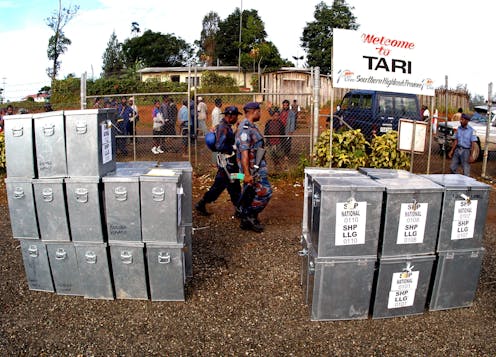
Despite Australia “stepping up” its relations with the Pacific since the election of the Albanese government, one of the notable things about the recent national election in Papua New Guinea (PNG) was the almost complete lack of coverage of it in Australian media – except for the odd report of violence.
2022 election outcome
For the record, voting took place across the country from July 4 to 22. Counting was supposed to be completed and writs returned by July 29, but that was extended to August 4. On August 9, with 99 of the 118 seats declared, the National Parliament met to elect a prime minister.
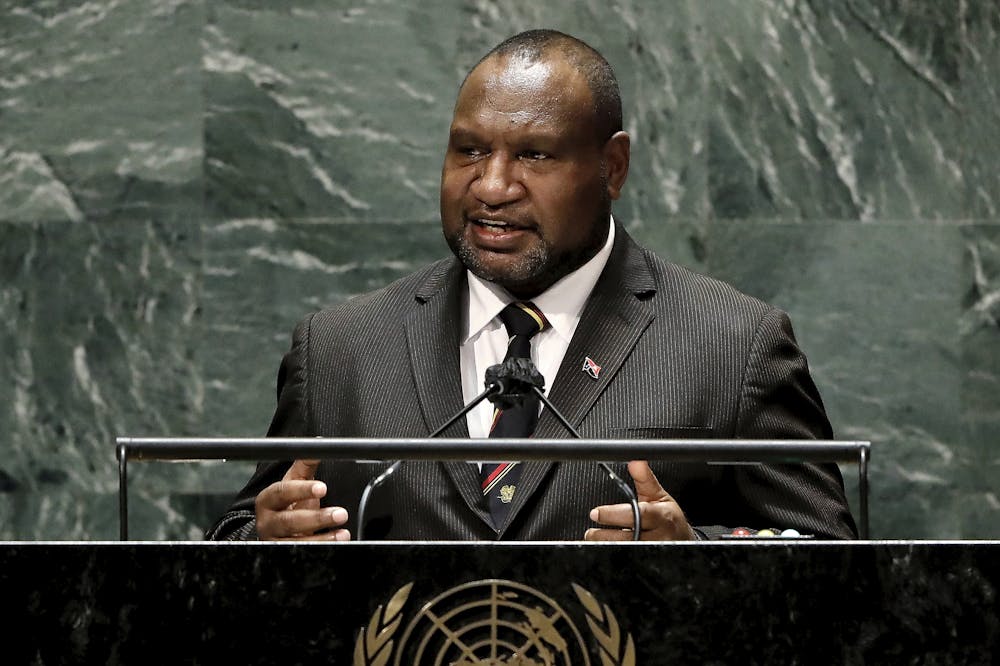
As leader of the party with the largest number of endorsed candidates elected (Pangu Pati with 36 members at August 9), outgoing prime minister James Marape was invited by the governor-general to form government and was re-elected to the office. Unusually, he was elected unopposed.
Like all other prime ministers before him, Marape heads a coalition government, including at least 17 parties and some independents. Most of the 17 parties have only one or two MPs and, with the independents, will probably merge with the larger parties in the early months of the new parliament.
The new parliament will include two women, better than the zero in 2017-2022, but still a disappointing result given the efforts to promote women candidates, whose numbers were fewer in 2022 than in 2017.
Read more: Why Papua New Guinea urgently needs to elect more women to parliament[1]
Previous volatility
In many parts of the country, this year’s elections were carried out without incident or drama. The previous election, in 2017[2], was widely described as the worst in the nation’s history, with inaccurate electoral rolls, vote-buying and intimidation of voters in some parts of the country.
The election was also afflicted by delays in polling and counting, theft and destruction of ballot boxes, and violence throughout. This included an estimated 200 “election-related deaths” (though “election-related deaths” are difficult to measure in a country where intergroup and domestic violence are endemic).
Some observers have suggested the 2022 election was more flawed and more violent than that of 2017, despite a substantial security presence and logistic support from the Australian Defence Force. A clearer picture will emerge once the reports of the ANU-coordinated domestic monitoring teams have been processed. However, the number of “election-related deaths” to date has been put at 50.
Counting has been delayed in several electorates, and elections may have failed[3] in at least three electorates due to allegations of vote fixing and other problems. Two of the potential failed election cases are in Morobe Province, while counting has been delayed in electorates of the National Capital District (Port Moresby) where violence has occurred.
Societal and political context of election violence
To understand the problems of elections in Papua New Guinea, and the violence associated with them, it is necessary to appreciate the social and political context in which elections take place.
Read more: Volatile times as rivals claim throne in Papua New Guinea: expert reactions[4]
Around 80-85%[5] of Papua New Guineans live in rural villages and hamlets with limited involvement in the cash economy. Politics therefore tends to be heavily localised.
 Around 80% of PNG’s population live in rural villages.
Getty Images
Around 80% of PNG’s population live in rural villages.
Getty Images
Political parties play a very minor role in how electors vote. Voters tend to vote for candidates they believe will give them access to government and bring them local services and other benefits – usually members of their clan or former public servants or businessmen who have a good local record.
Competition to get elected is intense, with large and growing numbers of candidates contesting in most electorates (on average 29 per electorate in 2022, but over 70 in two electorates). Some candidates invest large sums of money campaigning, including vote buying.
In the lead-up to the 2022 election, as in 2017, there were reports of sophisticated weapons being imported and distributed among candidates’ supporters in the highlands. The weapons were presumably for use in case of confrontations between rival candidates and their supporters.
Voting shifts
In 2007, Papua New Guinea shifted from a first-past-the-post system of voting[6], where the voter casts a single vote for the candidate of their choice, to one of limited preferential voting[7], where voters can indicate an order of preference for three candidates on their ballots.
Read more: Explainer: political crisis in Papua New Guinea [8]
This change was made in the hope of encouraging cooperation between candidates and reducing confrontation. However, there has been little evidence of changed behaviour. In some electorates, candidates have sought to prevent rivals from campaigning in the candidate’s core support area, even to the point of shooting at a helicopter bringing in a rival candidate.
Treacherous terrain, poor road networks and remote locations in much of the country have made it difficult and expensive to organise polling and to transport ballot boxes safely to counting centres. These physical conditions also contribute to the difficulties of compiling accurate electoral rolls, a continuing source of anger among voters whose names cannot be found on the rolls.
Corruption, control and other factors
However, the problems of inaccurate rolls and delayed polling are not just the result of geography and terrain, or even of inadequate or tardy payments from the government to the Electoral Commission and from the Electoral Commission to polling officials.
The ability of the Electoral Commission in Port Moresby to control what goes on at the local polling level is limited. Domestic monitoring in 2017 reported a number of instances where politicians appointed partisan polling officials. In other cases, supporters of candidates, sometimes in association with polling officials, filled out multiple ballots for one candidate – a reason that ballot boxes have sometimes been stolen of destroyed.
In 2022, almost 10,300 police and defence force personnel were deployed to provide security for polling; in designated “hotspots,” polling was limited to one day to maximise the coverage of security details. These efforts undoubtedly had an impact but were not sufficient to completely eliminate violence from frustrated would-be voters or supporters who believed that their candidate had been cheated.
After being elected, Marape promised to review and reform the voting process. However, it is difficult to see what can be done without a fundamental change in the behaviour of candidates, their supporters, and the voters themselves.
References
- ^ Why Papua New Guinea urgently needs to elect more women to parliament (theconversation.com)
- ^ in 2017 (www.theguardian.com)
- ^ failed (pina.com.fj)
- ^ Volatile times as rivals claim throne in Papua New Guinea: expert reactions (theconversation.com)
- ^ 80-85% (data.worldbank.org)
- ^ first-past-the-post system of voting (education.aec.gov.au)
- ^ limited preferential voting (www.ecanz.gov.au)
- ^ Explainer: political crisis in Papua New Guinea (theconversation.com)