The Liberal Party is in a dire state across Australia right now. That should worry us all
- Written by: Frank Bongiorno, Professor of History, ANU College of Arts and Social Sciences, Australian National University
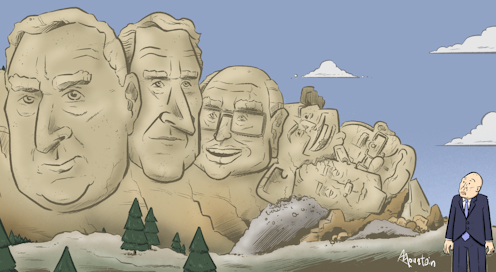
“The duty of an Opposition is to oppose” – attributed to Lord Randolph Churchill – is one of those quotations I remember seeing on exam papers in high school politics classes. It is true, but only half-true.
Tony Abbott opposed. He opposed relentlessly. Assisted by a conservative media that also opposed relentlessly, he did much to help destroy the Labor governments of Kevin Rudd and Julia Gillard, although they did a better job of destroying themselves.
When Abbott won a massive victory at the 2013 election, it was easy to proclaim him an all-time champion. In their book Battleground: Why the Liberal Party Shirtfronted Tony Abbott, Wayne Errington and Peter van Onselen thought historians might one day see Abbott as the country’s “best ever opposition leader”.
Yet the negativity surrounding the role rarely makes opposition leaders popular. Late in 2012, 60% of the public[1] told pollsters they disapproved of the job Abbott was doing.
Read more: Are we learning the wrong lessons from history?[2]
In most occupations, we do not treat people only capable of doing half their job as good at it. Abbott was, at best, capable of doing half his job. Even then, he brought such political aggression and opportunism to the task that it poisoned the well for when he won office. As prime minister, he continued to be the country’s most prominent opposition leader.
Under the system of party government that still operates in Australia, we need effective oppositions. We need them for two reasons. They are there to keep governments accountable. And they are there to prepare for being the government themselves.
Assuming for a moment that both sides of politics accept both democratic norms and that their mission is to serve the public good – assumptions that recent US experience, and a little of our own, suggest might be dubious – it is beneficial to have changes of government every few years. At best, it can freshen policy, challenge entrenched assumptions, and bring new personnel, energy and life to government.
As in sport, many people are wedded to their own “team” and want that team to win – although in Australian politics, far fewer today than a generation or two ago. But as in a sporting competition in which the same team wins every year, it is not good for democratic politics when one party is permanently excluded from office. That is why those who think the present weakness of the Liberal Party is only a cause for celebration or mockery might do well to think again.
The Liberals’ weakness is self-evident and, especially at the state level, part of a long-term change in the country’s electoral politics. Labor had only been a majority government once before John Cain junior became Victorian premier in 1982. In the 40 years since, it has only had three terms out of office.
The pattern in South Australia is similar, although the shift there occurred earlier. Decades of Liberal dominance to the mid-1960s were followed by decades of Labor dominance. In Queensland, Labor dominated from 1915 to 1957, the Country Party or Nationals (sometimes partnered by the Liberals) from then until 1989, and Labor has dominated since. In New South Wales, a Coalition government in office since 2011 has moved on to premier number four, looks tired, is often mired in scandal. It faces an uphill battle to be re-elected in March next year.
In the various states, the Liberal Party’s position seems dire. A report[3] on the Western Australian branch following its reduction to two lower house seats at the 2021 state election left the impression of an organisation that was a smouldering wreck. The WA Nationals, with four seats, became the opposition. WA voters registered their views again at the 2022 federal election by awarding Labor a swing of more than 10% and electing a teal independent to a formerly safe Liberal seat.
The Victorian Liberal Party, once considered that party’s “jewel in the crown”, has consistently failed to present as a serious alternative to the Andrews Labor government. Its polling is dire in the lead-up to a November election, and it is a regular target of ridicule.
The federal scene, too, is much worse for the Coalition parties than Labor’s poor primary vote and slight majority at the 2022 election would indicate. That election was a landslide – not in favour of Labor but against the Coalition. Its loss of seats to independents in traditional heartlands looks at least as bad – and probably worse – than the loss of blue-collar support by Labor in many of its own heartlands in the mid-1990s (the latter has, in any case, been consistently exaggerated).
Read more: Did Australia just make a move to the left?[4]
Oppositions do more than compete for government. They also play a crucial role in keeping governments accountable. It is a rare government that can enjoy years in office without becoming just a little arrogant and entitled. Equally seriously, popular and successful governments might perform poorly in some areas. Labor governments in Victoria and WA, for example, have had significant problems in the delivery of health services. It is appropriate and important to have an opposition that can identify and criticise problems as well as suggest alternative policies and provide viable electoral competition.
As we head towards the 50th anniversary of the election of the Whitlam government in December, it may well be that it is Gough Whitlam’s achievements as opposition leader that should grab our attention. For what it is worth, I consider him the best opposition leader the country has seen. Why? In stark contrast with Abbott, Whitlam was successful both in keeping governments accountable and in preparing for office. No one can accuse Prime Minister Whitlam of behaving as though he were leader of the opposition.
Whitlam’s government had faults. But his was a government with a genuine sense of purpose. It left a significant, positive and enduring imprint on the country. That had its origins in a fruitful period of opposition.
References
- ^ 60% of the public (www.theguardian.com)
- ^ Are we learning the wrong lessons from history? (theconversation.com)
- ^ A report (www.abc.net.au)
- ^ Did Australia just make a move to the left? (theconversation.com)