North Korea's flurry of missile tests raises alarm – but are we seeing anything new?
- Written by: Benjamin Habib, Lecturer in International Relations, Department of Politics and Philosophy, La Trobe University
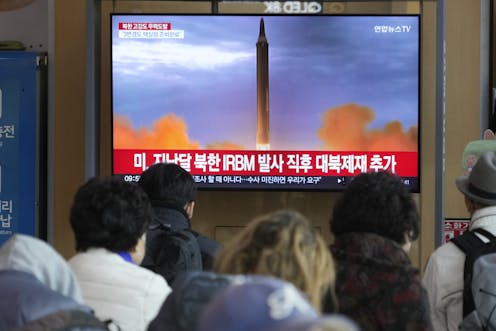
The sustained frequency and intensity of North Korea’s missile launches[1] in recent weeks has refocused attention on the Korean Peninsula at a time when the danger of great power war seems more immediate.
Yet the basic strategic balance on the Korean Peninsula remains as it has for decades: mutual deterrence based on overwhelming US military superiority and its nuclear umbrella[2] on the one hand; North Korea’s ability to inflict unacceptably significant damage to Seoul[3] on the other. Even in the context of North Korea’s nuclear weapons proliferation, this strategic balance has remained remarkably stable since the Korean War.
There are several possible reasons North Korea is testing a range of ballistic missiles at this time. If we step back from the immediate detail of the tit-for-tat escalations and rhetorical machismo, there are familiar patterns in its behaviour and in the reactions of the US and South Korea.
Demonstration of deterrence
Missile launches are a demonstration of North Korea’s deterrent capability. They show enemy states the country has the ability to strike the enemy targets it claims. Testing also helps North Korea ascertain how its adversaries might respond to those capabilities in the event of hot conflict.
North Korea’s diverse range of missile systems[4] are the backbone of its deterrence posture and its nuclear weapons capability. Its missile systems need to be able to attack a variety of different targets at different distances, defeat the missile defence systems of its adversaries, and have mobile launch capabilities so an enemy attack cannot destroy them all at once.
For this deterrent to be credible, North Korea needs to demonstrate to its enemies that these systems work. Hence the tests.
Technological development and training
Missile launches test the technology itself. Once the technical aspects of each missile system are mastered, further testing helps personnel train command and control and launch protocols.
In January 2021, Kim Jong-Un announced a five-year weapons development plan[5] to bolster and modernise the weapons inventory of the Korean People’s Army. This plan included a number of new missile systems such as submarine-launched missiles, intermediate-range missiles for targeting South Korea and Japan, and intercontinental ballistic missiles capable of targeting the continental United States.
An argument can be made that some of the recent missile activity is related to technological mastery and command and control training.
Read more: It's time to take Kim Jong Un and his nuclear threats seriously[6]
Strategic signalling
North Korea has used missile tests for strategic signalling. This might include communicating displeasure to its adversaries, testing the resolve of an incoming president in Washington or Seoul, or as a pinprick escalation for coercive diplomatic bargaining.
In this context, North Korea’s behaviour through the past month represents a pendular swing back toward escalation, with an incoming conservative government in Seoul.
Newly elected South Korean President Yoon Suk-yeol came to office promising a more muscular North Korea policy in response to the breakdown of Moon Jae-in’s summit engagement with the DPRK. Yoon’s “audacious[7]” plan for massive economic assistance to North Korea is conditional on its denuclearisation.
Yoon has also promised more assertive responses to North Korean provocations, essentially repackaging the policies of his right-leaning predecessors Park Geun Hye and Lee Myung Bak. As it did during these previous periods of conservative rule in Seoul, North Korea in 2022 has responded to this retreat from engagement with escalation.
North Korea’s reaction to joint US-South Korea military exercises has also been predictable. This month’s Vigilant Storm[8] airforce exercises were the largest mobilisation ever for this event. It comes on the back of South Korea’s Hoguk[9] military exercises and the large-scale joint US-South Korea Ulchi Freedom Shield[10] exercises, the first joint field training in nearly five years.
While usually held annually, the Moon Jae-in administration wound back joint US-South Korea military exercises as a confidence-building measure in its inter-Korean summit diplomacy. The exercises were then further curtailed due to the COVID pandemic. After a five-year hiatus, this year’s resumption of joint exercises rekindles what was an annual source of tension.
Internal signalling
North Korea has used missile tests for internal signalling to domestic audiences, as a nod to important constituencies in the military establishment, as a demonstration of strength and technological prowess to its public, and as a distraction during times of internal crisis.
The long-range ballistic missile launched from a mobile platform in the vicinity of Pyongyang[11] on November 2 is interesting as a public demonstration of strength, because of the visibility of the missile launch to residents of the capital.
Such a demonstration makes sense in the context of the even greater hardship experienced by the North Korean people over the past three years. The convergence of the COVID pandemic with successive disaster impacts[12] from typhoons, floods and drought has presented the nation with its most significant systemic challenge since the Arduous March[13] period of the 1990s.
The sustained pace of missile launches may serve as a distraction to focus the North Korean people’s gaze on the external enemy rather than their own distress and the government’s role in it.
Read more: North Korea: how the COVID outbreak is putting pressure on the regime[14]
We’ve seen this before
In North Korea’s current flurry of missile launches we see the repetition of old patterns of escalation and response. While there is still risk associated with any escalation of tension on the Korean Peninsula, this is far from uncharted territory.
References
- ^ missile launches (www.abc.net.au)
- ^ overwhelming US military superiority and its nuclear umbrella (www.defense.gov)
- ^ unacceptably significant damage to Seoul (theconversation.com)
- ^ diverse range of missile systems (www.nknews.org)
- ^ five-year weapons development plan (www.nknews.org)
- ^ It's time to take Kim Jong Un and his nuclear threats seriously (theconversation.com)
- ^ audacious (www.mofa.go.kr)
- ^ Vigilant Storm (www.7af.pacaf.af.mil)
- ^ Hoguk (www.koreaherald.com)
- ^ Ulchi Freedom Shield (www.usfk.mil)
- ^ launched from a mobile platform in the vicinity of Pyongyang (www.nknews.org)
- ^ convergence of the COVID pandemic with successive disaster impacts (www.nknews.org)
- ^ Arduous March (www.theguardian.com)
- ^ North Korea: how the COVID outbreak is putting pressure on the regime (theconversation.com)