Why haven't I had COVID yet?
- Written by: Nathan Bartlett, Associate Professor, School of Biomedical Sciences and Pharmacy, University of Newcastle
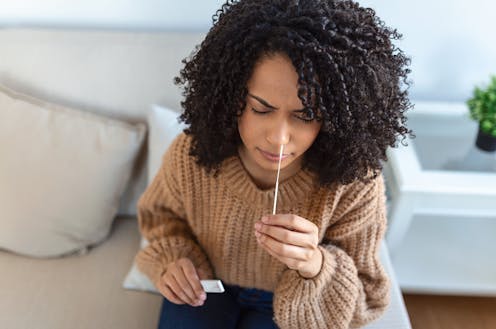
Throughout the pandemic, Australia has recorded[1] 10.4 million cases of COVID-19, with the majority occurring this year.
This is without doubt an underestimate, as not everyone tests for COVID-19 or reports their positive results.
The latest survey[2] of donor blood looked at the proportion of people who had antibodies against SARS-CoV-2, the virus that causes COVID-19. It found at least two thirds of Australians have been infected.
That leaves about a third of the population who are yet to have COVID.
I’m one such “NOVID” – despite multiple confirmed COVID-19 exposures during the pandemic, I’m yet to have symptoms and test positive.
So what do we know about NOVIDs?
First, we might not actually be NOVIDs
Some people claiming they’ve never had COVID-19 might be surprised to learn they have virus-targeting antibodies in their blood that could only have been generated by infection.
The reliance on home rapid antigen tests (RATs), which are less sensitive than PCR testing, will contribute to many people failing to definitively determine whether they have COVID-19.
Under ideal testing conditions[3], the best tests detect SARS-CoV-2 infection more than 95% of the time. However in the real world, the detection rate is lower.
If you have mild symptoms that don’t last long, you’re less likely to test repeatedly and may miss your window to get a positive result. So some COVID-19 cases will escape detection by RATs.
Read more: Could I have had COVID and not realised it?[4]
At this point, it’s important to distinguish between being infected with SARS-CoV-2 and experiencing the illness (COVID-19) caused by this infection. You can be infected without experiencing COVID-19 symptoms – this is called asymptomatic infection.
It’s unclear what proportion of Omicron subvariant cases are asymptomatic. Early in the pandemic, one in six people infected were asymptomatic[5] and it could now be as high as 50% or more[6] with Omicron.
So, many NOVIDs will have been infected with SARS-CoV-2, generated antibodies to the virus, but did not experience or notice any COVID-19 symptoms at the time, did not test and have remained unaware of their infection status (and whether they were unknowingly transmitting[7] the virus).
What role does the immune system play?
Everyone’s immune system is different. How your immune system responds to a particular infection is affected by many factors including your genes, gender, age, diet, sleep patterns, stress levels, history of other infections and illnesses, medications, vaccination status, and level of virus exposure.
So are some people less likely to get COVID-19 because of the strength of their immune system?
The status of our immune system at any given moment will impact our susceptibility to disease. So it’s unsurprising the people most susceptible to severe COVID-19 are those with less effective immunity because they have chronic diseases, are immune-suppressed or elderly.
Read more: Your immune system is as unique as your fingerprint – new study[9]
The other key variable is the virus. SARS-CoV-2 continues to evolve with new Omicron subvariants[10] continuing to emerge. This will affect how the virus interacts with us and the relative impact of different factors affecting our immune protection and susceptibility.
SARS-CoV-2 has proven itself to be particularly adept at evolving to generate viral variants that can evade our established immune protection. In addition, our immune protection is not stable and will begin to wane after a couple of months if not boosted by vaccination or infection.
Are my genes protecting me?
Let’s consider something that is relatively stable: your genes.
Scientists looking for associations between specific genes and disease can undertake genome-wide association studies. The effect of individual genetic variations on disease risk is usually very small, so identifying them requires large numbers of people and factoring in other variables that make us all different.
In once such study[12], researchers compared genomes of nearly 50,000 people with COVID-19 with the genomes of 2 million people without known infection.
They identified regions in the genome (loci) associated with contracting COVID-19 and other genetic regions associated with disease severity. So this is evidence that, like many other diseases, certain genes do modify the risk of COVID-19.
While association is not causation, these types of genomic studies point us in a direction to better understand the biology of COVID-19 to address questions such as who might be at risk of severe disease or long COVID and assist development of new therapies to prevent these outcomes.
Read more: Do genetic differences make some people more susceptible to COVID-19?[13]
Another study[14] identified a small number of critically ill COVID-19 patients with rare gene variants. These could be directly linked to defective antiviral immunity.
So for a very small number of people, it appears their genes make them more susceptible to COVID. But for the vast majority of people, the picture is far more complicated.
Could I have immunity from previous infection with a similar virus?
SARS-CoV-2 is not the only respiratory coronavirus that regularly infects humans. Four others – 229E, HKU-1, OC43 and NL63 – share some similarity with SARS-CoV-2.
Most adults would have been infected by these viruses multiple times throughout their life. This raises the possibility[15] that immunity generated by lifetime and/or recent exposure to these other coronaviruses might generate immunity that provides some protection against SARS-CoV-2 infection and symptomatic COVID-19.
More research is needed to better understand this, but the existing evidence is compelling and it’s certainly plausible.
The bottom line is there are many reasons why people who socialise and inevitably interact with people with COVID-19 believe they’ve never had COVID themselves. For most NOVIDs, it has been a combination of vaccination, leveraging a healthy immune system, sensible decisions and luck that have kept them COVID-free thus far.
Of course, luck eventually runs out, so enjoy your NOVID status while you can.
References
- ^ recorded (covid19.who.int)
- ^ latest survey (www.ncirs.org.au)
- ^ ideal testing conditions (www.tga.gov.au)
- ^ Could I have had COVID and not realised it? (theconversation.com)
- ^ asymptomatic (jammi.utpjournals.press)
- ^ 50% or more (jamanetwork.com)
- ^ transmitting (www.sip-spp.pt)
- ^ Unsplash/Nick Fewings (unsplash.com)
- ^ Your immune system is as unique as your fingerprint – new study (theconversation.com)
- ^ new Omicron subvariants (theconversation.com)
- ^ Meizhi Lang/Unsplash (unsplash.com)
- ^ once such study (www.nature.com)
- ^ Do genetic differences make some people more susceptible to COVID-19? (theconversation.com)
- ^ study (www.nature.com)
- ^ possibility (www.nature.com)
Read more https://theconversation.com/why-havent-i-had-covid-yet-193861