Lower speed limits don’t just save lives – they make NZ towns and cities better places to live
- Written by: Simon Kingham, Professor of Human Geography, University of Canterbury
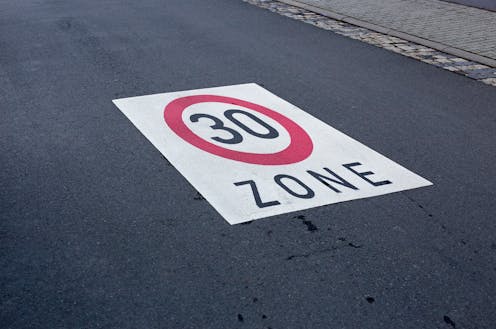
It seems New Zealand is about to slow down, with proposals to reduce urban speed limits right across the country, as well as on state highways[1]. And while there has been some resistance, the evidence suggests it’s the right move.
The changes are part of Waka Kotahi’s Road to Zero[2] project, which tasked local councils with developing speed management plans[3] to reduce transport-related deaths. Generally, those plans will set 30 kilometre per hour (km/h) limits around schools and 40km/h limits in many residential areas of Auckland[4], Wellington[5], Christchurch[6] and Dunedin[7].
There’s no doubt speed[8] is a major factor in the number of deaths and injuries on New Zealand roads. It causes more injuries than alcohol and drugs[9], and it’s estimated that 87% of current speed limits are incorrectly set[10].
But there’s a counter argument that speed limits should only be reduced in “high-risk areas[11]”, with school environs being the most common example. Widespread speed limit reduction, the argument goes, will waste drivers’ time and damage the economy.
But this assumes the only way speed limits affect society is through crash-related deaths and injuries, and through time lost travelling. So it’s important we recognise the other significant benefits that come from slowing traffic down.
Death and injury
The risk of injury or death if you are hit by a vehicle is substantially lower[12] at speeds below 50km/h. At 40km/h, for example, the risk of dying drops from around 90% to around 10%. For injuries, the greater reductions are seen at speeds of 20 or 30km/h.
Research in the UK[13] found the introduction of 20 miles per hour (mp/h) zones resulted in a 42% reduction in road casualties, and the reduction was greatest in younger children. There was also no evidence of more people moving to drive on adjacent streets with higher speed limits.
Read more: Why giving the Commerce Commission the power to set 'fair' fuel prices is unfair on NZ’s climate targets[14]
Recent research in Wales[15], a country with a population of 3.1 million that implemented a default urban speed limit of 20mp/h (30km/h), found the economic value of savings from lower accident rates to be in the region of NZ$180m in the first year alone. The total value is far greater if other benefits are included[16].
What statistics don’t show is the reality of the suffering road crash deaths and injuries cause. But survivors’ stories, such as those recorded[17] by transportation consultant Jeanette Ward, also powerfully demonstrate how lower speeds can save lives.
Economics and emissions
But what of the argument that slowing drivers down and prolonging trips mean the economy will suffer? There are two answers to this.
The first is that evidence shows[18] lower speed limits in urban areas add virtually no time to journeys[19]. You can see why in this simple simulation[20] that compares traffic with different speed limits.
The second is that people don’t always productively use the time saved by faster travel. In fact, research suggests[21] people often choose to travel further, especially for their daily commute. Making journeys faster can also encourage people to travel more often. This is called induced demand[22] and it adds to congestion.
Read more: Climate explained: does building and expanding motorways really reduce congestion and emissions?[23]
Furthermore, there is a reasonably established relationship between the speed a vehicle travels and greenhouse gas emissions, with the lowest emissions being produced when a vehicle travels at around 55-80km/h.
However, this assumes a vehicle is moving smoothly, without stops and starts. Higher emissions[24] are created when a vehicle has to repeatedly brake and accelerate. While individual driver behaviour can be a factor, the road environment and volume of traffic play a role too.
Research has actually found that in urban areas the optimum speed limit[25] to minimise emissions for small petrol cars is 28.2km/h. For larger vehicles, diesels and SUVs, CO2 emissions are minimised with a maximum speed of 20km/h.
Read more: Climate explained: does your driving speed make any difference to your car's emissions?[26]
Pollution, noise and health
Nitrogen dioxide from traffic is estimated to cause 2,000 deaths[27] each year in New Zealand. Emissions are lowest[28] with 20km/h speed limits.
The World Health Organization estimates traffic noise is the second-biggest environmental stressor[29] on public health after air pollution. Lower speeds significantly reduce noise, with research finding[30] that “in urban areas with speeds of between 30 and 60kp/h, reducing speeds by 10kp/h would cut noise levels by up to 40%”.
References
- ^ state highways (www.rnz.co.nz)
- ^ Road to Zero (www.nzta.govt.nz)
- ^ speed management plans (www.nzta.govt.nz)
- ^ Auckland (www.stuff.co.nz)
- ^ Wellington (www.stuff.co.nz)
- ^ Christchurch (www.stuff.co.nz)
- ^ Dunedin (www.dunedin.govt.nz)
- ^ speed (www.transport.govt.nz)
- ^ alcohol and drugs (www.transport.govt.nz)
- ^ incorrectly set (www.newshub.co.nz)
- ^ high-risk areas (www.times.co.nz)
- ^ substantially lower (futuretransport.info)
- ^ Research in the UK (www.bmj.com)
- ^ Why giving the Commerce Commission the power to set 'fair' fuel prices is unfair on NZ’s climate targets (theconversation.com)
- ^ research in Wales (media.service.gov.wales)
- ^ other benefits are included (blogs.napier.ac.uk)
- ^ recorded (abley.com)
- ^ evidence shows (www.nzta.govt.nz)
- ^ no time to journeys (futuretransport.info)
- ^ simulation (videos.futuretransport.info)
- ^ research suggests (www.greaterauckland.org.nz)
- ^ induced demand (theconversation.com)
- ^ Climate explained: does building and expanding motorways really reduce congestion and emissions? (theconversation.com)
- ^ Higher emissions (www.fueleconomy.gov)
- ^ optimum speed limit (futuretransport.info)
- ^ Climate explained: does your driving speed make any difference to your car's emissions? (theconversation.com)
- ^ cause 2,000 deaths (www.stuff.co.nz)
- ^ Emissions are lowest (futuretransport.info)
- ^ second-biggest environmental stressor (www.euro.who.int)
- ^ research finding (cfile240.uf.daum.net)
- ^ said a 20 mile per hour (30km/h) speed limit (www.thebritishacademy.ac.uk)
- ^ disproportionately affect (www.ehinz.ac.nz)
- ^ Slow Cities (doi.org)