Google AI
The Times Australia

Times Media Advertising

It's time to add climate change and net-zero emissions to the RBA's top 3 economic goals

  • Written by: Toby Phillips, Public Policy Researcher, University of Oxford
It's time to add climate change and net-zero emissions to the RBA's top 3 economic goals

Increasingly, climate change is at the centre of government decision-making.

This year’s federal budget devoted pages to an examination of the fiscal impact[1] of climate change; Treasury has established a climate change modelling unit[2]; and it’ll be front and centre of next year’s intergenerational report[3].

Yet it is still nowhere near the centre of the deliberations of Australia’s Reserve Bank – one of the nation’s most important economic decision-making institutions.

The Reserve Bank’s enabling legislation is the Reserve Bank Act 1959. That 63-year old legislation requires the bank to make decisions that are directed to the “greatest advantage of the people of Australia[4]” in three specific areas:

  • the stability of the currency of Australia

  • the maintenance of full employment in Australia

  • the economic prosperity and welfare of the people of Australia

The first objective is interpreted in an agreement signed by the treasurer as aiming to get “inflation between 2% and 3%, on average over time[5]”.

The second and third aren’t clearly defined in the agreement, leaving most of the focus on the first.

Climate given second-order status

While it is beyond doubt that the third objective – “economic prosperity and welfare of the people of Australia” – includes a liveable climate and a sustainable environment, not spelling this out relegates climate and sustainability to second-order status as the bank makes decisions.

In a submission to the independent review[6] of the bank, set up by the treasurer and due to report in March, I put forward an argument for adding a fourth objective along with my colleagues from the Centre for Policy Development[7]:

  • an orderly transition to, and maintenance of, net-zero greenhouse gas emissions, and management of climate-related risks and opportunities

Should that be seen as too much of a change, we suggest a fallback: adding the word “sustainability” to the existing third objective, making it refer to

  • the economic prosperity, sustainability and welfare of the people of Australia

In addition, our submission asks the government to include in its written directions[8] to the bank a statement setting out the government’s view of the ways in which the bank’s objectives relate to climate change.

What’s the climate got to do with the bank?
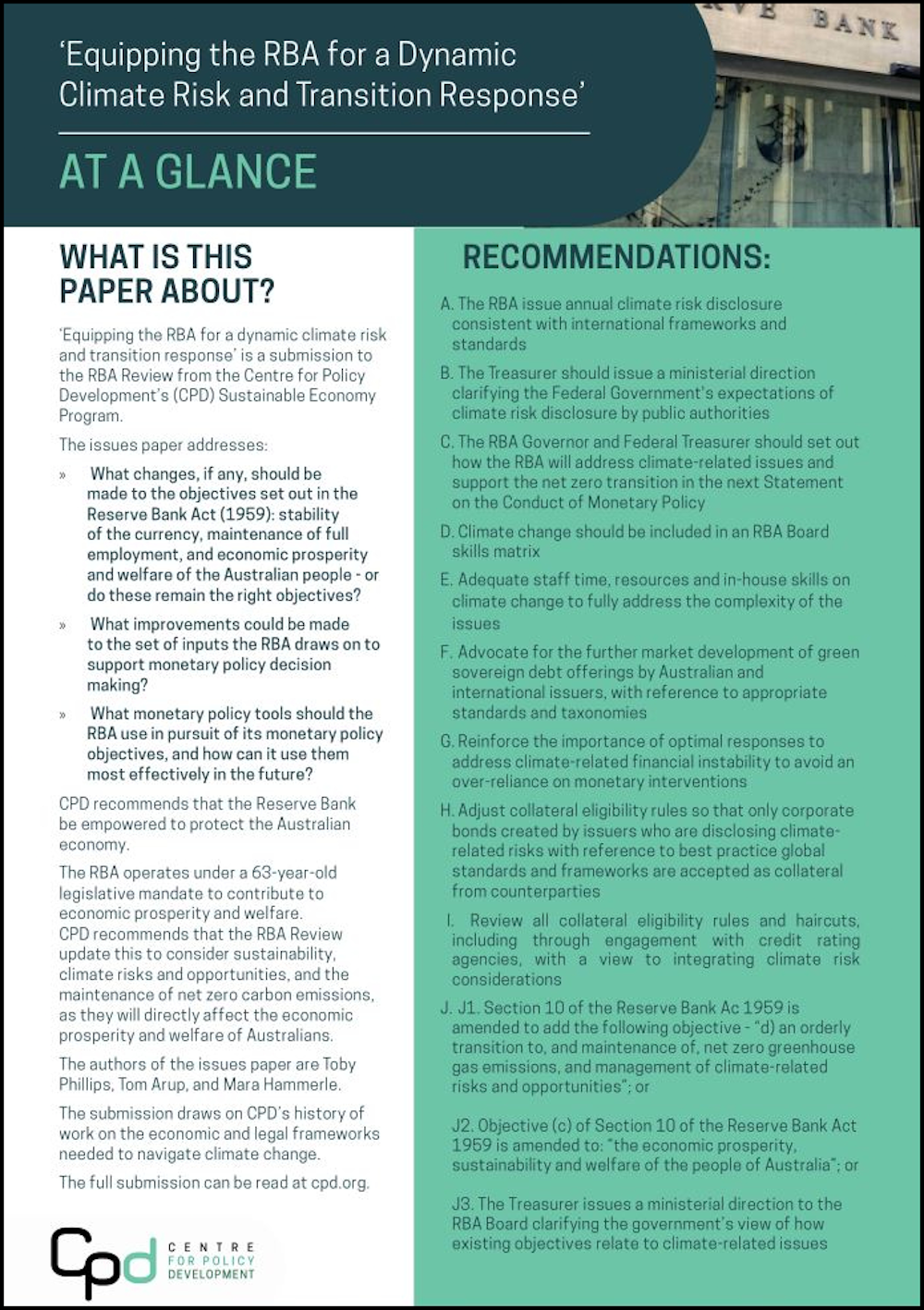
Centre for Policy Development[9] Climate change is a first-order financial stability issue and will be the dominant economic theme of this century, due to both the scale of likely damage and the opportunities in the transition to net-zero. The bank needs to build out a more sophisticated toolkit for dealing with the impacts of this transition. The bank’s primary tool – the interest rate – is particularly good at sending signals to the “demand” side of the economy, but climate risks are more likely to present supply-side inflationary shocks. This means an obsessive focus on short-term inflation without considering the transition could be self-defeating, as it might encourage the continued use of fossil fuels even as they play an increasingly less stable and more inflationary role[10] in the economy. One way this could play out would be a decision by the bank to push up interest rates in response to inflation caused by high fossil fuel prices. In turn, this could make it more expensive to invest in renewable energy – the very thing that would decouple prices from fossil fuels. Beyond setting interest rates, a less public part of the Reserve Bank’s role is maintaining liquidity in the financial system by lending to private banks against collateral, some of which includes corporate bonds. The bank can insist on climate risk reporting The international task force on climate-related financial disclosures – which reports to the Bank for International Settlements, of which Australia’s Reserve Bank is a member – is pushing for the standardised reporting of corporate climate risks[11]. If Australia’s Reserve Bank insisted on this[12] from firms whose corporate bonds it held as collateral (as the European Central Bank[13] is planning to), it would help spread awareness of accounting for the importance of accounting for climate risks throughout the financial system. The bank could go further and consider the impact of climate-related risks on expected default rates when assessing the creditworthiness of assets used as collateral, preferencing corporate debt from companies with credible transition plans. The effects of this repricing would ripple through the financial system. Read more: Why it's not anti-environmental to be in favour of economic growth[14] It could even decide to preference government debt from “green sovereigns” (foreign states or Australian states whose activities involve little climate risk) over those of less-green sovereigns by offering differentiated interest rates. In 2019 the Centre for Policy Development hosted a landmark address in which then Reserve Bank Deputy Governor Guy Debelle[15] emphasised the importance of an orderly climate transition to financial stability, saying: decisions that are taken now can have significant effects on future climate trends and can limit or eliminate the ability to mitigate the effect of those trends The Reserve Bank, Australia’s oldest and arguably most important public financial regulator, has the ability to help smooth the transition. An early step would be to update the bank’s 1950s rules, and put beyond doubt that climate change is one of its 21st century responsibilities. References^ fiscal impact (budget.gov.au)^ modelling unit (www.smh.com.au)^ intergenerational report (theconversation.com)^ greatest advantage of the people of Australia (www.rba.gov.au)^ inflation between 2% and 3%, on average over time (www.rba.gov.au)^ independent review (rbareview.gov.au)^ Centre for Policy Development (cpd.org.au)^ directions (www.rba.gov.au)^ Centre for Policy Development (cpd.org.au)^ less stable and more inflationary role (cpd.org.au)^ standardised reporting of corporate climate risks (www.fsb-tcfd.org)^ insisted on this (www.lse.ac.uk)^ European Central Bank (www.ecb.europa.eu)^ Why it's not anti-environmental to be in favour of economic growth (theconversation.com)^ Guy Debelle (www.rba.gov.au)

Read more https://theconversation.com/its-time-to-add-climate-change-and-net-zero-emissions-to-the-rbas-top-3-economic-goals-194068

Times Magazine

Offshore vs Inshore Centre Console Boats: Which One Should You Buy?

Centre console boats have become one of the most popular choices among modern anglers. Their open ...

Why Australian Enterprises Are Rethinking Their Core Communication Technologies

The corporate landscape in Australia has undergone a permanent structural shift over the past few ...

Road safety risk: New data reveals almost 2 in 3 Australian drivers are letting car maintenance slide as cost of living pressures bite

Australians are putting off vehicle maintenance and new research released on the eve of National R...

Technology

Why Australian Enterprises Are Reth…

The corporate landscape in Australia has undergone a permanent structural shift over the past few ...

Local News

QLD Day

On Saturday 6 June, parkrun events across the state will be a sea of maroon, with communities  str...

Culture

Covid: The pandemic has ended but the health …

Covid is no longer the daily emergency it was in 2020 and 2021. The fear, lockdowns, border closur...

Travel

The Times Guide to Sydney's Beaches

Winter may still have a grip on Sydney, but anyone who has lived in Australia's largest city knows...

The Times Features

Pauline Hanson at the National Press Club: A Defining P…

For almost 30 years, Senator Pauline Hanson has been one of the most recognisable and controversia...

Covid: The pandemic has ended but the health story hasn…

Covid is no longer the daily emergency it was in 2020 and 2021. The fear, lockdowns, border closur...

Macca’s introduces new McSmart range with more choice f…

Macca’s is launching its new-look McSmart range from Wednesday,1 July, with  three new meals at thre...