The concept of class is often avoided in public debate, but it's essential for understanding inequality
- Written by: Jessica Gerrard, Senior lecturer, The University of Melbourne
In Australian news, opinion and popular culture, the figures of the hipster and the bogan are everywhere. These figures are proxies for cultural, commercial and moral aspects of class, signalling differences in fashion, accents and tastes. Perhaps one of the most recognisable examples is the popular television series, Upper Middle Bogan.
So potent and provocative are these figures in Australian popular culture, that in our experience of talking about class in the media earlier this year, following the release of our book Class in Australia[1], interviewers most often wanted to talk about hipsters and bogans.
These figures are important for understanding class in Australia, including how moralised classed judgements about “good” versus “trashy” culture are made. But to talk about class in Australia involves talking about material inequality, work conditions, and the social, economic and political relations that produce wealth and poverty.
In a settler colony like Australia, it also involves addressing how class relations have been built on the foundations of colonialism and the exclusion and exploitation of Indigenous people, as Eualeyai/Kamilaroi academic, lawyer, filmmaker and advocate Larissa Behrendt noted in her contribution to our book.
The ongoing crisis of COVID-19 has highlighted the need to acknowledge the drastically different experiences of the global pandemic, depending on the kind of work you do. Front-line “essential” workers, often precariously employed, many of whom are in working-class jobs, have fundamentally different experiences of risk and exposure than white-collar workers able to work from home.
COVID-19 has also exposed the complex and fragile global flows of migrant agricultural workers[2], whose labour Australians rely upon to put food on the table, and whose lives were put in limbo.

Read more: How your race, class and gender influence your dreams for the future[3]
The rhetoric of class
Class has a unique place in Australian public life. At times it looms large, acting as an organising frame to declare interests and political sentiments. In Australia, the concept of “class” has a cultural history with deep connections to unionism and the struggle for workers’ rights, including, for instance, the campaign for the eight-hour day[4].
Yet often class is obscured. It is markedly absent from contemporary public and political debates on poverty, inequality, disadvantage and wealth. These other terms appear to roll off the political tongue with ease. They lend themselves to policy discourse and political rhetoric where structural inequalities are broken down into a series of “risk factors” attributed to individuals.
When the concept of class is mentioned, it is often presented in an inverted top-down manner. Some of Australia’s most privileged and powerful people routinely use anti-“elite” rhetoric. The notion of elitism is used to stereotype and denigrate so-called inner-city latte sippers. Their education and “progressive” political values are cited as evidence that they fail to grasp the needs and beliefs of “ordinary” people, exemplified by the “quiet” Aussie “battler”.
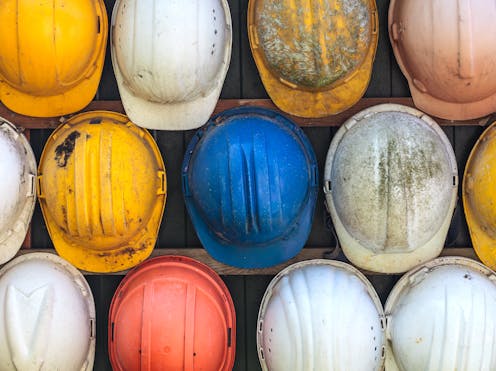
The symbols of class are invoked when our highly paid politicians cosplay as working class, dressing in high-vis and helmets, wearing army fatigues, or getting on tractors when visiting farms. These performances are attempts to connect the political class with the everyday worker, while at the same time glossing over social and employment inequalities.
Whenever arguments about income or economic redistribution arise, we hear immediate invocations of a “class war”. For instance, arguing in favour of lowering the minimum wage in 2012, Australian mining magnate Gina Rinehart[5] implored Australians to
get through the class warfare smokescreen […] if you’re jealous of those with more money, don’t just sit there and complain; do something to make more money yourself – spend less time drinking, or smoking and socialising, and more time working.
It seems that in Australia, as elsewhere, as US-based billionaire investor Warren Buffett quipped[6]:
There’s class warfare all right, but it’s my class, the rich class, that’s making war, and we’re winning.
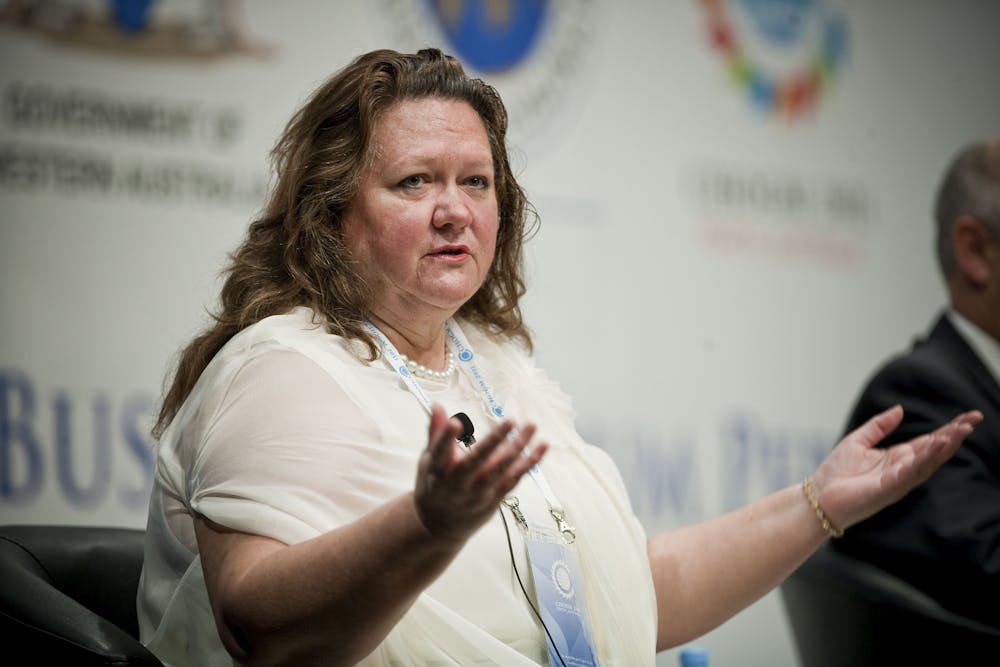 Gina Reinhart.
Tony McDonough/AAP
Gina Reinhart.
Tony McDonough/AAP
Read more: Gentrification is dividing Australian schools[7]
What is class in Australia?
The term “class” – as distinct from related concepts like socio-economic status, inequality or disadvantage – remains useful because it refers to the cultural, social, economic and employment relations that have produced widening inequality[8]. It means acknowledging that some must sell their labour for wages, while others generate wealth from the capital produced from that labour.
At the same time, any genuine understanding of class in Australia requires qualifications. Class also refers to deep cultural and social practices which shape our identities, our communities and ways of being.
Class is a term that is hotly contested. Many have revisited the term, considering it in relation to, for instance, Indigenous experiences, gender and women’s work, and questions of race and racism. Not all distinctive experiences of difference, disadvantage and inequality – gender, race, Indigeneity, sexuality, ability, age for instance – represent equivalences that can be subsumed into class.
For instance, in our book, Rose Butler, Christina Ho and Eve Vincent discuss how ethnicity complicates straightforward understandings of class when it comes to education. Their research shows that many white parents denigrate Asian-Australian parents who invest in tutoring for their children, believing that it is “unfair” and does not allow kids to be kids.