Transport election promises are much smaller this time round in Victoria, but the quality control is no better
- Written by: Marion Terrill, Transport and Cities Program Director, Grattan Institute
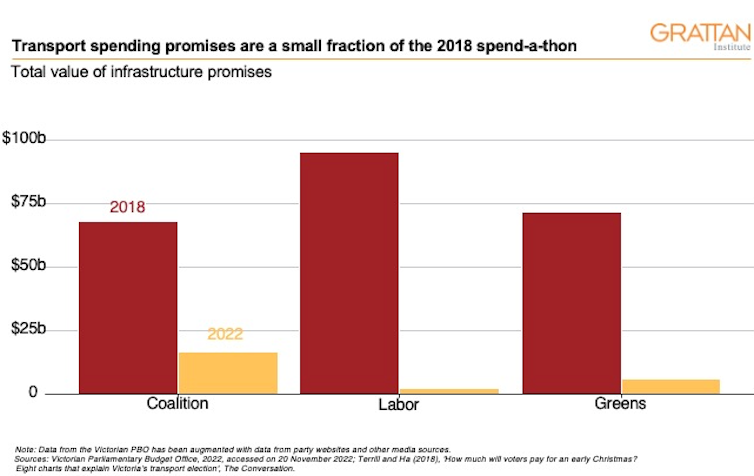
An election campaign can sometimes feel like Groundhog Day, but this Victorian election is genuinely different. While the major parties are still making plenty of transport promises, they’ve dialled them way down from the dizzy heights of 2018[1].
Our hope for the next election? Stop promising projects on the hoof, and start listening to what Infrastructure Victoria and Infrastructure Australia assess as worthwhile.
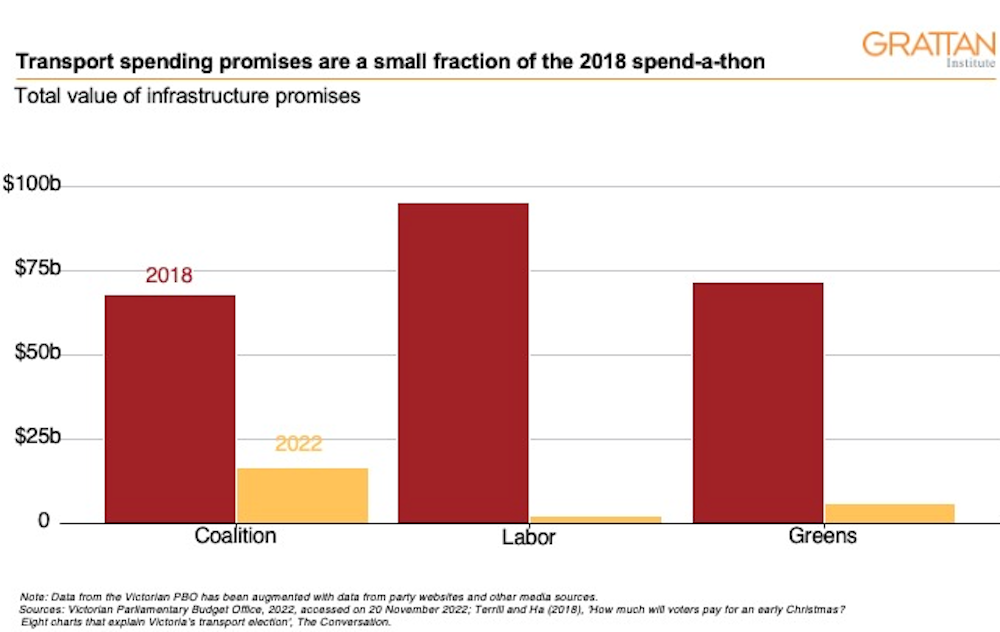
The biggest difference between the transport promises made this campaign compared to last time is scale. Back in 2018[2], the Coalition promised to spend $68 billion and Labor an eye-watering $95 billion, of which about half was for the Suburban Rail Loop[3]. This time around, we calculate the Coalition’s promised new spending is just 25% of last time’s, at $16.7 billion, and Labor’s a tiny 2%, at $2.3 billion.
 Author provided
 Author provided
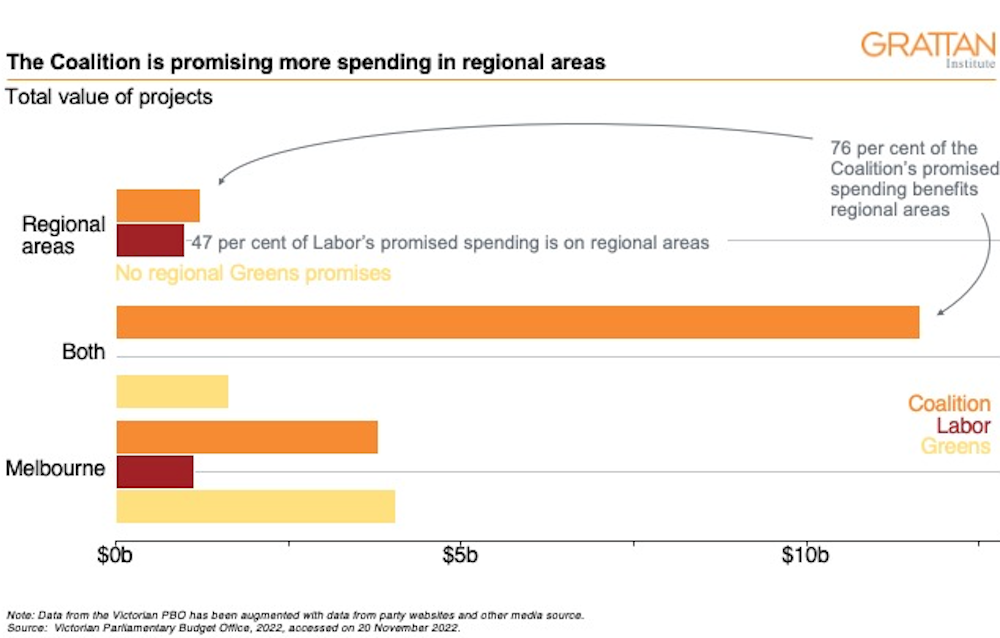
The two major parties have promised 32 projects valued at $100 million or more, but they agree on just one: stage 2 of the Barwon Heads Road duplication[9]. 2018 wasn’t much better, with the parties agreeing only on North East Link[10] and Airport Rail Link[11].
New South Wales does things differently: in the 2019 NSW election campaign, Labor and the Coalition agreed on three of the four largest projects[12] promised.
Independent advisory bodies ignored
One reason the Victorian parties diverge so markedly on transport priorities is that they don’t pay much attention to the views of the independent advisory bodies, Infrastructure Victoria[13] and Infrastructure Australia[14].
Infrastructure Victoria has produced a 30-year strategy[15] for the state’s infrastructure, and it doesn’t mention some key policies of both parties. For instance, the Coalition has promised $2 tram and bus fares[16], and Labor has promised to cap regional public transport fares[17]. But what Infrastructure Victoria recommends is a nuanced combination of off-peak discounts, reduced tram and bus fares, removal of the free tram zone, parking reform, and a congestion pricing trial in inner Melbourne.
Infrastructure Australia is supposed to scrutinise the business case of any infrastructure project where the proponent is seeking $250 million or more in federal funding. Up to 11 promised Victorian projects are in this category, but Infrastructure Australia has assessed only one as being investment-ready. The other ten are not even at the stage of evaluating potential investment options.
Read more:
Of Australia's 32 biggest infrastructure projects, just eight had a public business case[18]
The one project that is investment-ready is Labor’s proposal to upgrade the Melton line[19]. Of the rest, three are what Infrastructure Australia calls early-stage proposals, and seven have not been submitted to it at all. The three that have reached early-stage status are the Coalition’s proposals to commit $10 billion to road maintenance[20] and to reinstate the country roads and bridges program, and the Greens’ Big Bike Build[21].
Author provided
The two major parties have promised 32 projects valued at $100 million or more, but they agree on just one: stage 2 of the Barwon Heads Road duplication[9]. 2018 wasn’t much better, with the parties agreeing only on North East Link[10] and Airport Rail Link[11].
New South Wales does things differently: in the 2019 NSW election campaign, Labor and the Coalition agreed on three of the four largest projects[12] promised.
Independent advisory bodies ignored
One reason the Victorian parties diverge so markedly on transport priorities is that they don’t pay much attention to the views of the independent advisory bodies, Infrastructure Victoria[13] and Infrastructure Australia[14].
Infrastructure Victoria has produced a 30-year strategy[15] for the state’s infrastructure, and it doesn’t mention some key policies of both parties. For instance, the Coalition has promised $2 tram and bus fares[16], and Labor has promised to cap regional public transport fares[17]. But what Infrastructure Victoria recommends is a nuanced combination of off-peak discounts, reduced tram and bus fares, removal of the free tram zone, parking reform, and a congestion pricing trial in inner Melbourne.
Infrastructure Australia is supposed to scrutinise the business case of any infrastructure project where the proponent is seeking $250 million or more in federal funding. Up to 11 promised Victorian projects are in this category, but Infrastructure Australia has assessed only one as being investment-ready. The other ten are not even at the stage of evaluating potential investment options.
Read more:
Of Australia's 32 biggest infrastructure projects, just eight had a public business case[18]
The one project that is investment-ready is Labor’s proposal to upgrade the Melton line[19]. Of the rest, three are what Infrastructure Australia calls early-stage proposals, and seven have not been submitted to it at all. The three that have reached early-stage status are the Coalition’s proposals to commit $10 billion to road maintenance[20] and to reinstate the country roads and bridges program, and the Greens’ Big Bike Build[21].
 Author provided
A shift to many smaller projects
This election also stands out for the large number of smaller projects worth less than $100 million. That was also a feature of the federal election[22] in May. About half of both the Coalition’s and Labor’s promised projects in Victoria are worth less than $100 million.
Read more:
As federal government spending on small transport projects creeps up, marginal seats get a bigger share[23]
Author provided
A shift to many smaller projects
This election also stands out for the large number of smaller projects worth less than $100 million. That was also a feature of the federal election[22] in May. About half of both the Coalition’s and Labor’s promised projects in Victoria are worth less than $100 million.
Read more:
As federal government spending on small transport projects creeps up, marginal seats get a bigger share[23]
 Author provided
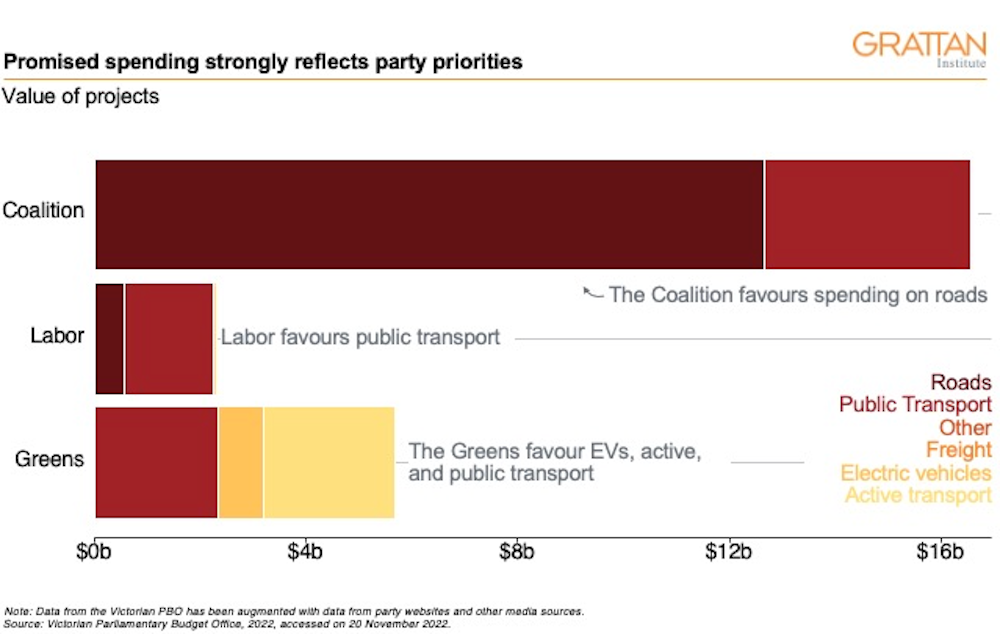
Interesting for its absence from Labor’s platforms is a focus on electric cars and bikes. The Coalition promises[24] to pause the distance-based charge for electric vehicles until 2027, at a cost of $82 million, and spend $50 million establishing 600 new electric vehicle charging stations across the state. The Greens want to[25] manufacture 3,000 electric buses, subsidise the purchase of electric cars, subsidise two-way chargers, fund more public chargers and ban petrol car sales from 2030; none of these policies have been costed. What’s the bet we’ll see a lot more action in this sphere in 2026?
Read more:
Australia could rapidly shift to clean transport – if we had a strategy. So we put this plan together[26]
In the end, this Victorian election campaign has turned out to be far less profligate than the last one. The promised spend is a small fraction of what it was in 2018 – but the quality of the promises is no better.
Voters should demand more. Whoever wins the election should commit to a transport program that focuses not so much on the political advantage to be had from dreaming up new projects as on rigorous business cases before – not after – the promise to invest.
References^ dizzy heights of 2018 (theconversation.com)^ Back in 2018 (theconversation.com)^ Suburban Rail Loop (bigbuild.vic.gov.au)^ Suburban Rail Loop (bigbuild.vic.gov.au)^ between $31 billion and $51 billion (bigbuild.vic.gov.au)^ $200 billion (pbo.vic.gov.au)^ redirect the $34.5 billion (www.matthewguy.com.au)^ Budget restraint? When it comes to transport projects, it's hard to find (theconversation.com)^ Barwon Heads Road duplication (bigbuild.vic.gov.au)^ North East Link (bigbuild.vic.gov.au)^ Airport Rail Link (bigbuild.vic.gov.au)^ three of the four largest projects (theconversation.com)^ Infrastructure Victoria (www.infrastructurevictoria.com.au)^ Infrastructure Australia (www.infrastructureaustralia.gov.au)^ 30-year strategy (www.infrastructurevictoria.com.au)^ $2 tram and bus fares (www.matthewguy.com.au)^ cap regional public transport fares (www.danandrews.com.au)^ Of Australia's 32 biggest infrastructure projects, just eight had a public business case (theconversation.com)^ upgrade the Melton line (static1.squarespace.com)^ $10 billion to road maintenance (vic.liberal.org.au)^ Big Bike Build (greens.org.au)^ feature of the federal election (theconversation.com)^ As federal government spending on small transport projects creeps up, marginal seats get a bigger share (theconversation.com)^ promises (vic.liberal.org.au)^ want to (greens.org.au)^ Australia could rapidly shift to clean transport – if we had a strategy. So we put this plan together (theconversation.com)
Author provided
Interesting for its absence from Labor’s platforms is a focus on electric cars and bikes. The Coalition promises[24] to pause the distance-based charge for electric vehicles until 2027, at a cost of $82 million, and spend $50 million establishing 600 new electric vehicle charging stations across the state. The Greens want to[25] manufacture 3,000 electric buses, subsidise the purchase of electric cars, subsidise two-way chargers, fund more public chargers and ban petrol car sales from 2030; none of these policies have been costed. What’s the bet we’ll see a lot more action in this sphere in 2026?
Read more:
Australia could rapidly shift to clean transport – if we had a strategy. So we put this plan together[26]
In the end, this Victorian election campaign has turned out to be far less profligate than the last one. The promised spend is a small fraction of what it was in 2018 – but the quality of the promises is no better.
Voters should demand more. Whoever wins the election should commit to a transport program that focuses not so much on the political advantage to be had from dreaming up new projects as on rigorous business cases before – not after – the promise to invest.
References^ dizzy heights of 2018 (theconversation.com)^ Back in 2018 (theconversation.com)^ Suburban Rail Loop (bigbuild.vic.gov.au)^ Suburban Rail Loop (bigbuild.vic.gov.au)^ between $31 billion and $51 billion (bigbuild.vic.gov.au)^ $200 billion (pbo.vic.gov.au)^ redirect the $34.5 billion (www.matthewguy.com.au)^ Budget restraint? When it comes to transport projects, it's hard to find (theconversation.com)^ Barwon Heads Road duplication (bigbuild.vic.gov.au)^ North East Link (bigbuild.vic.gov.au)^ Airport Rail Link (bigbuild.vic.gov.au)^ three of the four largest projects (theconversation.com)^ Infrastructure Victoria (www.infrastructurevictoria.com.au)^ Infrastructure Australia (www.infrastructureaustralia.gov.au)^ 30-year strategy (www.infrastructurevictoria.com.au)^ $2 tram and bus fares (www.matthewguy.com.au)^ cap regional public transport fares (www.danandrews.com.au)^ Of Australia's 32 biggest infrastructure projects, just eight had a public business case (theconversation.com)^ upgrade the Melton line (static1.squarespace.com)^ $10 billion to road maintenance (vic.liberal.org.au)^ Big Bike Build (greens.org.au)^ feature of the federal election (theconversation.com)^ As federal government spending on small transport projects creeps up, marginal seats get a bigger share (theconversation.com)^ promises (vic.liberal.org.au)^ want to (greens.org.au)^ Australia could rapidly shift to clean transport – if we had a strategy. So we put this plan together (theconversation.com)