Get ready, a spectacular meteor shower is hitting our skies in the next few days
- Written by: Jonti Horner, Professor (Astrophysics), University of Southern Queensland
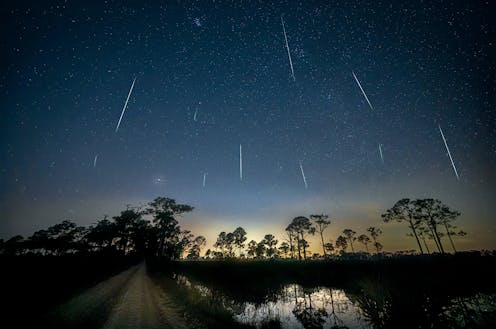
It’s the most wonderful time of the year… not because Christmas is coming, but because it’s time for the Geminid meteor shower – an annual spectacle to bring joy and good cheer to all!
The Geminids are the best meteor shower of the year – a reliable show that graces the heavens every December. Active for around a fortnight, the shower peaks on the evening of December 14.
This year, the Moon will interfere with the best view of the Geminids. Rising just before or around midnight (depending on where you live), its glare will wash out and hide the fainter members of the shower.
For a normal meteor shower, that would be the kiss of death – but the Geminids are so good that, even fighting the glow of the Moon, they can still put on a spectacular show.
So where (and when) should you look? And where do the Geminids come from?
Read more: Explainer: why meteors light up the night sky[1]
The Geminids are fragments of a rock comet
Our Solar System is full of debris, left behind from when the planets formed. That debris includes comets and near-Earth asteroids[2] – objects whose orbits around the Sun cross that of Earth itself.
Comets and asteroids are dirty beasts. They both have a tendency to shed dust and debris to space as they move around our star. The parent of the Geminids is an asteroid called 3200 Phaethon[3]; its extremely elongated orbit around the Sun[4] takes it in closer than Mercury, and out beyond the orbit of Mars. With each lap, the temperatures on Phaethon vary dramatically – from extreme cold (below -100℃) to extreme heat (above 750℃) and back again.
The result? The rocks on Phaethon expand and contract with the heat[5], fracturing and fragmenting, causing shards of debris to go out into space. Over thousands of years, that debris has spread around Phaethon’s orbit, creating a vast “tube”. We go through that debris each December as we move around the Sun, and it ablates[6] (often described as “burning up”, though no fire is involved) high in our atmosphere, giving birth to the Geminid meteor shower.
So where and when should I look for the Geminids in 2022?
For most of the fortnight the Geminids are active, their rates are low. At that time, Earth is passing through the outer regions of Phaethon’s debris stream, where the dust is widely spread.
But for around 24 hours, centred on the evening of December 14, Earth will be passing through the densest part of the meteor stream. That’s when the view will be best.
While Geminid meteors can appear in any part of the sky, all will point back to the same area. That region, in the constellation Gemini, is known as the shower’s “radiant”[7]. When the radiant is below the horizon, meteors from the shower are hitting the far side of our planet, and so no shower meteors will be visible.
The time at which the Geminid radiant rises is in the table below for cities around Australia. That marks the start of the show, and is a good time to head out and start getting adapted to the darkness.
In the first hour after the radiant rises, Geminids will be few and far between, but those that do appear have the potential to be spectacular. Entering Earth’s atmosphere at a very shallow angle, these “Earthgrazers” can appear to travel from horizon to horizon, an amazing sight[8].

As the hours pass, the show would normally get better and better, with the best rates visible in the early hours. This year, however, the waning gibbous Moon will rise roughly a couple of hours after the Geminid radiant. The moonlight will add glare to the night sky, hiding the fainter Geminids. Despite this, the show will continue to be spectacular – just a bit less so than in a normal year!
This year, the best time to observe might just be the hour or so before moonrise (and a little while after, when the Moon is still low in the sky). That’s a good time to lie back, relax, and gaze up at Mars – brilliant, red and brighter than the brightest stars in the night sky. This year, Mars will be a perfect guide to view the Geminids.
If you can relax and find Mars, and keep it roughly in the centre of your vision, you’ll be well placed to see plenty of Geminids. While the meteors can appear anywhere in the sky (always pointing back to the radiant), we’ve found that looking about 45 degrees from the radiant and about 45 degrees above the horizon seems to be the sweet spot to get the best display.
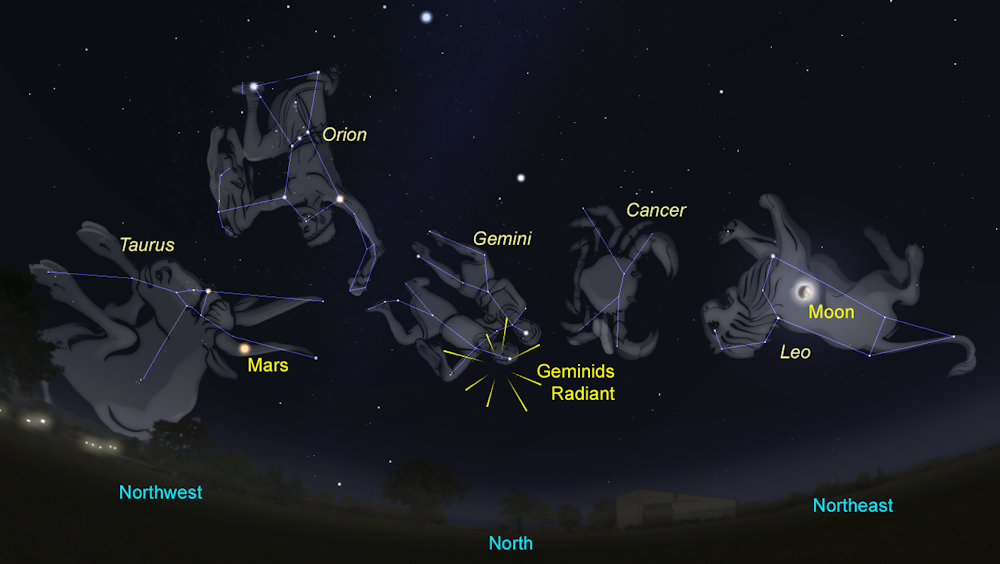 The Moon will brighten the sky during the early hours of December 15. By this time the Geminid radiant will be well placed in the northern sky, surrounded by famous constellations including Orion, the Hunter.
Museums Victoria/Stellarium
The Moon will brighten the sky during the early hours of December 15. By this time the Geminid radiant will be well placed in the northern sky, surrounded by famous constellations including Orion, the Hunter.
Museums Victoria/Stellarium
Find somewhere comfortable to relax, and enjoy the show. Remember, though, that meteors are a bit like buses. While you might hope to see 20 or 30 in the hour before moonrise (more, if you’re lucky), don’t expect them to fall as regularly as clockwork. You’ll wait ten minutes, then three will come along at once!
What if it’s cloudy? You might have better luck next year!
The Geminids are an annual spectacle – something wonderful to set your calendar by. If you miss the peak this year, all is not lost. The nights either side of the maximum (December 13 and 15) will still put on a decent show, albeit not as good as the maximum. If all three are lost to cloud, then let’s look forward to next year’s show. There’s good news there – in 2023, the Moon will be new, and won’t interfere at all.
In the meantime – fingers crossed for clear skies! Hopefully we’ll all get a good chance to see the best meteor shower of 2022. And if not, well, there’s always next year.
Read more: Explainer: why meteors light up the night sky[9]
References
- ^ Explainer: why meteors light up the night sky (theconversation.com)
- ^ near-Earth asteroids (www.jpl.nasa.gov)
- ^ 3200 Phaethon (en.wikipedia.org)
- ^ elongated orbit around the Sun (theskylive.com)
- ^ The rocks on Phaethon expand and contract with the heat (phys.org)
- ^ ablates (ui.adsabs.harvard.edu)
- ^ shower’s “radiant” (earthsky.org)
- ^ an amazing sight (www.cnet.com)
- ^ Explainer: why meteors light up the night sky (theconversation.com)