Despite government delays, food waste recycling bins are coming to your kitchen sooner than you think
- Written by: William Clarke, Professor of Waste Management, The University of Queensland
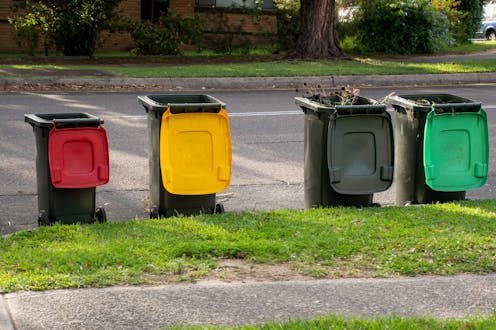
Only 24% of local councils[1] in Australia separately collect household food organics and garden organics (FOGO) waste. Another 16% provide garden waste collection only. This limited progress has prompted the federal government to push back the target date[2], from 2023 to 2030[3], for all councils to collect food and garden waste separately from landfill waste.
Most food waste currently goes into red bins as mixed waste bound for landfills. Kerbside collection of organic waste will become a standard service for all residents in New South Wales and Victoria by 2030[4], for metropolitan residents in South Australia and Western Australia by 2025 and for Canberra residents by 2023.
To achieve these targets, effective policies and incentives will need to be put in place for councils or private waste management companies. They will have to build and operate the infrastructure needed to process FOGO waste, and will want to recoup their costs.
Happily, this waste has increasing value as a source of both high-quality compost and biogas[5], which can be used like natural gas. The markets for these products, with gas prices in particular soaring, should help drive widespread adoption earlier than 2030.
Read more: Four bins might help, but to solve our waste crisis we need a strong market for recycled products[6]
Why collect this waste separately?
The rationale for diverting organic waste from increasingly limited[7] landfill space is clear. Collecting this waste separately reduces landfill impacts and costs, while delivering other environmental benefits.
Organic waste in a landfill will biodegrade slowly, eventually turning into biogas (methane and carbon dioxide). It can also produce organic acids that dissolve and mobilise heavy metals[8], creating a toxic hazard.
Modern landfills operate for decades. Waste is covered as it is placed, but only with soil until the landfill is full. Despite the use of multi-layer liners and impermeable final covers, these eventually deteriorate. In addition to harmful local environmental legacies of landfills, emissions of methane – a potent greenhouse gas – cause global harm.
In contrast, returning clean organic material to soils is beneficial. Australia’s arable soils are typically low in organic carbon, which needs to be regularly supplemented[9].
Read more: We need more carbon in our soil to help Australian farmers through the drought[10]
But, to produce high-quality compost, FOGO must be collected in a separate bin to avoid contamination. It’s possible to extract organic material from mixed (red bin) waste. This is done by grinding the waste and then using magnets, eddy currents, water flotation and air sorting to remove glass, plastic and metal fragments.
However, red bin waste is not closely monitored. It can contain batteries, electrical goods, paints and other sources of heavy metals in dissolved or fine-particle form.
This is why NSW banned the use on land of compost derived from mixed waste in 2019. A NSW EPA review[11] had identified cadmium, zinc and copper as metals of high concern in this compost. It also found chemicals such as flame retardants and disinfectants were household sources of persistent organic pollutants.
How much waste are we talking about?
The size and composition of the FOGO resource will change if Australia achieves the UN Sustainable Development Goal of halving the food waste generated per person by 2030, compared to 2015. The 2019 National Waste Policy and Action Plan[12] adopted this goal.
Estimates of food waste in Australia vary. The most comprehensive survey was a nation-wide audit in 2020 of 450 kerbside bins[13] by the Fight Food Waste Cooperative Research Centre[14]. It showed weekly food waste was 0.79kg per person, including 0.34kg of inedible peels, bones and expired or perished food. These households disposed of a similar amount of food waste in the home by composting, feeding to pets or flushing down the sink.
The United Nations Environment Programme’s 2021 estimate[15] is similar at 1.5-1.7kg of weekly food waste per person. The National Waste Database[16] estimate for Australia is higher at 2.37kg.
According to the database, 31% of food waste in NSW was separately collected and composted or digested in 2018-19. The figure was less than 10% in all other states except Western Australia, where it was 13%.
As for garden waste, 2.01kg per person each week[17] goes into kerbside bins. Over 50% of garden waste (85% in South Australia) is separately collected in all mainland states.
Read more: Why 'best before' food labelling is not best for the planet or your budget[18]
How can collection costs be covered?
The demand for organic carbon[19] in Australian soils far exceeds[20] the amount of compost that could be produced from FOGO. But, to tap into this market, the compost quality must be consistent.
A clear definition of acceptable FOGO and carefully controlled operations are needed to produce consistent quality compost. The waste management industry[21] and advice to government[22] have called for FOGO bins to be limited to food waste and garden waste, excluding materials like paper, cardboard and animal waste.
Many councils compost garden waste on open pads, some under cover. Machinery is used to shred and turn over the piles to control temperature and moisture levels.
The control of this process becomes more critical for FOGO. Food waste can be smelly, particularly if the composting process is open to the air but not adequately aerated.
Tighter control, particularly of odour, can be achieved if composting is done in vessels. Typically, these take the form of concrete tunnels[23].
High-quality compost for farming can fetch A$50 to $80 per cubic metre[24]. That makes separate collection and processing of bio-waste more attractive financially.
In addition, surging gas and electricity prices and the revival in value of renewable energy credits have increased the viability of first anaerobically digesting FOGO to produce biogas, then composting the digested material. FOGO can be digested in sealed tunnels similar to composting tunnels.
Read more: Capturing the true wealth of Australia’s waste[25]
This biogas will not solve Australia’s gas shortage (FOGO biogas could meet about 2% of the demand). However, I calculate, as a conservative figure, that the income to an anaerobic digestion operator would exceed $40 per fresh tonne of waste. This figure is based on a conservative methane yield of 50m³ per tonne, a wholesale electricity price of $200 per MWhr and a renewable energy credit value of $50 per MWhr.
All of these considerations indicate we should be confident almost all households will have a FOGO service before 2030. The alternative is to waste this resource in landfills, with all their future environmental liabilities.
References
- ^ 24% of local councils (experience.arcgis.com)
- ^ target date (www.dcceew.gov.au)
- ^ 2023 to 2030 (www.abc.net.au)
- ^ New South Wales and Victoria by 2030 (www.compostconnect.org)
- ^ biogas (www.climatecouncil.org.au)
- ^ Four bins might help, but to solve our waste crisis we need a strong market for recycled products (theconversation.com)
- ^ increasingly limited (www.dcceew.gov.au)
- ^ dissolve and mobilise heavy metals (doi.org)
- ^ regularly supplemented (www.aora.org.au)
- ^ We need more carbon in our soil to help Australian farmers through the drought (theconversation.com)
- ^ EPA review (www.epa.nsw.gov.au)
- ^ 2019 National Waste Policy and Action Plan (www.dcceew.gov.au)
- ^ 450 kerbside bins (fightfoodwastecrc.com.au)
- ^ Fight Food Waste Cooperative Research Centre (fightfoodwastecrc.com.au)
- ^ 2021 estimate (www.unep.org)
- ^ National Waste Database (www.dcceew.gov.au)
- ^ 2.01kg per person each week (www.dcceew.gov.au)
- ^ Why 'best before' food labelling is not best for the planet or your budget (theconversation.com)
- ^ demand for organic carbon (www.aora.org.au)
- ^ far exceeds (mraconsulting.com.au)
- ^ waste management industry (mraconsulting.com.au)
- ^ advice to government (www.agriculture.gov.au)
- ^ concrete tunnels (www.phoenixpower.com.au)
- ^ A$50 to $80 per cubic metre (www.soilwealth.com.au)
- ^ Capturing the true wealth of Australia’s waste (theconversation.com)