A message to anxious parents as 320,000 Australian children start school
- Written by: Kate Highfield, Senior Lecturer, Deputy Head of School (ACT and regional NSW), Australian Catholic University
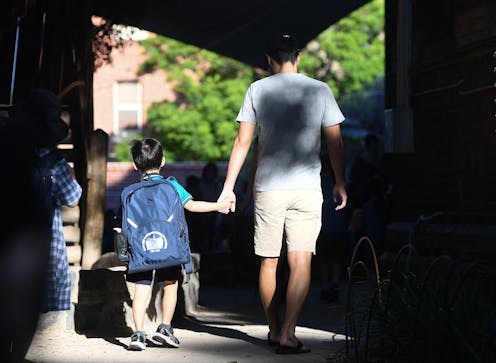
Around Australia, about 320,000 children[1] are starting school for the first time. As an early childhood researcher, former kindergarten teacher, and parent of a child beginning school on Monday, this transition fascinates me.
Culturally we place so much importance on this time. Everyone from the lovely cashier at the supermarket, to family, friends and neighbours have been eagerly asking my child, “are you excited about starting school?”
While people have good intentions, the question comes with the clear expectation that “starting big school” is a really big deal. And this puts a lot of pressure on the transition.
For parents, it also raises the question of how best we can prepare our children (and ourselves) for this time. The following tips may help.
Learning is ongoing, not a one-off
Research consistently shows[2] a positive start to school is linked to long-term benefits in education and wellbeing and helps avoid issues such as school avoidance and refusal[3].
Parents (me included) need to recognise children’s learning as a lifelong trajectory[4]. What happens in the first weeks of school will not determine your child’s success in life. Your. child will continue to build skills over the year and over their whole school experience.
It is easy to compare your child with others, but often this is unhelpful.
There will be some children starting school who can read, some who will know letters and sounds, and others who are just beginning in this area. Schools will be aware of this (and realistically, children do not need to be fluent readers at five or six).
Traditional thinking has been that all children should be able to do certain things before starting school, with a focus on “school readiness”. But this has been replaced with a new focus on schools being ready for all students, regardless of their diverse skills.
Communication matters
Ongoing, clear communication with our children about what to expect and how to manage is important.
This could include reminding our children of the pickup routine, or helping them talk about how (and who) to ask for help if they need it.
Read more: Is your child anxious about starting school? The approaches we use for children with disability can help all families[5]
Communication also matters with teachers. As parents, this is one key way we can support our children. Research shows family engagement[6] with teachers helps children learn and build confidence.
This means talking to the teacher about your child’s strengths and interests, but also outlining areas where they may need help. In suggesting this, launching into this discussion at drop-off on the first day might not be ideal. Instead, email the front office to set up a time or schedule an early parent-teacher meeting to talk.
Worry isn’t helpful, but instincts can be powerful
As parents, we have much we could worry about. Have we read enough books to our kids? Have they watched too much television? Does my child remember where the bathroom is at school? Will they behave? Should I have made them learn all the sounds of the alphabet? Will they drink enough water? The list is endless.
Sometimes our worries can be transmitted to our children. We need to take care to speak positively about school around our kids, to help to reduce anxiety[7] in our children.
But while worry can be unhelpful, parental instincts are important. In my time as a teacher I learned to listen to parents’ concerns, particularly around eyesight and hearing.
For example, if you are concerned that your child might not be seeing things as you share a book, or they don’t hear you unless looking at you, talk to your teacher. Early support is important for all areas of children’s health and development.
Transitions take time
Finally, transitions (especially once-in-a-lifetime ones like this) take time, so give yourself and your child time to settle in.
Read more: 5 tips to help ease your child back into school mode after the holidays[8]
Your child will have good days, bad days and OK days. So don’t worry if they don’t come home from school on the first day or week absolutely loving it, or having learned obvious new skills.
Helping our children acknowledge the challenge and seeing their growth is helpful (“wow, you’ve done a whole week at your new school!”).
This is not just about academic achievement. It can be about making friends, learning how to buy their lunch at the canteen or mastering the monkey bars.
References
- ^ about 320,000 children (ministers.education.gov.au)
- ^ consistently shows (read.oecd-ilibrary.org)
- ^ school avoidance and refusal (raisingchildren.net.au)
- ^ trajectory (www.learningtrajectories.org)
- ^ Is your child anxious about starting school? The approaches we use for children with disability can help all families (theconversation.com)
- ^ family engagement (www.edresearch.edu.au)
- ^ to reduce anxiety (theconversation.com)
- ^ 5 tips to help ease your child back into school mode after the holidays (theconversation.com)