Here's who decides cause of death, how death certificates work – and whether a person died with or of COVID
- Written by: Kathy Eagar, Adjunct professor in the School of Clinical Medicine, UNSW Sydney

COVID was Australia’s third leading cause of death[1] (after heart disease and dementia) in 2022. In a bad flu year[2] we have about 1,200 influenza deaths. We had more than 1,500[3] COVID deaths in just the first month of 2023. We need to take COVID seriously. It is not like a cold or the flu. It is an exceptional disease.
Because of the availability of vaccines and antivirals, there is no need for panic or further lockdowns. But there is no room for complacency either.
The starting point in taking COVID seriously is ensuring policymakers and the public have confidence in the data about who is getting sick and who is dying. Without accurate data, there is no way to track the disease or work out how best to contain it.
And a crucial part of this is ensuring people understand how death certificates work and how death data are recorded.

Read more: Thousands more Australians died in 2022 than expected. COVID was behind the majority of them[4]
Dying of COVID or with COVID?
A common misconception is that the numbers being reported are people who died with, not of, COVID.
Dying of COVID means COVID caused your death. Dying with COVID means you died from another cause, but just happened to have COVID at the time.
While we routinely collect data about both, a COVID death is when you die of COVID.
This misconception makes it easy to dismiss COVID deaths on the basis that the numbers being reported are exaggerated. Dismissing the numbers makes people complacent and lets governments off the hook. If we all pretend COVID is just a mild disease, there is no need for governments and individuals to do our bit to minimise its spread.
For most people whose vaccinations are up to date, COVID really is a mild disease. But about one in ten[5] people infected with COVID go on to develop “long COVID” and the number of COVID deaths just keeps increasing as the pandemic drags on.
How the system works
The cause of every death in Australia must be certified by a medical practitioner. If the cause of death is not clear, the death is reported to the state or territory coroner for a coronial investigation.
After the cause of death is determined either by a medical practitioner or the coroner, a death certificate is issued and sent to the bureau of births, deaths and marriages in each state or territory.
From there, the data are sent to the Australian Bureau of Statistics, which is the independent statutory agency responsible for national statistical reporting.
The death certificate
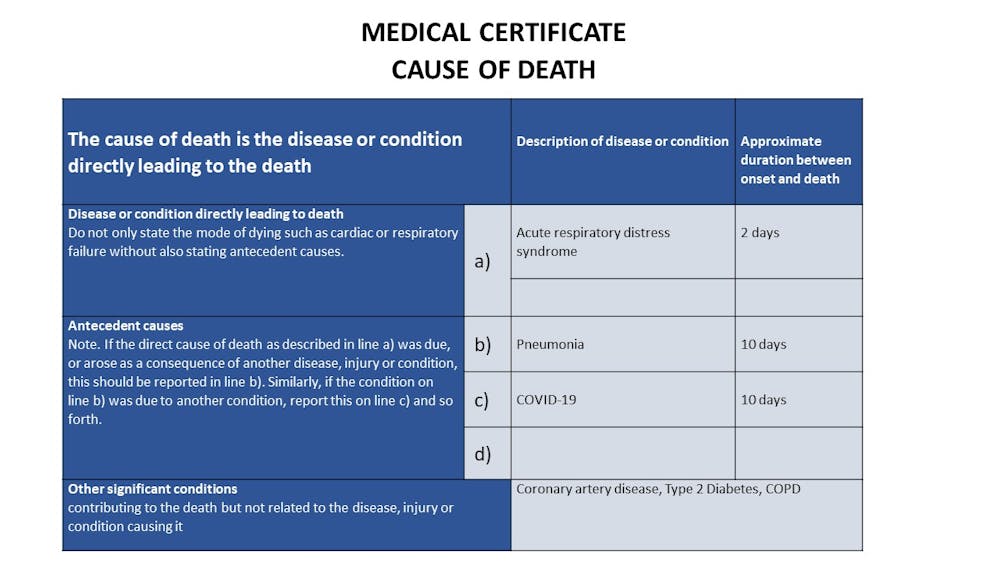
The death certificate[6] records the immediate cause or the condition that led directly to death. It also records what are called “antecedent causes”.
Antecedent causes are the underlying causes. These are the conditions or events that occurred before the immediate cause. All other significant conditions that contributed to the death but were not related to the disease or condition that caused it must also be reported.
So how does it work in practice? Imagine a family member dies of respiratory problems after having COVID. In this imaginary case, the direct cause of death is recorded as “acute respiratory distress syndrome”. The acute respiratory distress syndrome was due to pneumonia. In turn, the pneumonia was due to COVID. COVID is recorded as the antecedent cause of death. So the data may be recorded like this:
 Author provided
The way medical certificates are written is important. They give us quite accurate data on who dies of COVID (where COVID recorded as the direct or the antecedent cause) and who dies with it (COVID recorded as an “other significant condition”). We use both of these pieces of information for different purposes.
Professional judgment
While the cause of a person’s death is usually clear, this isn’t always the case. Sometimes doctors and coroners have to exercise their professional judgement in determining the cause of death.
But this is a long way from claims on social media that medical practitioners and coroners are systematically reporting deaths “with COVID” as deaths “of COVID” as a way to exaggerate the COVID death toll. This is simply nonsense.
There are often time delays between a person dying and their death certificate being issued.
This is particularly the case for deaths referred to the coroner for investigation. In the interim, health departments around the country need data in real time so they can track the pandemic. They compile provisional COVID cause of death data as they go and then progressively update their data as death certificates are finalised. While this causes the numbers to fluctuate a little from week to week, the data used in official statistics are of very high quality.
Australian clinical training, standards and documentation are excellent by all international standards. Australia has well developed systems in place for the accurate reporting of the causes of death and illness.
These systems should inspire confidence in the numbers and that medical practitioners and coroners are reporting COVID deaths correctly.
Read more:
'Died from' or 'died with' COVID-19? We need a transparent approach to counting coronavirus deaths[7]
References^ third leading cause of death (www.theguardian.com)^ bad flu year (www.abs.gov.au)^ 1,500 (covidlive.com.au)^ Thousands more Australians died in 2022 than expected. COVID was behind the majority of them (theconversation.com)^ one in ten (www.smh.com.au)^ death certificate (www.abs.gov.au)^ 'Died from' or 'died with' COVID-19? We need a transparent approach to counting coronavirus deaths (theconversation.com)
Author provided
The way medical certificates are written is important. They give us quite accurate data on who dies of COVID (where COVID recorded as the direct or the antecedent cause) and who dies with it (COVID recorded as an “other significant condition”). We use both of these pieces of information for different purposes.
Professional judgment
While the cause of a person’s death is usually clear, this isn’t always the case. Sometimes doctors and coroners have to exercise their professional judgement in determining the cause of death.
But this is a long way from claims on social media that medical practitioners and coroners are systematically reporting deaths “with COVID” as deaths “of COVID” as a way to exaggerate the COVID death toll. This is simply nonsense.
There are often time delays between a person dying and their death certificate being issued.
This is particularly the case for deaths referred to the coroner for investigation. In the interim, health departments around the country need data in real time so they can track the pandemic. They compile provisional COVID cause of death data as they go and then progressively update their data as death certificates are finalised. While this causes the numbers to fluctuate a little from week to week, the data used in official statistics are of very high quality.
Australian clinical training, standards and documentation are excellent by all international standards. Australia has well developed systems in place for the accurate reporting of the causes of death and illness.
These systems should inspire confidence in the numbers and that medical practitioners and coroners are reporting COVID deaths correctly.
Read more:
'Died from' or 'died with' COVID-19? We need a transparent approach to counting coronavirus deaths[7]
References^ third leading cause of death (www.theguardian.com)^ bad flu year (www.abs.gov.au)^ 1,500 (covidlive.com.au)^ Thousands more Australians died in 2022 than expected. COVID was behind the majority of them (theconversation.com)^ one in ten (www.smh.com.au)^ death certificate (www.abs.gov.au)^ 'Died from' or 'died with' COVID-19? We need a transparent approach to counting coronavirus deaths (theconversation.com)