Jetlag hits differently depending on your travel direction. Here are 6 tips to help you get over it
- Written by: Sally Ferguson, Director, Appleton Institute, CQUniversity Australia
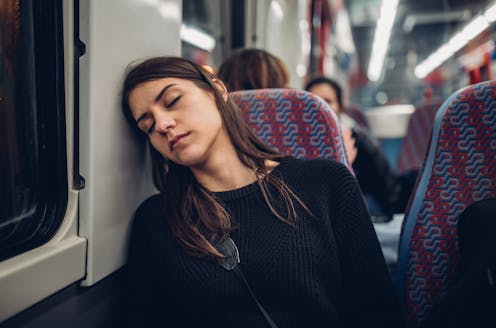
After a few difficult years of lockdowns and travel restrictions, people are finally winging their way across the globe again; families are being reunited and sights are being seen.
Yet the joys of international travel often come with a side of jetlag, which can make it hard to initially enjoy a holiday, and to settle in once you return home.
Why do people experience jetlag? And is there anything you can do to lessen its effects?
What causes jetlag?
The term “jetlag” describes the physical and cognitive symptoms people experience when travelling quickly across several timezones.
Before you leave for a trip, you’re synchronised to your local time. Once you enter a new timezone, your body’s rhythms are no longer lined up with the clock on the wall.
That’s when jetlag symptoms hit. You’re sleepy when you want to be awake, and wide awake when you want to be asleep. You’re hungry in the middle of the night, and might feel bloated or nauseous if you eat during the day.
Until your body clock and all the rhythms it controls line up with the new local time, you are physiologically and mentally discombobulated. Not a happy holiday vibe!
Jetlag isn’t the same for everyone
Interestingly, the experience of jetlag varies between people. That’s because we all tick along to our own internal rhythm.
Most of us have a natural daily cycle of about 24.2 hours. So if we lived in a cave and didn’t see any light, our sleep/wake cycle and other daily rhythms would tick along at about 24.2 hours. Researchers think this is an evolutionary adaptation[1] that allows us to adjust to different day lengths across the year.
Read more: Morning lark or night owl? How our body clocks affect our mental and physical performance[2]
But some people have slightly longer cycles than others, and this may play a role in how a person experiences jetlag.
Research suggests[3] if you have a longer cycle you might adjust quicker to westward travel, such as when travelling from Australia to South Africa, but we don’t know if a shorter cycle helps going the other way.
We also get a little less resilient as we age, so the older among us might have worse jetlag symptoms.
Does direction of travel matter?
More generally, many people find westward travel, where you “gain” time, a bit easier.
Say Jasmine and Sarah depart Adelaide at the same time. Jasmine lands in Perth in the afternoon, where it’s about 2.5 hours earlier in the day. She sees some sights and easily falls asleep at about 8.30pm local time. She then wakes up very early and starts her day.
Because Jasmine’s body clock naturally delays – shifting a little later relative to the local time each day – after a few days she is fully synchronised.
Sarah, meanwhile, lands in Auckland which is about 2.5 hours later in the day. She takes advantage of the balmy evening and some of the night, and is wide awake until 2am. She then struggles out of bed when the alarm goes off at 7am, because it’s still 4.30am on her body clock.
Sarah will likely feel the effects of jetlag more severely than Jasmine, and for longer.
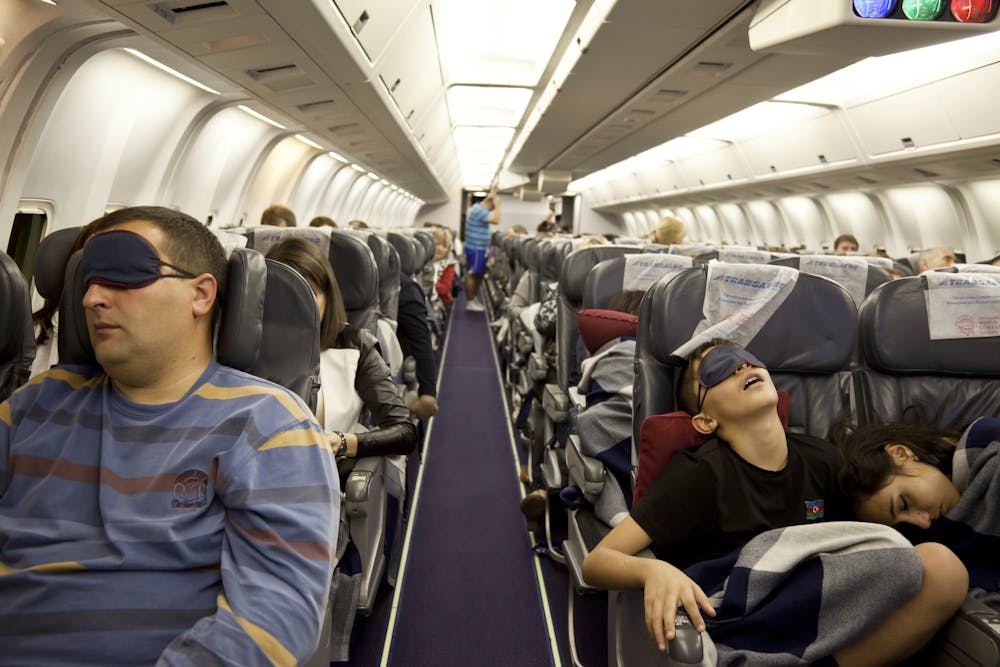
Is jetlag just ‘psychological’?
Some people might wonder if jetlag is just in your head. Well, in a way it is, because it’s a mismatch between your body’s internal time (which is determined in your brain) and your local time.
But that doesn’t mean you can talk yourself out of jetlag. It’s better thought of as a physiological condition, rather than a psychological one.
Luckily, there are a few simple ways to alleviate jetlag symptoms and help your body clock adjust. This is particularly important for elite athletes[4] who travel to compete.
First, decide whether it’s worth trying to adapt to the new time or not. If it’s only a short trip, it might make more sense to stay on your home time. If it’s longer than three days, start consciously moving your own rhythms – such as when you sleep, eat, exercise and get sunlight – towards the new timezone.
If you’re trying to shift your body clock, it’s a good idea to start on the plane. Set your watch to your destination’s timezone and line up your activities accordingly.
Keep caffeine and alcohol intake low on the journey. This will be better for sleep and hydration, and will help with adjusting your body clock to the new timezone.
When adjusting to a new timezone, try to sleep during the local night time and just rest when you need to at other times. Short naps can give you a boost to get through the day and evening activities. Aim for about 30 minutes and avoid naps later in the day as you near your actual planned bedtime.
Gastrointestinal discomfort is a symptom of jet lag. If you’re prone to or experience tummy trouble while travelling, stick to small meals and eat when you’re hungry. Your body will tell you when it’s ready for food. Tip 3 about caffeine and alcohol applies here too.
Get outside. Sunlight is key to adjusting to a new timezone. Depending on your timezone change, appropriately-timed outside activities[5] will help.
If that’s not enough, the Sleep Health Foundation has more tips here[6].
Read more: Is there such a thing as the perfect alarm tone? We think so (and this is what it might sound like)[7]
References
- ^ this is an evolutionary adaptation (royalsocietypublishing.org)
- ^ Morning lark or night owl? How our body clocks affect our mental and physical performance (theconversation.com)
- ^ Research suggests (journals.plos.org)
- ^ for elite athletes (link.springer.com)
- ^ outside activities (www.frontiersin.org)
- ^ here (www.sleephealthfoundation.org.au)
- ^ Is there such a thing as the perfect alarm tone? We think so (and this is what it might sound like) (theconversation.com)