Prince Harry's kill count revelation could spark important discussions about war's effects on soldiers
- Written by: L. William Uhl, Assistant Professor of Philosophy, United States Air Force Academy
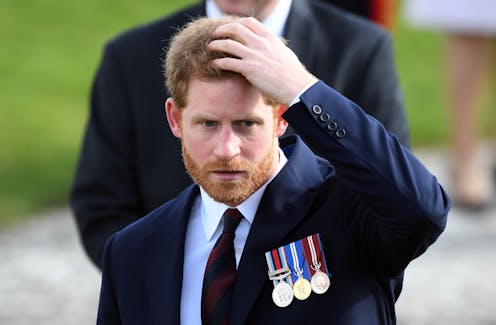
When Prince Harry revealed in his new book, “Spare[1],” that he killed 25 Taliban fighters as an Apache helicopter pilot, he compared their deaths to “chess pieces removed from the board.” His comments have drawn ire from critics, such as Anas Haqqani, a member of the Haqqani Network[2], which is an Afghan Sunni Islamist militant organization and part of the Taliban government of Afghanistan. Haqqani shot back that those slain fighters “were not chess pieces, they were humans; they had families who were waiting for their return[3].” But others have questioned whether Prince Harry should have spoken about his body count at all.
Here, L. William Uhl[4], an assistant professor of philosophy at the United States Air Force Academy, provides insight on what airmen are taught and told when it comes to the sensitive topic of taking lives in the line of duty.
1. How often do airmen have to discuss the kills they did in battle?
Reporting kills is actually a routine part of an airman’s duty. It comes up as part of what is called battle damage assessment. This assessment is necessary to determine how much of the enemy’s physical and functional capabilities remain.
Some airmen’s annual performance reports will include the number of enemy combatants they have killed. These numbers become part of these airmen’s permanent records and are used to demonstrate how they have contributed to their units’ missions. It is possible to determine how many have been killed, for example, if certain weapon imaging systems are used or enemy combatants are out in the open.
Prince Harry himself says, “So, my number: Twenty-five. It wasn’t a number that gave me any satisfaction. But neither was it a number that made me feel ashamed. Naturally, I’d have preferred not to have that number on my military CV [curriculum vitae], on my mind, but by the same token I’d have preferred to live in a world in which there was no Taliban, a world without war.”
It is one thing to destroy a facility and not dwell on the people inside, another to witness one or more deaths directly or through some form of imaging.
2. With whom should airmen discuss their kills?
After airmen deploy to combat areas, they are required to talk to counselors when they redeploy home. But I know from experience that sometimes they cannot wait until then.
While I was deployed to Baghdad International Airport in 2004 – one year after the overthrow of Saddam Hussein – Iraqi insurgents ambushed a convoy returning to Baghdad from Balad. During the firefight, American forces lost one captain but managed to kill some of the insurgents. A friend who was a chaplain told me that from the time these troops had returned to base, many had sought him out for counseling, even into the wee hours of the morning. They struggled with the realization that they had killed people in the performance of their duties.
3. Is there any reason not to disclose the number of kills during or after one’s service?
Richard Kemp, a former British Army colonel, has said that Prince Harry’s providing the number of kills could provoke attacks from the Taliban and their followers[5] on the United Kingdom. Tobias Ellwood, a member of Parliament and a former British Army captain, said that “there is the unwritten assumption[6] that nobody publicly discusses kill counts for the principal reason that it can have security repercussions.” They are responding not only to Prince Harry’s notoriety as a member of the royal family but also to his connections with the British military and the Invictus Games[7], the charity he launched to help wounded British service members recover from their injuries.
Few, if any, American service members will rise to Prince Harry’s level of notoriety. Nevertheless, while in service or after leaving the service, those who wish to publish their memoirs in one form or another should contact the public affairs office of their military branch for guidance. Memoirs about wars fought many decades ago, such as World War II, Korea or Vietnam, will most likely not raise as many security concerns as accounts about more recent conflicts.
Discussing numbers of people killed or thought processes about killing can elicit strong reactions from anyone, but especially from those who consider the United States and its allies to be the enemy. Without realizing it, active-duty service members and former service members who have left active duty since Desert Storm may put lives at risk by revealing information about current operations, weapon system capabilities or deployment locations.
4. How do service members view such disclosures?
When teaching my cadets about the moral issues of killing in war, I find that these young future officers wrestle with taking on the daunting responsibility: most people their age will never have to reckon with killing if called upon to do so.
In class I teach about what Michael Walzer refers to as “naked soldiers” in his book “Just and Unjust Wars: A Moral Argument with Historical Illustrations[8].” The book recounts five examples from World War I, the Spanish Civil War and World War II. In each example, a soldier refrained from killing an enemy soldier because he realized that the enemy soldier was just like him: another human being.
Upon discussing this book, many of my cadets have told me about conversations they have had with relatives who have seen combat. In most cases, my cadets say their relatives leave out the specifics of having killed or don’t talk about their combat experience at all.
In the first few years after the 9/11 attacks, some military units would show, for various purposes, videos[9] that were set to heavy metal music and contained footage from the weapon’s point of view as it was about to impact the target. I would say that these videos were a way of not only expressing Americans’ anger about the 9/11 attacks but also of motivating airmen to take the fight to the enemy.
Cadets I have recently taught have said that while they understood the purposes of the videos they have seen, they were bothered knowing that as these munitions zeroed in on their targets, people were only a few moments away from dying.
Each semester, cadets enrolled in our core philosophy course attend a lecture on an issue related to just war theory[10], a framework of ethics used to determine when it is permissible to go to war. In 2019, Karl Marlantes, a Marine lieutenant during the Vietnam War, spoke about what it was like for him to kill a young Vietnamese soldier at close range. He also spoke about what he has done “to make peace with his past[11].” I still recall the dead silence from the audience as they listened to Marlantes’ account.
5. Should Harry get some sort of consideration because of the public or media interest in his life?
Many people have criticized “Spare” because they believe that Prince Harry has revealed details about not only his own life but also royal family life that probably should remain undisclosed. In many instances, I tend to agree. But I also think that, given his notoriety, he addresses a very important question: How do service members maintain their moral integrity and well-being after having taken lives in the performance of their duties?
In “The Unseen Scars of Those Who Kill via Remote Control[12],” Dave Philipps discusses the stress that drone pilots experience. These pilots may observe targets for a long time before finally receiving the order to kill them. What bothers many of these pilots is that they come to see these targets as ordinary human beings with families. The difference is when their shifts are over, these pilots go home to their own families and do the very same activities they observed their targets doing with theirs.
References
- ^ Spare (princeharrymemoir.com)
- ^ Haqqani Network (foreignpolicy.com)
- ^ were not chess pieces, they were humans; they had families who were waiting for their return (www.yahoo.com)
- ^ L. William Uhl (www.usafa.edu)
- ^ provoke attacks from the Taliban and their followers (www.yahoo.com)
- ^ unwritten assumption (www.yahoo.com)
- ^ Invictus Games (www.royal.uk)
- ^ Just and Unjust Wars: A Moral Argument with Historical Illustrations (www.basicbooks.com)
- ^ videos (www.youtube.com)
- ^ just war theory (ethics.org.au)
- ^ to make peace with his past (groveatlantic.com)
- ^ The Unseen Scars of Those Who Kill via Remote Control (www.nytimes.com)