US is spending record amounts servicing its national debt – interest rate hikes add billions to the cost
- Written by: Gerald P. Dwyer, Professor Emeritus of Economics and BB&T Scholar, Clemson University
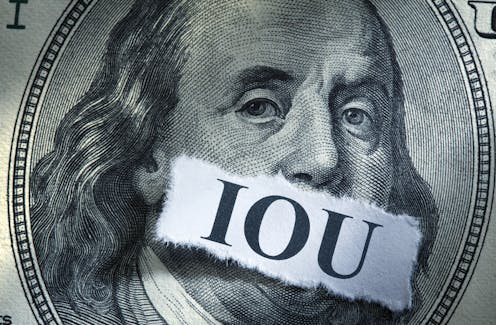
Consumers and businesses aren’t the only ones feeling the pain of higher borrowing costs[1] because of Federal Reserve rate hikes. Uncle Sam is too.
The U.S. government spent a record US$213 billion on interest payments on its debt in the fourth quarter, up $63 billion from a year earlier. Indeed, a jump of almost $30 billion on the previous quarter represents the biggest quarterly jump[2] on record. That comes as the Fed lifted interest rates a whopping 4.25 percentage points[3] from March through December.
As an economist[4], I am concerned that the effect of higher interest payments on the government’s budget is being ignored. Higher interest payments mean the federal government will either have to lower spending, raise taxes or issue more debt to service its obligations. And financing interest payments by issuing more debt could be a particularly poor choice – sooner or later, the bill will come due.
The national debt[5] – the amount the federal government borrows to balance the budget – increases when spending is greater than revenue and accumulates over time. As a general rule, it increases over time because of increases in spending, revenue and the deficit. Inflation tends to increase[6] government spending, as well as revenue and deficits. As a result, the dollar value of government debt increases in times of inflation. Debt also tends to grow as the economy gets bigger – although this is not inevitable as policymakers could choose to balance the government’s budget.
In this way, total government debt has climbed over the years[7] – by the end of 2022 it was 10 times larger than it was in 1990. It currently stands at over $31 trillion dollars[8] and represents more than 120% of the nation’s gross domestic product. GDP is the total annual amount of goods and services produced by a country and often is used to judge whether debt is high or low.
Since 1990, government debt has more than doubled[9] relative to the size of the economy – indicating that servicing debt could be quite a bit more of an issue than it once was.
A decade of record-low borrowing costs
But how concerning are these numbers? After all, it is not as if the government debt has to be paid off every year.
Government borrowing has some similarities to a person paying for an expensive item with a credit card, with the actual amount due to be paid off over an extended period. Just as with purchases on credit, interest is applied – and can add to the overall outlay. The federal government is different from consumers, though – it need not pay off its debt for the foreseeable future.
In terms of interest payments, the U.S. has been fortunate in recent years. Historically low interest rates[10] since the 2008 financial crisis[11] have held down interest payments. And just as low interest rates encourage would-be homeowners, for example, to take out a larger mortgage, they have also made it much more attractive for the federal government to borrow money to pay for whatever Congress and the administration want to finance.
But then came 2022. Soaring inflation[12] – which reached levels not seen in 40 years[13] – meant an end to the days of near-zero interest rates. To restrain inflation, the Fed raised rates seven times[14] in 2022, taking the base rate from near zero to a range of 4.25% to 4.5% at the end of 2022. It is expected that the Fed will raise rates by a further 0.25 percentage point[15] at its next monetary policy meeting starting Jan. 31[16]. Projections made by Federal Board members indicate that, with future increases, rates will average 5% or more in 2023.
Not all government debt, however, carries these current higher interest rates. Just as with typical U.S. mortgages, much of the government debt bears the interest rate applied when it was taken on. The difference is, unlike homeowners, the government does not pay off its debt. Instead it rolls over old debt into new debt – and when it does so it takes on whatever the interest rate is when the debt is rolled over. And when this happens and interest rates have risen, the cost of servicing the overall debt goes up.
There may be trouble ahead
The federal government’s interest expense has only begun to reflect the higher interest rates. The average rate the U.S. paid in 2022 was just over 2%[17], which is up from the 1.61% average in 2021 but still lower than it’s been over much of the past decade. But even so, the effect is being felt. Since the Fed began hiking rates, the U.S. government’s exposure to debt interest has climbed sharply.
It may all sound a little worrying, especially amid talk of a recession[18] – it is as if the interest on your credit card or mortgage suddenly jumped at a time when you were facing a possible cut in wages.
But there are some reassuring economic projections as well. Inflation declined substantially[19] in the second half of 2022 and appears likely to be under control. And there is good reason to think that interest rates of 4% – or even less – are in the U.S.‘s future, as well as in the Federal Reserve projections. Whether there will be a “soft landing” in the economy – that is, a slowdown that avoids a recession – is not so obvious. While it is not inevitable, many indicators point to a recession in 2023.
Either way, the days of borrowing trillions of dollars at near-zero interest rates to finance extravagant spending are over for the foreseeable future.
References
- ^ feeling the pain of higher borrowing costs (www.bloomberg.com)
- ^ biggest quarterly jump (fred.stlouisfed.org)
- ^ lifted interest rates a whopping 4.25 percentage points (www.federalreserve.gov)
- ^ an economist (www.clemson.edu)
- ^ national debt (theconversation.com)
- ^ tends to increase (www.pgpf.org)
- ^ debt has climbed over the years (fred.stlouisfed.org)
- ^ stands at over $31 trillion dollars (fiscaldata.treasury.gov)
- ^ government debt has more than doubled (fiscaldata.treasury.gov)
- ^ Historically low interest rates (fred.stlouisfed.org)
- ^ 2008 financial crisis (www.federalreservehistory.org)
- ^ Soaring inflation (www.economist.com)
- ^ reached levels not seen in 40 years (www.bls.gov)
- ^ Fed raised rates seven times (www.cbsnews.com)
- ^ the Fed will raise rates by a further 0.25 percentage point (www.forbes.com)
- ^ starting Jan. 31 (www.federalreserve.gov)
- ^ was just over 2% (fiscaldata.treasury.gov)
- ^ talk of a recession (www.cnbc.com)
- ^ declined substantially (www.cato.org)