I study how radiation interacts with the environment – and the capsule lost in WA is a whole new ballgame
- Written by: Madison Williams-Hoffman, PhD Candidate in Environmental Radioactivity, Edith Cowan University
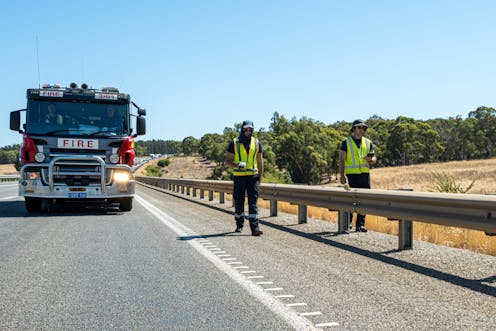
By now, you’ve probably heard about a tiny radioactive capsule that went missing from the back of a truck somewhere in Western Australia. Inside is a small but dangerous amount of Caesium-137, a radioactive chemical element that can harm both people and nature.
My research focuses on[1] detecting human-caused radioactive elements in the Australian environment.
These chemicals can persist[2] in water, soil, sediments, plants and animals, and even travel up food chains. But the situation of the lost capsule is unique. That makes it hard to predict the environmental damage it might cause.
Should the capsule not be found immediately, we can’t just write it off as lost. A long-term system of surveys and sampling will be needed, across a broad area, to monitor for radiation and protect humans and the environment.
Stay well away
The radioactive capsule fell from a truck somewhere along a 1,400-kilometre stretch of road between Newman and Perth. Authorities are now searching for it.
The device was part of a gauge[3] being used at a Rio Tinto mine in the Kimberley region and was being transported by a contractor.
It contained Caesium-137, a nuclear fission product used in high-tech equipment. The radioactive element is also a byproduct of nuclear weapons and reactors.
The lost device is tiny – just 6mm by 8mm. The Caesium-137 is contained[4] in ceramic material, which is then encased in a steel outer shell.
The capsule could eventually corrode when exposed to the elements.
People who come across the capsule could become seriously unwell, including developing burns, radiation sickness and, in the longer term, cancer. But plants, animals and ecosystems are at risk, too.
How might nature be harmed?
It’s well-documented[5] that caesium can accumulate in food webs.
The capsule was lost in a remote outback area. There, small animals such as insects and rodents could ingest all or part of the capsule, and suffer ill-effects. Plants can also absorb radiation.
If those animals or plants are then eaten by other animals, the radioactive caesium may travel up the food chain.
Research has found lower animal population sizes and reduced biodiversity in high-radiation areas. Radioactive caesium from Chernobyl, for example, can still be detected[6] in some food products today.
The damage caused by radiation varies depending on the type of radiation emitted, the amount of radiation present, and the ways a person or organism interacts with it. An animal that ingests the capsule, for instance, would suffer more harm than one that briefly walked past it.
My PhD research involves testing for radioactivity in the marine environment of the Montebello Islands off WA, where Britain conducted nuclear tests in the 1950s.
My colleagues and I discovered human-caused radioactive elements including Caesium-137. The elements exceeded “background” levels – in other words, the levels you could expect in the soil in a suburban backyard or in sand at your local beach.
We are currently seeking to understand if these levels pose a risk to people and nature, and how the radioactive elements move around the environment.
Read more: A tiny radioactive capsule is lost on a highway in Western Australia. Here's what you need to know[7]
The great unknown
WA authorities are searching for the lost capsule by trying to detect radiation from Caesium-137 in the environment. But this will not be easy.
The radiation was not dispersed over a large area, such as in a mushroom cloud following a weapons test. It was encased and condensed – though it may eventually escape the casing.
Working out what harm the radiation may cause is also difficult. The two most notable releases of Caesium-137 to date have occurred overseas, at Chernobyl[8] in Ukraine and Fukushima[9] in Japan. Both were large-scale releases from nuclear power plants – very different to the current situation in WA.
There have been smaller radioactive releases around the world. But most occurred in environments very different to Australia’s. We don’t have a great deal of information about how Caesium-137, and other radioactive elements, move through hot, arid environments such as ours.
How long will the radiation last?
This lost capsule is an entirely different ballgame to Caesium-137 releases in the past. Its radiation is currently 19 billion becquerels (a unit used to measure radioactivity). That is many orders of magnitude greater than what I’m dealing with at the Montebello Islands, for example.
If we apply what’s known as the exponential decay equation[10], in 100 years’ time the capsule’s radiation level will have fallen to about 1.9 billion becquerels. But even then it might still pose a risk to people or the environment.
Using the same equation, in 1,000 years, the radiation level will be about 1.9 becquerels. This might be too low for our current instruments to detect, and might not necessarily pose a significant safety hazard. However, the risk would still depend on many variables.
The long game
At the moment, the search for the lost capsule is in the acute phase. Let’s hope authorities find it soon.
If that doesn’t happen, the next step will be determining how to best keep looking for it.
The current resource-intensive searching – such as scouring highways on foot or slowly by vehicle – can’t go on forever. But if the capsule remains lost, ongoing sampling, surveys and monitoring is needed to protect people and the environment over the longer term.
Understandably, headlines about radiation accidents evoke public concern. But it’s important to stress that, if the device remains on the side of the road, the probability of a person stumbling across it by accident is very small.
Although unfortunately, the same can’t be said for wildlife.
Read more: Are bananas really 'radioactive'? An expert clears up common misunderstandings about radiation[11]
References
- ^ focuses on (www.ecu.edu.au)
- ^ persist (www.irsn.fr)
- ^ part of a gauge (www.reuters.com)
- ^ contained (www.facebook.com)
- ^ well-documented (www.sciencedirect.com)
- ^ still be detected (theconversation.com)
- ^ A tiny radioactive capsule is lost on a highway in Western Australia. Here's what you need to know (theconversation.com)
- ^ Chernobyl (www.oecd-nea.org)
- ^ Fukushima (link.springer.com)
- ^ exponential decay equation (mathworld.wolfram.com)
- ^ Are bananas really 'radioactive'? An expert clears up common misunderstandings about radiation (theconversation.com)