what happened when I watched Groundhog Day every day for a year
- Written by: Adam Daniel, Tutor / Lecturer in Film and Media Studies, Western Sydney University
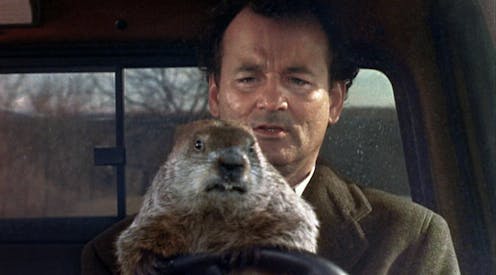
“What would you do if you were stuck in one place, and every day was exactly the same, and nothing that you did mattered?”
So asks time-stranded weatherman Phil Connors, played by Bill Murray, as he begins to come to grips with his predicament in the 1993 comedy classic Groundhog Day.
On February 2, while reporting on the annual Groundhog Festival in the quaint Pennsylvanian town of Punxsutawney, Phil becomes trapped in a time warp where he lives the same day over and over again.
In 2021 I was wrestling with the same question. Living in lockdown, I was feeling frustration, ennui, and like forward progress had ground to a halt. The circumstances created an opportunity to subject myself to a very unusual challenge: to watch the same film once a day, every day, for a year.
As a film scholar and cinephile, I wanted to find out how well a movie would sustain this kind of viewing and what a viewer might get out of the experience. Groundhog Day was the natural candidate.
On a Monday morning in September of 2021, I sat down on my couch and hit play.
Read more: When each pandemic day feels the same, Phil the Weatherman in "Groundhog Day" can offer a lesson in embracing life mindfully[1]
The act of watching
In the first month, my primary engagement was with the narrative.
Like many previous viewers, I found myself asking how long Phil was trapped in the loop for (my own approximation is 30 years, which sits between the 10 years offered by director Harold Ramis and the 10,000 years in the original screenplay by Danny Rubin).
I questioned the credibility of Rita (Andie MacDowell) falling in love with Phil having only known him for a day. I wondered how much of Murray’s performance was improvised (in Rubin’s words, some “colouring”[2] but proportionally less than is assumed).
Gradually, my familiarity with the narrative led me to shift focus. Rewatching became about exploration, as I sought to discover details the average viewer may have missed.
I began to notice the re-occurrence of certain extras from scene to scene, building my own narrative around their identities. I realised the boy in a wheelchair in the background of the hospital scene is the same boy Phil will eventually save from breaking his leg every day.
I consumed as much extra material on the film as possible. Rubin’s screenplay[3] and accompanying commentary, film critic Ryan Gilbey’s detailed monograph[4] and Harold Ramis’s commentary were all illuminating. I realise in hindsight that I was following my natural inclination as a scholar, to try to understand something more fully by diving more deeply into it.
And then I reached the doldrums.
Shifting perspectives
By the midway point, my viewing had shifted into a mode of cataloguing and memorisation. Phil Connors’ weather reports ran through my head unbidden, and I had built myself a mental map of Punxsutawney to the extent I felt like I could give directions to a visitor. I began to talk to the film as it played.
Some days, the viewing felt like a curse.
When Rita discovers Phil’s dilemma, she says: “Maybe it’s not a curse. Maybe it depends on how you look at it.”
My own shift in perspective came into play in the final three months. I found myself returning to the exploratory mode of viewing, encouraged by sharing and discussing theories with others who liked the film but who weren’t nutty enough to watch it hundreds of times.
New theories emerged.
I decided the bartender at the Pennsylvanian Hotel is clearly aware of Phil’s predicament (make note of his knowing looks and how quickly he serves them their favourite drinks), and that one of the Punxsutawney townspeople is clearly having an affair, as he can be seen visiting the Groundhog Festival with his wife and the banquet with his mistress.
I’m not the first to posit alternative readings[5] of the film, but I understood in my final stretch of viewing that a film can transform with us, revealing new layers from viewing to viewing.
Films as friends
In recent years, many scholars have examined the practice of repeat viewing, particularly with the emergence of technologies that provide flexibility to view when and where we like.
Film theorist Barbara Klinger suggests[6] familiar movies have the capacity to become our “friends” and she introduced the term “karaoke cinema” to describe the joy of deep familiarity and quotability, arguing this experience provides the audience with an element of both comfort and mastery.
My experience certainly affirms her claims. Watching Groundhog Day every day for a year provided me with a deeper appreciation for how a film may contain multitudes – particularly those we choose to willingly re-experience.
The legacy of Groundhog Day can be seen in the recurring appeal of the time loop narrative in TV shows and films such as Palm Springs, Russian Doll and Happy Death Day.
And, like every piece of worthwhile art, it can also sustain its own deep interrogation and reveal to the curious rewatcher its multifaceted layers and dimensions.
On reaching the finish line I was elated and celebrated with a final viewing on the big screen. I have a feeling it will be some time before I revisit the film, but it’s comforting to know it will be there when I’m ready, an old friend who welcomes visitors.
Read more: What Groundhog Day (and my time in a monastery) taught me about lockdown[7]
References
- ^ When each pandemic day feels the same, Phil the Weatherman in "Groundhog Day" can offer a lesson in embracing life mindfully (theconversation.com)
- ^ some “colouring” (www.reddit.com)
- ^ Rubin’s screenplay (howtowritegroundhogday.com)
- ^ detailed monograph (www.bloomsbury.com)
- ^ alternative readings (www.cbr.com)
- ^ suggests (www.ucpress.edu)
- ^ What Groundhog Day (and my time in a monastery) taught me about lockdown (theconversation.com)